A load that appears secure while a truck is stationary can become unstable under braking, cornering or sudden evasive manoeuvres.
Even a relatively small item can become lethal if it falls from a commercial vehicle at speed. A heavier load that shifts inside a trailer can affect steering, braking and vehicle stability, potentially causing a rollover or serious collision.
Load security is therefore not something that should be checked once and forgotten. It must be considered when the vehicle is loaded, before it leaves the yard and throughout the journey.
Who is responsible for securing the load?
Load security is a shared responsibility involving the vehicle operator, driver, loader and consignor.
The operator must provide a suitable vehicle, appropriate securing equipment and adequate training. The person loading the vehicle must position and restrain the goods correctly, while the driver must satisfy themselves that the vehicle and load are safe before travelling.
A driver should never assume that a load is secure simply because somebody else loaded it.
If the driver cannot inspect the load personally, the operator should have a reliable system confirming how it was loaded and secured. Where there is any doubt, the vehicle should not leave until the load has been checked.
Commercial pressure or an urgent delivery does not make an unsafe load acceptable.
Consider the forces acting on the load
A load does not have to fall from a vehicle to be dangerous.
When a truck brakes, the load will try to continue moving forward. During acceleration, it can move backwards. When the vehicle changes direction, the load can shift sideways.
The securing system must be capable of controlling these forces under normal driving conditions and during foreseeable emergency manoeuvres.
Drivers should pay particular attention to:
- heavy individual items;
- tall or top-heavy loads;
- cylindrical products that could roll;
- machinery with wheels or tracks;
- loose bags, boxes and parcels;
- stacked pallets;
- hanging meat or other suspended loads;
- bulk materials; and
- goods likely to settle or move during transport.
The centre of gravity should be kept as low as reasonably possible, with weight distributed across the vehicle without exceeding its permitted gross or individual axle weights.
Curtains are not always load restraints
One of the most dangerous assumptions in road transport is that closed curtains automatically secure the load.
On many curtain-sided trailers, the curtains are designed principally to protect goods from the weather. They should not be treated as the main method of restraint.
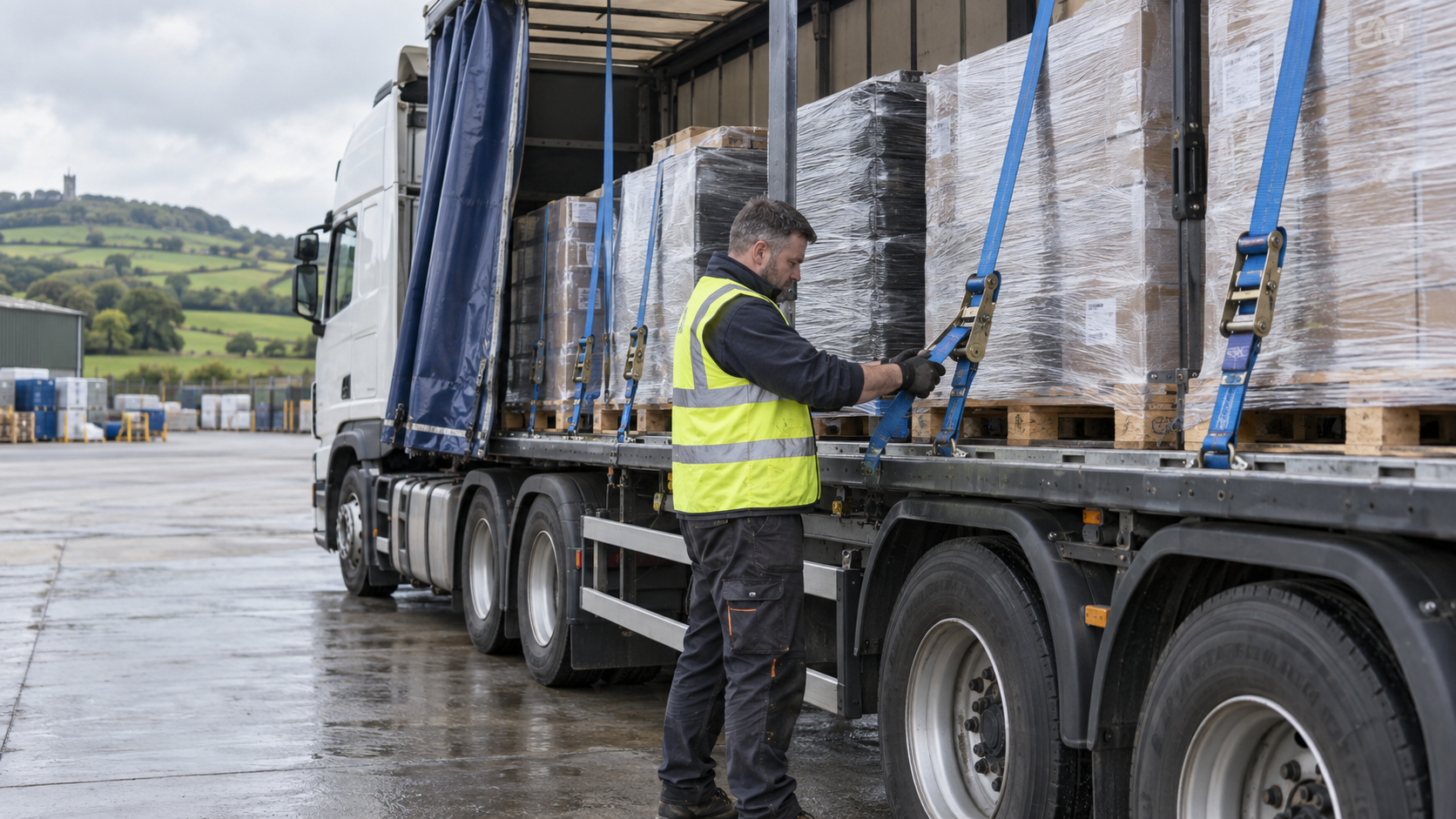
The load normally requires suitable straps, bars, nets or other securing equipment inside the trailer.
Some bodies are certified to recognised load-containment standards and may provide a defined level of restraint when used under specified conditions. However, that depends on the body specification, condition, loading arrangement and absence of excessive gaps.
Unless the operator and driver know that the body is designed and certified for the particular load, the curtains should not be relied upon to hold it in place.
Check the headboard and loading gaps
A strong headboard can help prevent forward movement, but only when the load is positioned correctly against it and the body is suitable for that purpose.
Large gaps between the load and the headboard allow goods to gain momentum before impact. Empty space between rows of pallets can create the same problem.
Gaps may need to be filled with suitable blocking, dunnage, pallets, airbags or other approved materials.
The load should never be arranged in a way that could place excessive force on doors, curtains or weak body panels.
Use the correct securing equipment
The equipment selected must be suitable for the weight, shape and nature of the load.
Common load-securing equipment includes:
- webbing straps;
- chains;
- tensioners;
- load bars;
- locking beams;
- nets and sheets;
- chocks and cradles;
- blocking materials;
- friction mats; and
- vehicle-mounted securing systems.
Every strap or chain should carry a legible label or marking showing its capacity. Damaged or unidentified equipment should not be used.
Inspect restraints for cuts, fraying, chemical damage, excessive wear, corrosion, distortion or damaged fittings.
Knots should not be tied in webbing straps because they can considerably reduce their strength. Straps should also be protected from sharp edges with suitable sleeves or corner protectors.
The vehicle’s lashing points must be strong enough for the intended restraint and should not be bent, cracked, badly corroded or obstructed.
Direct restraint versus friction
A strap thrown over the top of a load is not always sufficient.
Top-over lashings help by pressing the goods against the vehicle floor, increasing friction. Their effectiveness depends on the tension applied, the friction between the load and floor, and the angle of the straps.
Direct lashings work differently. They connect the load to the vehicle and resist movement in a particular direction.
Heavy machinery, plant and irregular loads may require direct lashings, chains, chocks or a combination of systems. Wheeled equipment should normally have its parking brake applied where possible and must be restrained against rolling as well as sliding.
Friction mats can improve grip but should form part of a properly designed securing system. They are not a substitute for adequate restraint.
Pallets and packaged goods
A pallet is a platform for handling goods—it is not automatically a securing device.
The products on each pallet should be stable and appropriately wrapped, banded or otherwise contained. The pallets must then be secured to prevent movement within the vehicle.
Drivers should look for:
- damaged pallets;
- leaning or unstable stacks;
- broken wrapping;
- crushed lower packages;
- excessive stacking height;
- unfilled spaces between pallets; and
- goods extending beyond the pallet edges.
A load that has settled during transport may require its restraints to be retensioned.
Machinery, steel and irregular loads
Heavy machinery, steel products, concrete items, timber and other concentrated loads require careful planning.
The vehicle and its loading platform must be suitable for the weight involved. The load should be positioned to avoid overloading individual axles, and appropriate cradles, chocks, chains or direct restraints should be used.
Attachments on machinery should be lowered, folded or secured. Loose tools, buckets, ramps and ancillary equipment must be restrained separately.
Drivers should never rely solely on a machine’s weight to keep it in position. A heavy object can still slide, roll or overturn under braking.
Check doors, tail lifts and ancillary equipment
Rear and side doors must be properly closed and locked before departure.
Drivers should check that:
- hinges and catches are secure;
- shutters are fully closed;
- tail lifts are correctly stowed;
- ramps are locked;
- curtain buckles and tensioners are fastened;
- roof supports are undamaged; and
- no strap or sheet is hanging loose.
Doors should be opened cautiously at delivery points. A shifted load may be resting against them and could fall without warning.
Recheck the load during the journey
Loads can settle as the vehicle travels, causing straps and chains to lose tension.
The securing arrangements should be checked after the initial part of the journey and again at suitable intervals. Additional checks are particularly important after:
- heavy braking or an evasive manoeuvre;
- travelling over rough roads;
- a ferry crossing;
- removing part of the load;
- adding another consignment;
- changing trailers; or
- discovering a loose curtain or unusual noise.
After a partial delivery, the remaining goods may need to be repositioned and secured again. The removal of one pallet can change the stability of the entire load.
What if the load is unsafe?
If a driver believes a load is insecure, the vehicle should remain stationary until the problem has been corrected.
The defect should be reported to the operator or transport manager. Additional restraints, different equipment or complete reloading may be required.
A visibly bulging curtain, leaning load, damaged restraint or unsecured item should never be ignored.
If a problem develops during the journey, the driver should stop at the first safe location. Attempting to open a curtain or door beside moving traffic may create an additional danger, so the situation must be assessed carefully.
The final pre-departure check
Before moving off, every driver should be able to answer yes to the following questions:
- Is the vehicle suitable for this load?
- Is the weight distributed correctly?
- Are the gross and axle-weight limits respected?
- Is the load stable in every direction?
- Are all straps, chains and fittings in good condition?
- Are the lashing points suitable and secure?
- Are gaps properly blocked or filled?
- Are machinery, pallets and loose equipment independently restrained?
- Are doors, curtains, ramps and tail lifts secured?
- Can the load be safely rechecked during the journey?
If the answer to any of these questions is no—or the driver is uncertain—the vehicle should not leave.
A secure load protects the driver, the operator and every other road user. Taking a few extra minutes before departure can prevent a roadside prohibition, damaged goods, an overturned vehicle or a fatal collision.
Further operator and vehicle-compliance information is available from the CVRT service.