European truck manufacturers are stepping up pressure on EU negotiators to ensure new weight and axle-loading rules do not leave battery-electric and hydrogen trucks carrying less freight than comparable diesel vehicles.
The European Automobile Manufacturers’ Association (ACEA) renewed its call on 29 October for an “ambitious” agreement on the revision of the EU Weights and Dimensions Directive. Manufacturers argue that the rules must compensate adequately for the additional weight of zero-emission powertrains if operators are to adopt them without sacrificing payload.
The revision is still being negotiated and has not become law. The European Commission presented its proposal in July 2023, while the Council adopted its negotiating position in December 2025. Technical discussions between the institutions continued during September and October 2026.
Gross weight is only part of the problem
The Commission proposed increasing the permitted weight of certain zero-emission combinations from 42 to 44 tonnes, alongside additional vehicle length to accommodate batteries, hydrogen tanks and improved aerodynamics.
However, manufacturers say a higher gross-combination limit will not solve the problem if individual axle limits prevent an operator from using that allowance.
The main dispute concerns two-axle, or 4×2, tractor units—the configuration widely used for European long-haul operations. Batteries and other zero-emission components can place additional weight on the tractor’s drive axle before the trailer is fully loaded.
ACEA argues that proposed compromises do not provide enough flexibility for these vehicles and could leave some electric trucks with a meaningful payload disadvantage. That is an industry claim, but it identifies a genuine operational question: a vehicle can be legal at 44 tonnes overall and still exceed an axle limit.
A technical submission circulated during the Council negotiations argued for increasing the maximum drive-axle load from 11.5 to 12.5 tonnes. It described 4×2 tractor-and-semitrailer combinations as representing roughly 75% of the relevant market. That proposal remains part of the negotiating debate rather than an agreed EU rule.
Why payload matters to Irish hauliers
For Irish operators, the consequences would depend heavily on the work being undertaken.
A payload penalty may have little effect on low-density or volume-limited freight. It becomes much more serious for businesses carrying beverages, food ingredients, agricultural products, construction materials or other dense loads.
- Every key deadline: diesel rebate, fuel excise, carbon tax
- Tick-box checklist for tacho, CVRT, CPC & operator licence
- Where drivers get caught at RSA roadside checks
If an electric truck must carry less freight, an operator may need additional journeys to move the same tonnage. That would increase driver hours, ferry movements, tolls and vehicle costs—potentially cancelling part of the environmental and operating benefit.
Consistent cross-border rules are also crucial. Irish international hauliers need confidence that a vehicle combination legal at home can operate through France, Belgium, the Netherlands and Germany without encountering different national interpretations or infrastructure restrictions.
The Council says its approach attempts to balance zero-emission payload needs against additional wear on roads and bridges. Its position supports weight allowances for zero-emission vehicles, but differentiates between vehicle and axle configurations rather than applying the same increase universally.
Operators need specification-level answers
The emerging lesson is that operators should not judge an electric truck solely by its headline range or maximum combination weight.
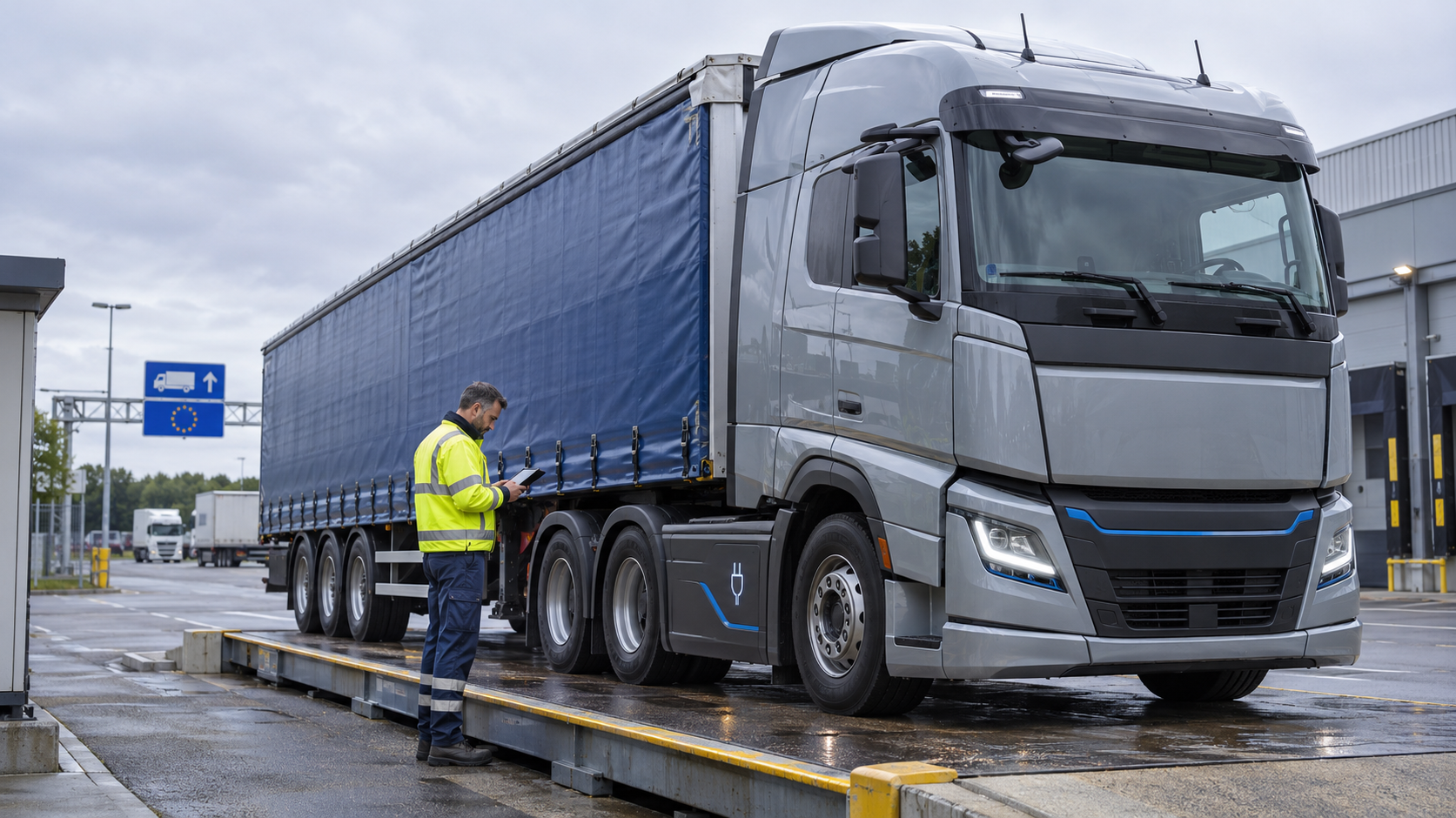
Before ordering, fleets need the vehicle’s precise unladen weight, front- and drive-axle loads, fifth-wheel position and usable payload with the required battery, cab and equipment specification. They also need confirmation that the combination is legal across every country on the intended route.
The political argument is now entering its decisive stage. Truckmakers want rules that make zero-emission vehicles commercially equivalent to diesel trucks; governments remain concerned about infrastructure damage and enforcement.
For Irish hauliers, the test of the final agreement will be straightforward: can a zero-emission truck carry the required load without adding another vehicle or journey?