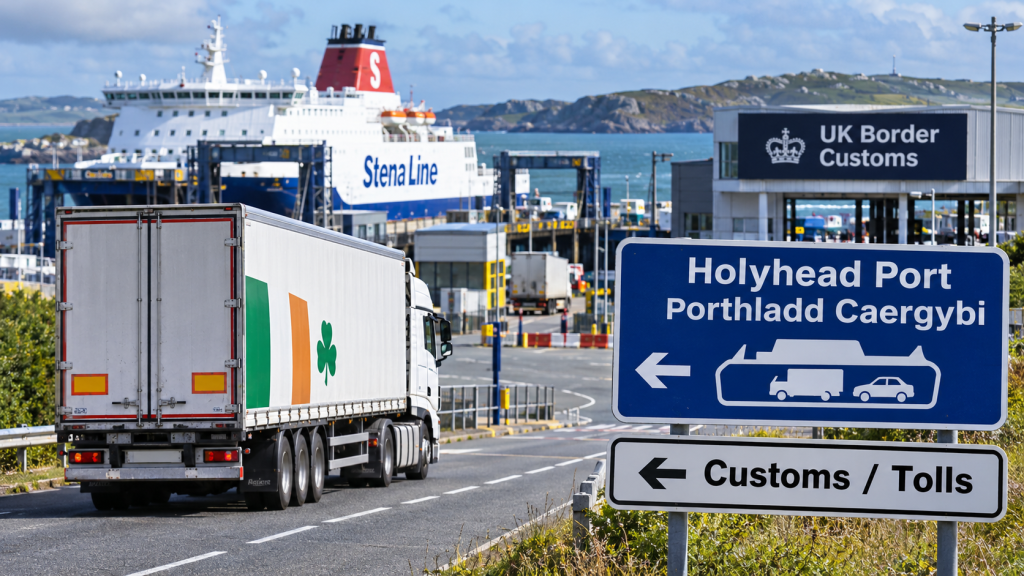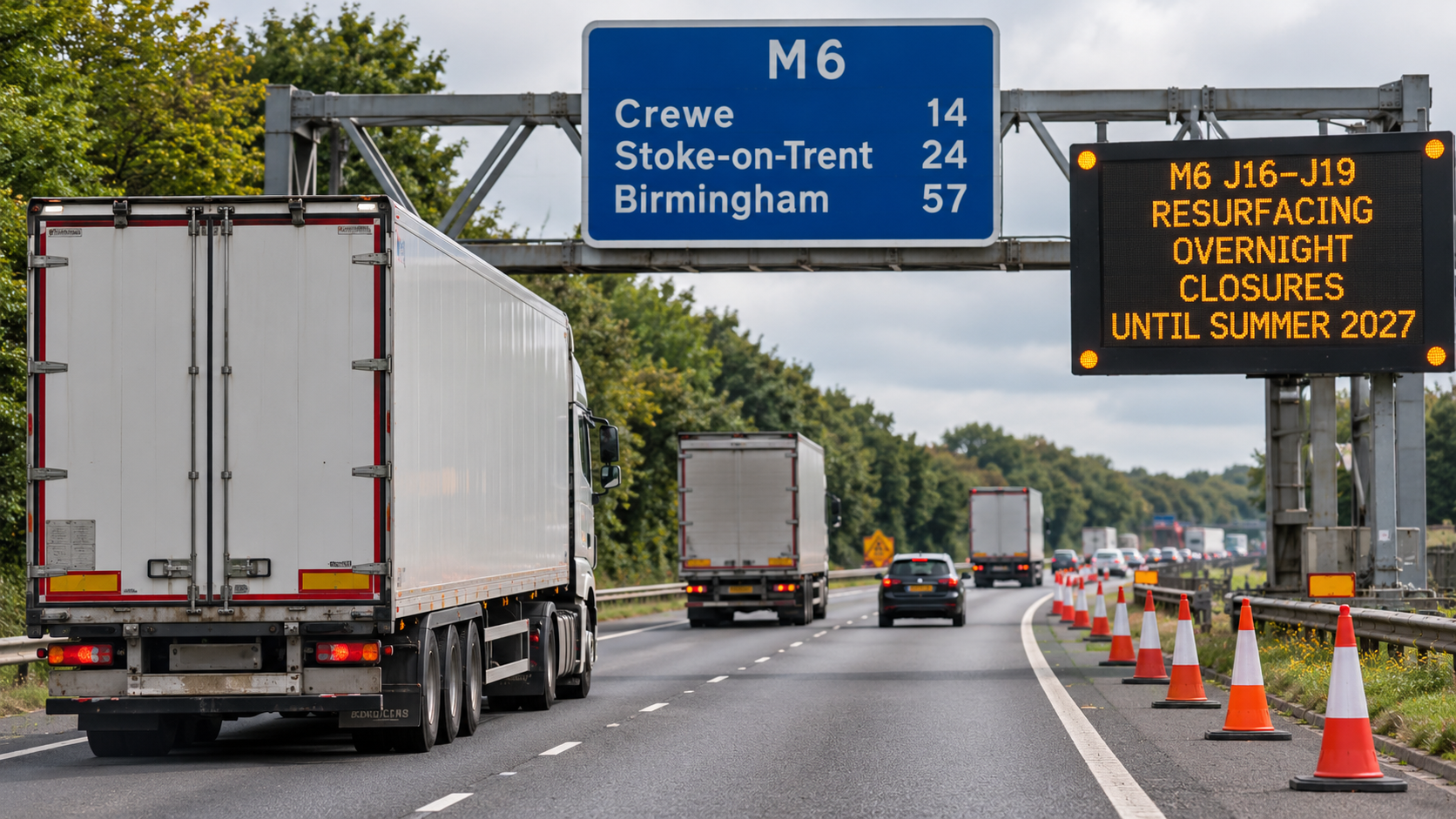
Irish hauliers travelling through north-west England are being advised to prepare for further disruption on the M6 motorway, with National Highways confirming an extensive resurfacing programme between junctions 16 and 19 that will continue until summer 2027.
The works, which began on 14 October 2026, cover a strategically important section of the motorway between Crewe and Knutsford in Cheshire.
The programme involves overnight lane and slip-road closures, potentially affecting Irish transport operators travelling between the Holyhead ferry port, the English Midlands, Manchester, northern England and Scotland.
With restrictions scheduled to remain in place for several months, transport managers will need to factor possible delays into delivery schedules, drivers’ hours and ferry connections.
Overnight restrictions between Crewe and Knutsford
National Highways has confirmed that the resurfacing programme will involve overnight lane and slip-road closures between 9pm and 6am.
The restrictions will apply on weekdays and weekends throughout the project, although the precise locations and arrangements may change as work progresses.
Where closures require diversions, alternative routes will be clearly signposted.
National Highways has not published a single fixed diversion route for the entire programme, meaning drivers and transport managers will need to check the latest restrictions before travelling.
The work is scheduled to continue until summer 2027, subject to operational requirements and weather conditions.
Important freight corridor for Irish hauliers
The M6 is one of Britain’s most important north-south freight corridors and is particularly significant for Irish hauliers using the Dublin–Holyhead ferry services.
For operators travelling from Holyhead towards the Midlands, the M6 provides access to major distribution centres, manufacturing facilities and logistics hubs.
It is also a key route for freight traffic heading north towards Manchester, Liverpool, Lancashire and Scotland.
The section between junctions 16 and 19 connects with several important regional routes, including the A500 at junction 16 and the A556 at junction 19, which provides access towards the M56 and Manchester.
Any restrictions along this stretch have the potential to affect journey-time reliability, particularly for operators working to tightly scheduled delivery appointments.
Ferry connections could come under pressure
For Irish hauliers, the timing of the resurfacing works is particularly significant.
Many transport operators schedule overnight journeys through Britain to maximise vehicle utilisation, meet early-morning delivery appointments or connect with ferry departures at Holyhead.
Lane restrictions and temporary slip-road closures between 9pm and 6am could therefore affect vehicles travelling during some of the busiest periods for long-distance freight movements.
Delays on the M6 could have consequences beyond the immediate journey.
An operator travelling south towards Holyhead may face difficulties meeting a scheduled ferry departure if motorway restrictions add unexpected time to the journey.
Missing a ferry sailing can result in additional waiting time, disruption to drivers’ schedules and delays to onward deliveries in Ireland.
Similarly, trucks arriving at Holyhead from Dublin and travelling onwards into England may encounter restrictions during overnight journeys.
- Every key deadline: diesel rebate, fuel excise, carbon tax
- Tick-box checklist for tacho, CVRT, CPC & operator licence
- Where drivers get caught at RSA roadside checks
For transport operators working with time-sensitive or just-in-time deliveries, even relatively short delays can create operational difficulties.
Further M6 works add to pressure on Irish operators
The resurfacing programme comes as National Highways continues a separate major maintenance project at the Thelwall Viaduct, between junctions 20 and 21 near Warrington.
That project involves replacing bridge joints and is scheduled to continue until winter 2027–28.
A 24-hour contraflow system is already operating at Thelwall, with a temporary 40mph speed restriction in both directions and additional overnight lane restrictions.
The combination of resurfacing works between Crewe and Knutsford and ongoing restrictions further north at Thelwall means Irish hauliers could encounter several areas of disruption during the same journey.
This is particularly relevant to operators travelling between Holyhead, Manchester, Lancashire and Scotland.
Although both projects are intended to improve the long-term condition and reliability of the motorway network, their overlapping schedules could create additional challenges for freight operators over the coming months.
Drivers’ hours and operating costs
For Irish hauliers, motorway disruption is not simply an inconvenience.
Additional journey time can affect drivers’ hours compliance, vehicle productivity, fuel consumption and delivery performance.
Where delays result in drivers approaching their permitted driving limits, transport managers may need to identify suitable stopping locations or adjust planned schedules.
There may also be implications for return loads and vehicle turnaround times.
Operators already facing substantial costs for diesel, insurance, wages, vehicle finance, maintenance and road tolls have limited scope to absorb further inefficiencies.
Repeated delays on important freight corridors can ultimately increase the cost of moving goods between Ireland and Britain.
Hauliers advised to plan ahead
Irish transport operators using the M6 between Crewe and Knutsford are advised to monitor National Highways updates and check planned closures before departure.
Particular attention should be given to overnight journeys and routes involving the M6, M56 and A556.
Transport managers should also consider allowing additional contingency time when scheduling deliveries or ferry connections.
Drivers should follow official diversion signs where slip roads or sections of the motorway are closed, rather than relying solely on satellite navigation systems.
With the resurfacing programme continuing until summer 2027, the restrictions are likely to remain an important consideration for Irish hauliers using the British road network.