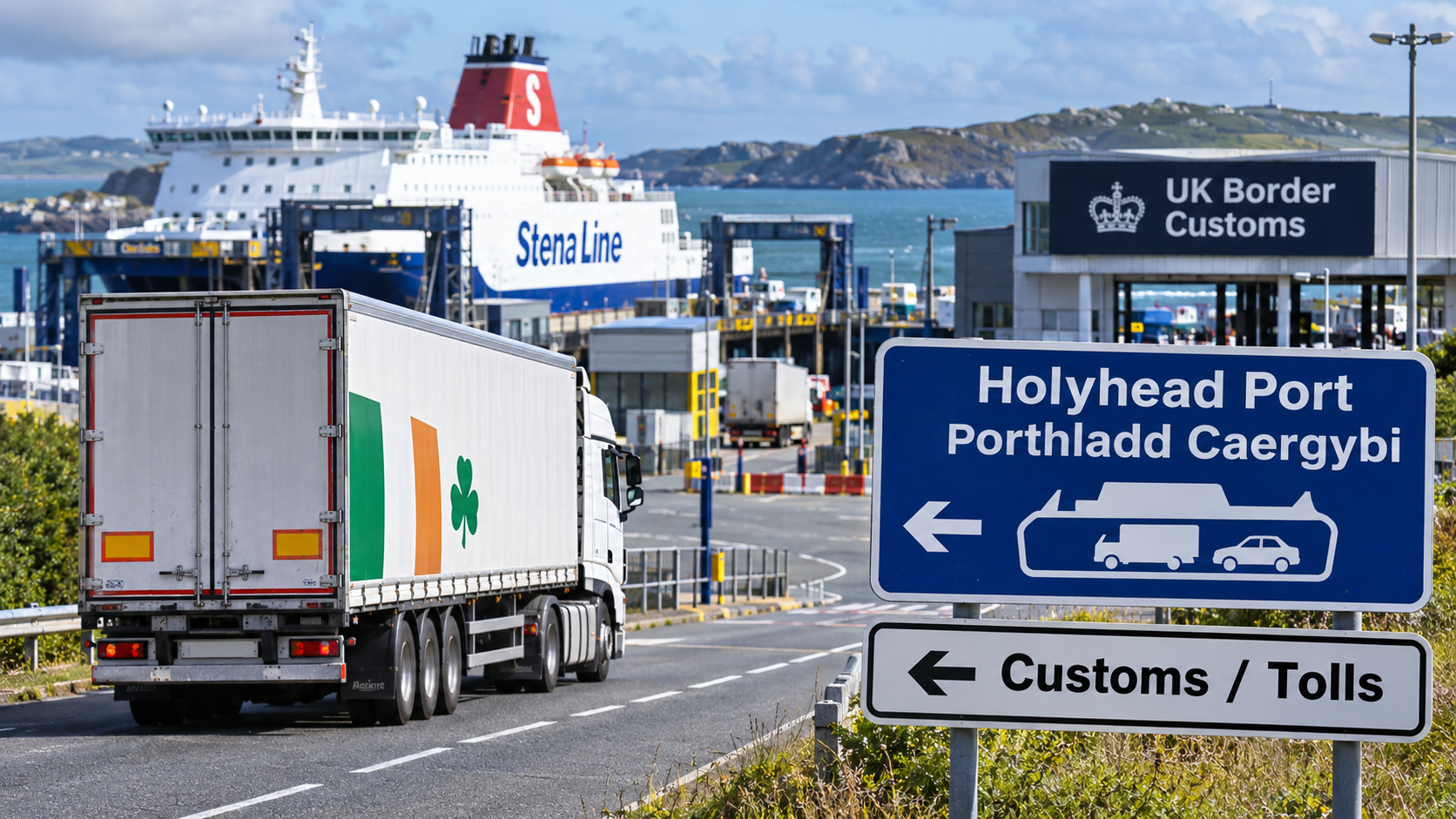
Irish hauliers using the busy Dublin–Holyhead freight corridor face changes to UK customs arrangements from early 2027, following confirmation by HM Revenue & Customs (HMRC) that border checks are expected to move from the existing inland facility to infrastructure within Holyhead Port.
The planned changes form part of a wider UK Government strategy to transfer responsibility for customs infrastructure from temporary, government-funded inland border facilities to port operators.
In guidance updated on 26 October 2026, HMRC confirmed that it intends to move customs checks currently undertaken through the Holyhead Inland Border Facility (IBF) to infrastructure provided by the port operator within Holyhead Port.
However, the precise implementation timetable and detailed operating arrangements have yet to be finalised.
For Irish hauliers, the announcement raises important questions about how customs inspections will be managed, whether vehicle movements through the port will change and what impact the new arrangements could have on journey times.
GOV.UK+1
Why Holyhead matters to Irish hauliers
Holyhead is one of the most important gateways for Irish road freight entering Britain, with regular ferry services linking the Welsh port with Dublin.
The route provides Irish transport operators with access to markets across Britain and forms an important part of the UK landbridge used by some operators travelling onwards to continental Europe.
For hauliers operating to tight delivery schedules, any changes to customs procedures can have significant operational implications.
Additional waiting time, altered vehicle routing or delays in completing customs formalities could affect drivers’ hours, delivery appointments and return ferry connections.
Equally, if the new arrangements allow customs inspections to be completed more efficiently within the port, they could potentially reduce unnecessary vehicle movements.
Much will depend on how the new facilities are designed and operated.
What exactly is changing?
Following Brexit, the UK Government established inland border facilities to provide additional customs capacity where ports lacked sufficient space to undertake the necessary checks.
These facilities were intended as temporary arrangements.
HMRC now plans to move towards the more established UK model, under which port operators provide the infrastructure required to support customs and border processes.
At Holyhead, this means customs checks are expected to move from the existing inland border arrangements to facilities within the port itself.
The Government has not yet published the final operating model, meaning important details about vehicle routing, inspection procedures and the capacity of the new facilities remain outstanding.
HMRC has stressed that there are no immediate changes to existing customs processes or requirements.
Hauliers should continue using the current Holyhead Inland Border Facility arrangements until further notice.
GOV.UK+1
Could the changes lead to delays?
One of the main concerns for Irish transport operators will be whether relocating customs checks into the port could create additional congestion.
Holyhead handles significant volumes of accompanied and unaccompanied freight, with vehicle movements closely linked to ferry arrival and departure schedules.
If customs inspections are carried out closer to ferry operations, adequate space and efficient traffic management will be essential.
Potential issues include queues for customs inspections, vehicle circulation within the port and the ability to separate freight requiring checks from vehicles cleared to continue their journeys.
However, it would be premature to suggest that delays are inevitable.
- Every key deadline: diesel rebate, fuel excise, carbon tax
- Tick-box checklist for tacho, CVRT, CPC & operator licence
- Where drivers get caught at RSA roadside checks
The new arrangements could also provide opportunities to streamline procedures and reduce the need for drivers to travel between separate customs locations.
The key question is whether the proposed infrastructure will have sufficient capacity to cope with peak freight movements.
Changes also planned for Dover and Eurotunnel
The Holyhead announcement forms part of a broader reorganisation of customs infrastructure at important UK freight gateways.
HMRC has also confirmed plans to transfer customs checks currently undertaken at the Sevington Inland Border Facility in Kent to alternative facilities provided by the Port of Dover and Getlink, the operator of Eurotunnel.
These changes are also expected from early 2027, although final implementation dates remain subject to confirmation.
Unlike Holyhead, HMRC has already outlined specific changes to the availability of transit services at Sevington.
Facilities for starting and ending transit movements will no longer be provided there once the transition takes place.
Traders will instead need to use facilities at the relevant border location, commercially provided Authorised Consignor or Authorised Consignee services, or appropriate transit simplifications.
This could be particularly relevant to Irish hauliers using the UK landbridge to reach European markets.
GOV.UK+1
What Irish hauliers should do now
Although the Holyhead changes are not yet operational, transport companies should begin reviewing their existing customs procedures.
Operators should consider:
- Checking which consignments currently require attendance at the Holyhead Inland Border Facility.
- Reviewing customs and transit arrangements with freight forwarders and customs agents.
- Monitoring HMRC announcements for confirmation of the new operating procedures.
- Ensuring drivers receive updated instructions before any changes take effect.
- Reviewing journey planning and ferry connections once the new arrangements are confirmed.
For companies operating through both Holyhead and Dover, the wider changes to UK transit facilities may also require a review of existing customs processes.
HMRC engaging with industry
HMRC says it will continue working with border operators, representative organisations and businesses as the transition progresses.
The department is encouraging affected businesses to engage with the relevant operators and participate in discussions about the future arrangements.
Hauliers and freight businesses interested in taking part in HMRC engagement sessions can contact transitpolicymailbox@hmrc.gov.uk.
Further details about the Holyhead arrangements and implementation timetable are expected as planning progresses.
GOV.UK+1
Another change for Irish Sea freight
For Irish hauliers, the planned Holyhead customs reorganisation represents another operational change in the post-Brexit trading environment.
While the objective is to establish a more permanent system of customs infrastructure, the success of the transition will depend on whether the new arrangements can accommodate freight traffic without creating additional costs or delays.
With early 2027 approaching, operators will be looking for clarity on inspection locations, vehicle routing, customs procedures and the timing of the changeover.
For now, existing arrangements remain in place.
The message for Irish hauliers is straightforward: there is no immediate requirement to change procedures, but operators using Holyhead should prepare for revised customs arrangements during 2027.