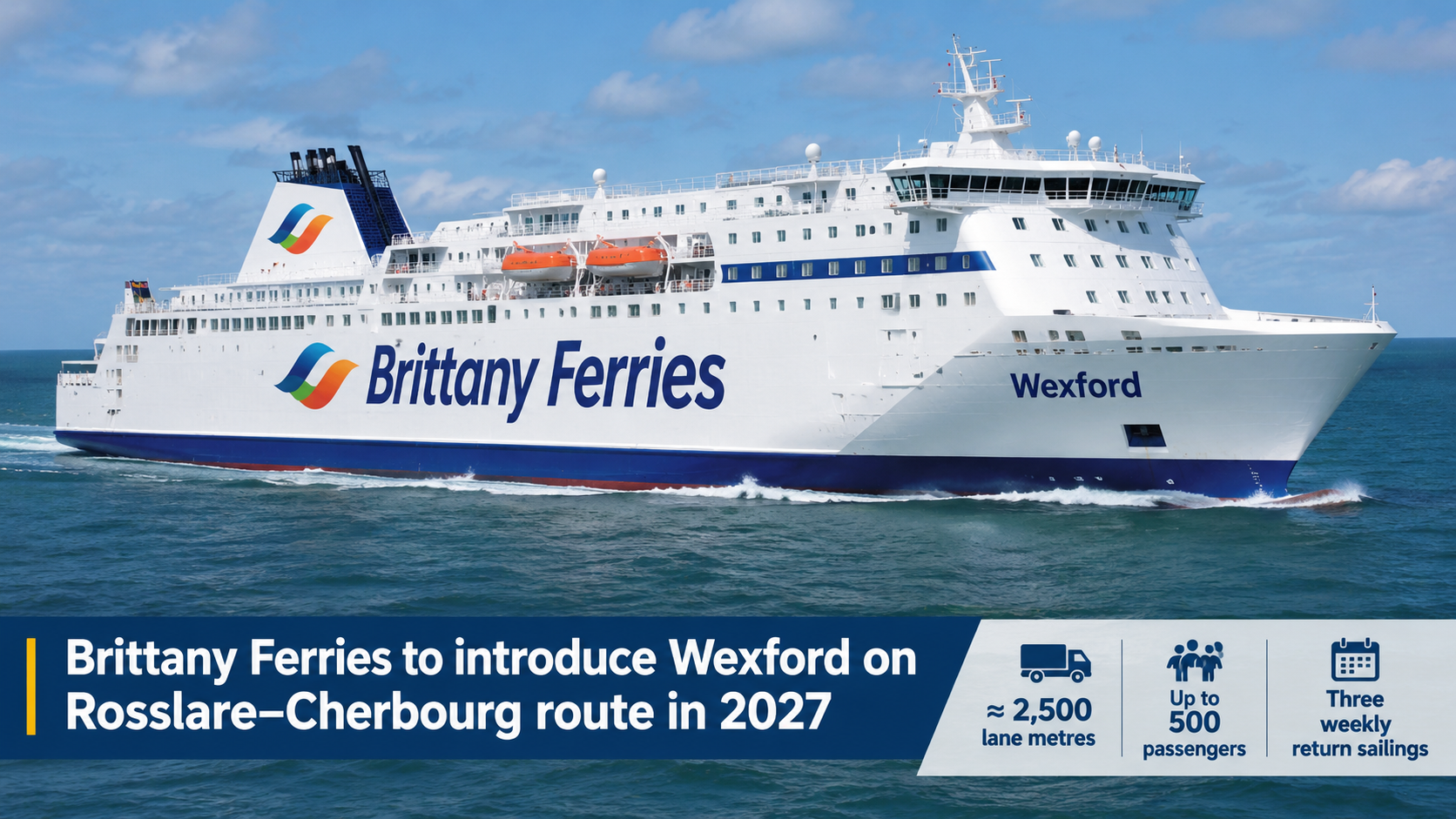
Brittany Ferries is set to strengthen its direct ferry services between Ireland and mainland Europe with the introduction of a new passenger and freight vessel, Wexford, on the Rosslare–Cherbourg route from March 2027.
The vessel, currently operating under the name Vizzavona, will be renamed Wexford and replace the freight-focused Norbay, which has been operating on temporary charter.
The new ship will operate three weekly return crossings between Rosslare Europort and Cherbourg in France, together with one weekly rotation between Portsmouth and Cherbourg.
For Irish hauliers and logistics operators, the introduction of Wexford represents another significant development in the expansion of direct shipping connections between Ireland and continental Europe.
Substantial freight capacity
Although Wexford is designed to accommodate both passengers and commercial vehicles, freight transport will remain an important part of its operations.
The vessel offers approximately 2,500 lane metres of vehicle capacity, providing considerable space for trucks, trailers and other commercial vehicles.
It can also accommodate up to 500 passengers, with 146 cabins and space for approximately 130 cars.
This represents a significant improvement in passenger accommodation compared with Norbay, which has more limited cabin facilities.
Importantly for the haulage industry, the new vessel will maintain substantial freight capacity while allowing Brittany Ferries to develop its passenger business on the route.
The ship will operate under the French flag and will be crewed by French seafarers.
Seven weekly Rosslare–Cherbourg crossings
The introduction of Wexford forms part of Brittany Ferries’ wider commitment to maintaining frequent and reliable direct services between Ireland and France.
The company’s planned 2027 network will provide up to seven weekly return crossings between Rosslare and Cherbourg, using a combination of vessels.
Brittany Ferries also plans to maintain two weekly return crossings between Rosslare and Bilbao in northern Spain, together with two weekly return crossings between Cork and Roscoff.
Five vessels are scheduled to serve the Irish market: Salamanca, Wexford, Clipper, Armorique and Pont-Aven.
The expanding network gives Irish transport operators greater choice when moving goods between Ireland, France, Spain and other European destinations.
Important alternative to the UK landbridge
For Irish hauliers, direct ferry connections to France have become increasingly important since Brexit.
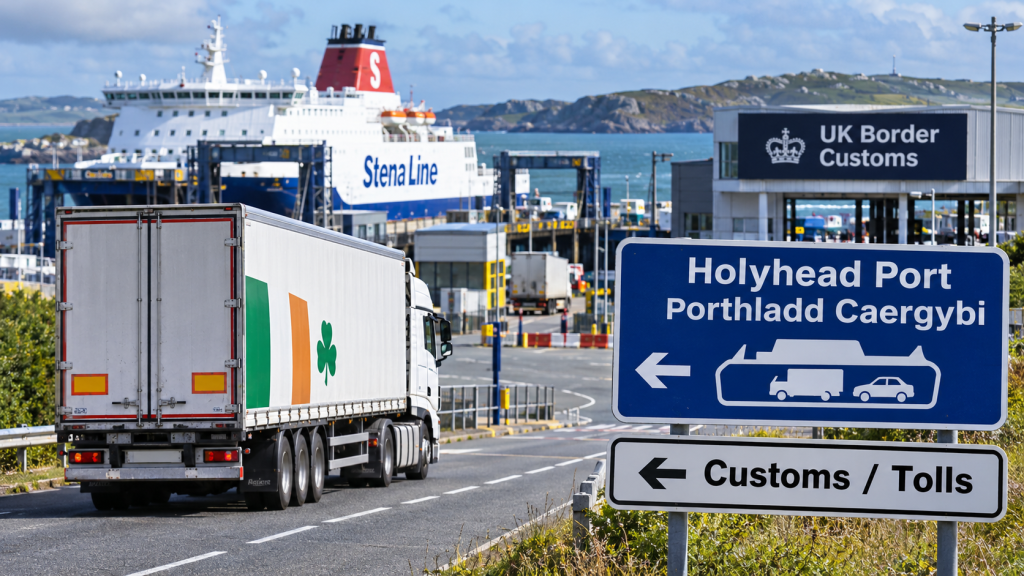
Traditionally, many operators transporting goods between Ireland and continental Europe relied on the UK landbridge, travelling through Britain before crossing the English Channel.
While that route remains important, direct services from Rosslare offer an alternative that avoids the need to transit Great Britain.
This can be particularly attractive to operators seeking to reduce exposure to UK border procedures, Channel crossing disruption and the additional administrative requirements associated with landbridge movements.
Direct ferry services can also provide opportunities for unaccompanied trailer operations, allowing transport companies to move freight without requiring drivers to accompany every trailer throughout the sea journey.
- Every key deadline: diesel rebate, fuel excise, carbon tax
- Tick-box checklist for tacho, CVRT, CPC & operator licence
- Where drivers get caught at RSA roadside checks
However, the commercial attractiveness of direct routes continues to depend on sailing schedules, freight rates, transit times and onward delivery requirements.
Greater certainty for Irish transport operators
The replacement of Norbay also provides a degree of longer-term certainty for freight customers using the Rosslare–Cherbourg corridor.
Norbay entered service with Brittany Ferries in March 2026 under a temporary charter arrangement designed to maintain freight capacity on the route.
At the time, Brittany Ferries emphasised the importance of reliable and consistent sailing schedules for hauliers and logistics businesses.
The introduction of Wexford represents the next stage in that commitment, with a vessel capable of serving both the freight and passenger markets.
Brittany Ferries Chief Executive Christophe Mathieu welcomed the development, describing the charter as a positive step for the company and the regions it serves in Ireland and France.
He also highlighted the importance of the company’s commitment to French-flagged vessels and French seafarers.
Rosslare’s growing importance as a European freight gateway
The announcement further reinforces Rosslare Europort’s position as an important gateway for Ireland’s international freight industry.
The development of direct European ferry services has given Irish exporters, importers and transport operators more options for reaching continental markets.
For operators based in the south and east of Ireland, Rosslare provides direct access to French ports and onward European road networks.
Cherbourg is particularly important because of its connections to the French motorway network, providing access to major logistics and distribution centres throughout France and beyond.
The arrival of Wexford in March 2027 should help maintain capacity on this important corridor while supporting the continued development of Ireland’s direct European freight links.
What it means for Irish hauliers
For Irish transport operators, the key benefits of the new vessel will be the continued availability of direct freight capacity, a regular sailing schedule and additional options for transporting goods between Ireland and continental Europe.
However, increased vessel capacity does not automatically translate into lower freight costs.
Operators will continue to assess ferry services on the basis of price, reliability, departure times, driver accommodation and the overall cost of completing international journeys.
With fuel, tolls, insurance and other operating expenses continuing to put pressure on margins, the availability of competitive ferry connections remains critical.
The introduction of Wexford is nevertheless a positive development for Irish road transport, reinforcing the importance of reliable direct sea connections to European markets.
As Ireland’s international freight requirements continue to evolve, investment in ferry capacity and route choice will remain essential to maintaining the competitiveness of Irish exporters and hauliers.