Air brakes are one of the most important safety systems on any heavy goods vehicle, yet many drivers only become concerned about the system when a warning light appears, air pressure drops or the truck develops a braking problem.
Understanding the basics of an HGV air brake system can help drivers identify developing faults earlier, improve daily vehicle checks and potentially prevent a breakdown—or something much more serious.
In this HGVIreland.com guide, we look at how truck air brakes work, what drivers should check and the warning signs that should never be ignored.
Why do HGVs use air brakes?
Heavy commercial vehicles require considerably greater braking capacity than cars and light vans.
Instead of relying solely on hydraulic fluid to transmit braking force, HGV braking systems use compressed air.
The vehicle’s engine-driven compressor produces compressed air, which is stored in reservoirs or air tanks. When the driver presses the brake pedal, the system controls the delivery of air pressure to the brakes.
Modern trucks also combine pneumatic braking with sophisticated electronic control systems designed to improve braking performance and vehicle stability.
Building air pressure
When a truck is started, the compressor builds pressure within the air system.
Drivers will normally see the pressure increasing on the vehicle’s dashboard gauges or display.
The vehicle should not be driven until sufficient operating pressure has been established and relevant low-pressure warnings have cleared.
If pressure takes unusually long to build, repeatedly fails to reach its normal operating level or falls unexpectedly, the cause should be investigated.
Listen for air leaks
One of the simplest checks a driver can make is also one of the most useful: listen.
With the vehicle stationary and the air system pressurised, an obvious hissing noise can indicate an air leak.
Air can escape from hoses, connections, valves, brake chambers and other components.
A small leak should not simply be dismissed because the vehicle still appears to brake normally. A deteriorating hose or fitting could become a much larger problem during a journey.
Any suspected defect should be reported through the operator’s defect-reporting procedure.
Don’t ignore the warning buzzer
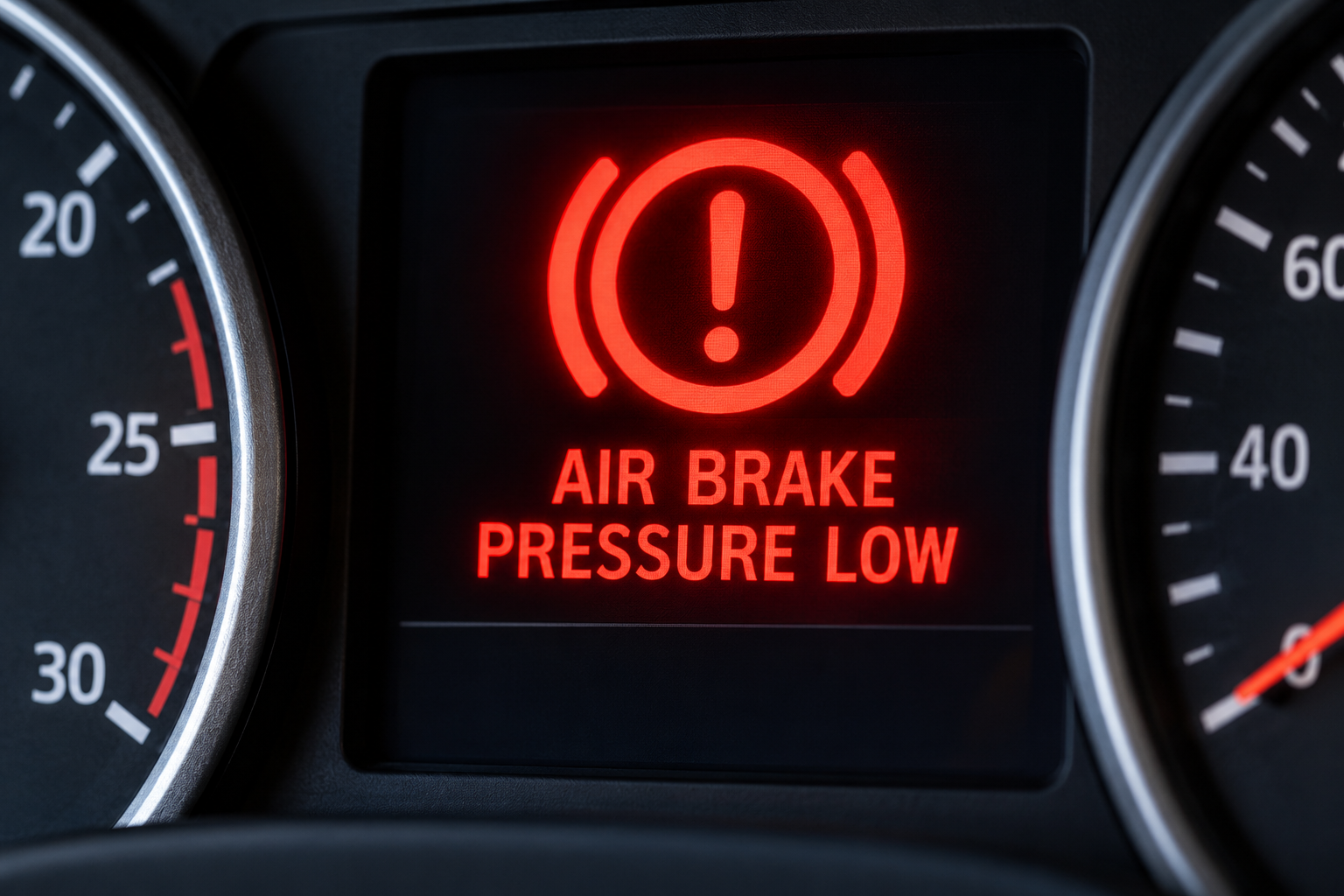
Low air pressure warnings exist for a reason.
Depending on the vehicle, the driver may receive dashboard warning lights, messages and an audible warning if system pressure falls below the required level.
A driver should never attempt to silence or ignore an air-pressure warning simply to complete a delivery.
Unexpected loss of air pressure can indicate a significant braking-system defect requiring immediate attention.
Check the tractor and trailer connections
The connection between tractor unit and semi-trailer deserves particular attention whenever trailers are changed.
Air lines must be correctly connected and should not be:
- damaged;
- badly kinked;
- excessively stretched;
- rubbing against other components;
- contaminated at the connections; or
- positioned where they could become trapped.
Drivers should check the condition of the couplings and ensure that all connections are secure before moving off.
After coupling a trailer, the driver should confirm that the trailer braking system is operating correctly as part of the complete coupling and vehicle safety procedure.
What happens if the trailer air supply fails?
Heavy vehicle braking systems are designed with safety features intended to deal with a loss of air pressure.
Spring brakes use powerful mechanical springs to apply braking force when sufficient air pressure is unavailable.
Compressed air normally holds these springs in the released position.
This means that loss of air does not simply leave the vehicle with no means of braking. However, an air-system failure remains a serious safety issue and must never be treated as something a driver can simply work around.
Drainage and contamination
Compressed-air systems can accumulate moisture and contamination.
Modern vehicles normally use air dryers and automatic systems to manage moisture, but these components still require appropriate inspection and maintenance.
Excessive water or oil contamination within the air system can indicate a problem requiring workshop investigation.
Maintenance schedules specified by the vehicle and component manufacturers should always be followed.
Brake performance can reveal developing problems
Drivers become familiar with how their own vehicle feels.
Changes in braking behaviour should therefore be taken seriously.
Warning signs can include the vehicle pulling to one side under braking, unusual noises, increased stopping distance, vibration, warning messages or a noticeable change in brake response.
The problem may not necessarily originate within the pneumatic system itself. Brake friction components, discs, drums, adjustment, tyres, suspension and electronic systems can all affect braking performance.
The important point is that a noticeable change should be investigated rather than ignored.
Don’t forget the trailer
A tractor unit can be maintained to an excellent standard while being connected to a trailer with a developing defect.
For operators running large trailer fleets—or collecting trailers belonging to customers or other operators—this is particularly important.
Drivers should include the trailer in their pre-use inspection regardless of who owns it.
Check tyres, wheels, lights, suspension, air lines and visible braking components as appropriate, and pay attention to warning lights or other indications of braking-system problems.
Never assume that a trailer is roadworthy simply because another driver used it earlier.
Electronic braking systems
Modern HGVs and trailers increasingly use Electronic Braking Systems (EBS).
EBS uses electronic signals and sensors to control braking more quickly and precisely than traditional pneumatic control alone.
It can work alongside systems such as ABS and electronic stability control.
While the technology is sophisticated, the rule for the driver remains straightforward: warning lights and fault messages should not be ignored.
A warning may indicate a sensor or electrical problem rather than complete loss of braking, but the fault still needs to be reported and assessed.
Air brakes and preventative maintenance
Brake maintenance should never be based solely on whether the vehicle appears to stop adequately.
Preventative maintenance can identify deterioration before it develops into a safety-critical failure.
Operators should ensure braking systems are inspected at appropriate intervals as part of their vehicle maintenance regime, with defects properly recorded and repaired.
Workshop staff should also investigate recurring driver reports rather than repeatedly clearing a warning without establishing its cause.
What drivers should check every day
The braking system forms an essential part of the daily vehicle inspection.
Drivers should pay particular attention to air-pressure warnings, visible damage to air lines, obvious leaks, tractor-to-trailer connections and any dashboard warning lamps.
The parking brake and service brakes should operate correctly, and the driver should remain alert to anything unusual when the vehicle begins moving.
A defect should be reported immediately.
Where there is any doubt about whether the braking system is safe, the vehicle should not enter service until it has been properly assessed.
Never take braking performance for granted
Air braking systems fitted to modern HGVs are highly developed and extremely reliable when correctly maintained.
But reliability depends on drivers and operators recognising problems early.
A hissing air line, slow pressure build-up or dashboard warning may appear inconvenient when a vehicle has a delivery deadline to meet.
Ignoring it can turn a relatively straightforward workshop repair into a roadside breakdown—or a serious safety incident.
For the professional driver, the basic rule is simple: build the pressure, watch the gauges, listen for leaks, check the connections and never ignore an air-brake warning.
A few minutes spent investigating a braking concern is always preferable to discovering the problem when the vehicle needs to stop.