Irish hauliers operating into Britain are being advised to check vehicle weights, maintenance records and journey plans before departure, as Driver and Vehicle Standards Agency (DVSA) inspections combine with major roadworks on the M6 freight corridor.
A roadside stop can result in fines, an immediate prohibition and missed delivery or ferry connections. At the same time, long-running works between Crewe, Knutsford and Warrington increase the risk of delays, particularly during overnight operations.
Check gross and axle weights before sailing
Compliance with the vehicle’s gross permitted weight does not necessarily mean every axle is legal. Poor load positioning can overload an individual axle even when the vehicle’s total weight remains within its limit.
Operators should verify:
-
Gross vehicle and train weights
-
Individual axle weights
-
Load distribution and security
-
Vehicle and trailer plated limits
-
The effect of fuel, pallets and equipment on final weight
If DVSA finds an overloaded vehicle, it can impose an immediate prohibition and prevent the vehicle from continuing until weight is removed or redistributed. The operator is responsible for arranging and paying for offloading, securing the removed goods and having the prohibition cleared.
Graduated penalties generally range from £100 for an overload below 10%, to £200 between 10% and 15%, and £300 at 15% or more. Serious cases can be referred to court.
An Irish driver without a satisfactory UK address may also have to pay an immediate financial-penalty deposit. Failure to pay can result in the vehicle being immobilised.
DVSA checks extend beyond overloading
DVSA officers may examine vehicle roadworthiness, drivers’ hours, tachograph records, load security and other operating requirements.
The agency’s April–June 2026 enforcement data recorded 603 weight checks on HGVs in its Great Britain category, with 152 overload prohibitions. Mechanical checks resulted in 858 prohibitions from 3,178 HGV inspections. These are targeted enforcement results and should not be interpreted as representing the condition of the entire British fleet.
- Every key deadline: diesel rebate, fuel excise, carbon tax
- Tick-box checklist for tacho, CVRT, CPC & operator licence
- Where drivers get caught at RSA roadside checks
Before sailing, operators should ensure that drivers can produce the required tachograph and transport documentation and that defects recorded during walkaround checks have been properly assessed and repaired.
M6 works threaten journey-time reliability
Britain-bound drivers must also allow additional time on the M6, a critical route linking Holyhead traffic with north-west England, the Midlands and Scotland.
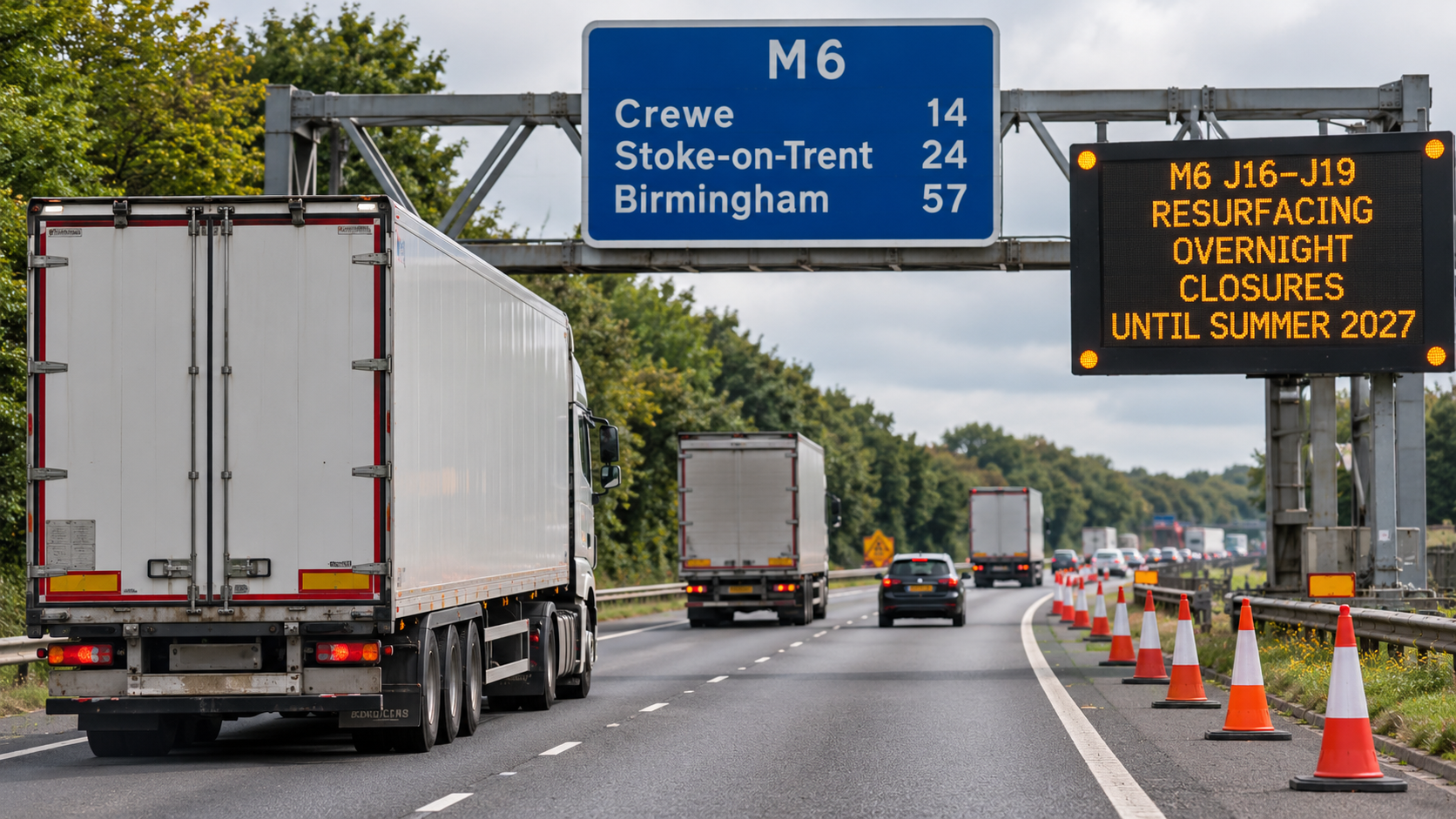
National Highways is resurfacing the M6 between junction 16 at Crewe and junction 19 at Knutsford. The programme runs from 14 October 2026 until summer 2027, with overnight lane and slip-road closures between 9pm and 6am.
Further north, the £27 million Thelwall Viaduct bridge-joint project between junctions 20 and 21 is scheduled to continue until winter 2027–28.
A permanent contraflow and 40mph restriction are in place. Four lanes are generally maintained in each direction during the day, but the northbound carriageway can be reduced to one lane between 10pm and 5am. Full overnight closures may require diversions through the M56, M60 and M62.
Build compliance and disruption into the journey plan
Transport managers should check live road restrictions before dispatch, add realistic contingency time and ensure drivers do not feel pressured to recover delays by reducing breaks or exceeding drivers’ hours.
For time-sensitive work, the safest approach is straightforward: confirm the weight before sailing, rectify defects before departure and plan the British leg around the M6 works. A few minutes spent checking at the depot could prevent a prohibition, an expensive roadside offload and a missed ferry home.