For decades, diesel has been the undisputed fuel of Ireland’s road haulage industry. It offers excellent range, rapid refuelling, an extensive infrastructure network and a proven ability to power trucks carrying heavy loads over long distances.
Leaving aside the the spiralling cost of road diesel, pressure on the industry to reduce carbon emissions is growing, and hauliers are increasingly looking beyond diesel for alternatives.
Battery-electric trucks are attracting considerable attention, while hydrogen continues to feature in discussions about the future of long-distance transport. Yet there is another technology that perhaps deserves more consideration: Compressed Natural Gas, or CNG.
For Ireland’s HGV sector, CNG is no longer simply an experimental alternative. There is now a growing network of refuelling stations, an increasing number of gas-powered trucks on Irish roads and, perhaps most importantly, access to renewable BioCNG.
The question is whether gas can realistically challenge diesel in the Irish HGV market.
A proven alternative
CNG is natural gas compressed to high pressure and stored in specially designed tanks on the vehicle. Modern gas-powered HGVs use dedicated engines and can operate in a very similar way to conventional diesel trucks.
The technology is well established internationally. Its attraction for commercial operators is relatively straightforward: quick refuelling, familiar vehicle operation and the potential for lower emissions.
Ireland’s CNG infrastructure has also developed considerably. Gas Networks Ireland currently reports 12 operational CNG stations — nine public and three private — with public stations strategically located in areas including Dublin, Cavan, Kildare, Limerick, Tipperary and Cork.
A typical public station can refuel between 50 and 80 HGVs per day, with an average fill taking around five to ten minutes.
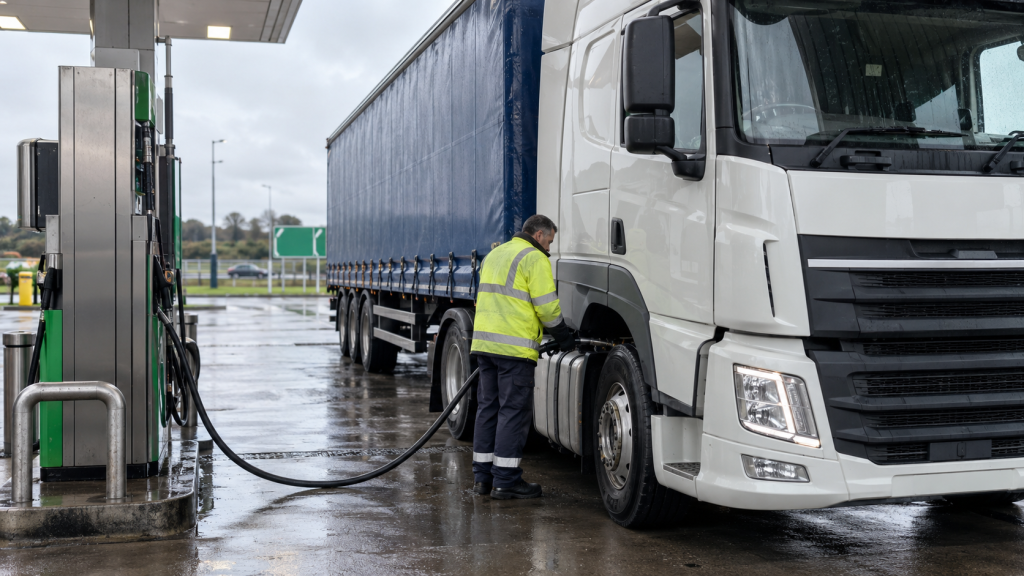
For a haulage operator, that is an important advantage. Unlike battery-electric vehicles, there is no requirement to leave a truck connected to a charger for an extended period. Refuelling can be incorporated into the normal working day.
The BioCNG opportunity
However, conventional fossil CNG is only part of the story.
The bigger opportunity for Ireland could be biomethane, used as BioCNG.
Biomethane is produced from organic material through anaerobic digestion. Feedstocks can include agricultural waste, food waste and other organic residues. Once processed, the resulting renewable gas can be used in CNG vehicles.
This gives CNG a potentially significant environmental advantage.
Gas Networks Ireland says switching from diesel to conventional CNG can reduce carbon emissions by up to around 20%, while switching to renewable BioCNG can reduce HGV carbon emissions by up to 90%.
That changes the conversation considerably.
A gas-powered truck does not necessarily have to remain dependent on fossil natural gas throughout its working life. As more renewable biomethane becomes available, the same basic vehicle technology and fuelling infrastructure can be used with a lower-carbon fuel.
In other words, the truck doesn’t necessarily need to change for the fuel to become cleaner.
Ireland’s biomethane industry is developing
This is particularly relevant because Ireland is beginning to build a domestic biomethane industry.
Gas Networks Ireland says biomethane has been flowing into the Irish gas network since 2019. The Government’s National Biomethane Strategy has also established a framework intended to accelerate the development of anaerobic digestion and renewable gas production.
Investment is now beginning to appear on the ground.
A new €50 million biomethane facility in Monasterevin, Co. Kildare, is under development and is expected to produce up to 100 GWh of renewable biomethane annually. Meanwhile, a new €80 million facility at Little Island in Cork is expected to become operational in 2027 and will process approximately 90,000 tonnes of food and garden waste annually.
For the transport industry, this matters.
Ireland could potentially create a more circular transport-fuel model in which agricultural and food waste is converted into renewable gas, which is then used to power commercial vehicles.
That is a considerably more compelling proposition than simply replacing diesel with fossil natural gas.
The economics matter
For any haulier, however, environmental arguments only go so far.
The business case has to work.
A new HGV represents a substantial investment, and gas-powered trucks can carry a higher initial purchase price than their diesel equivalents. The operator therefore needs to look at the complete cost of ownership.
Fuel cost, maintenance, vehicle utilisation, residual value, refuelling infrastructure and available grants all become important.
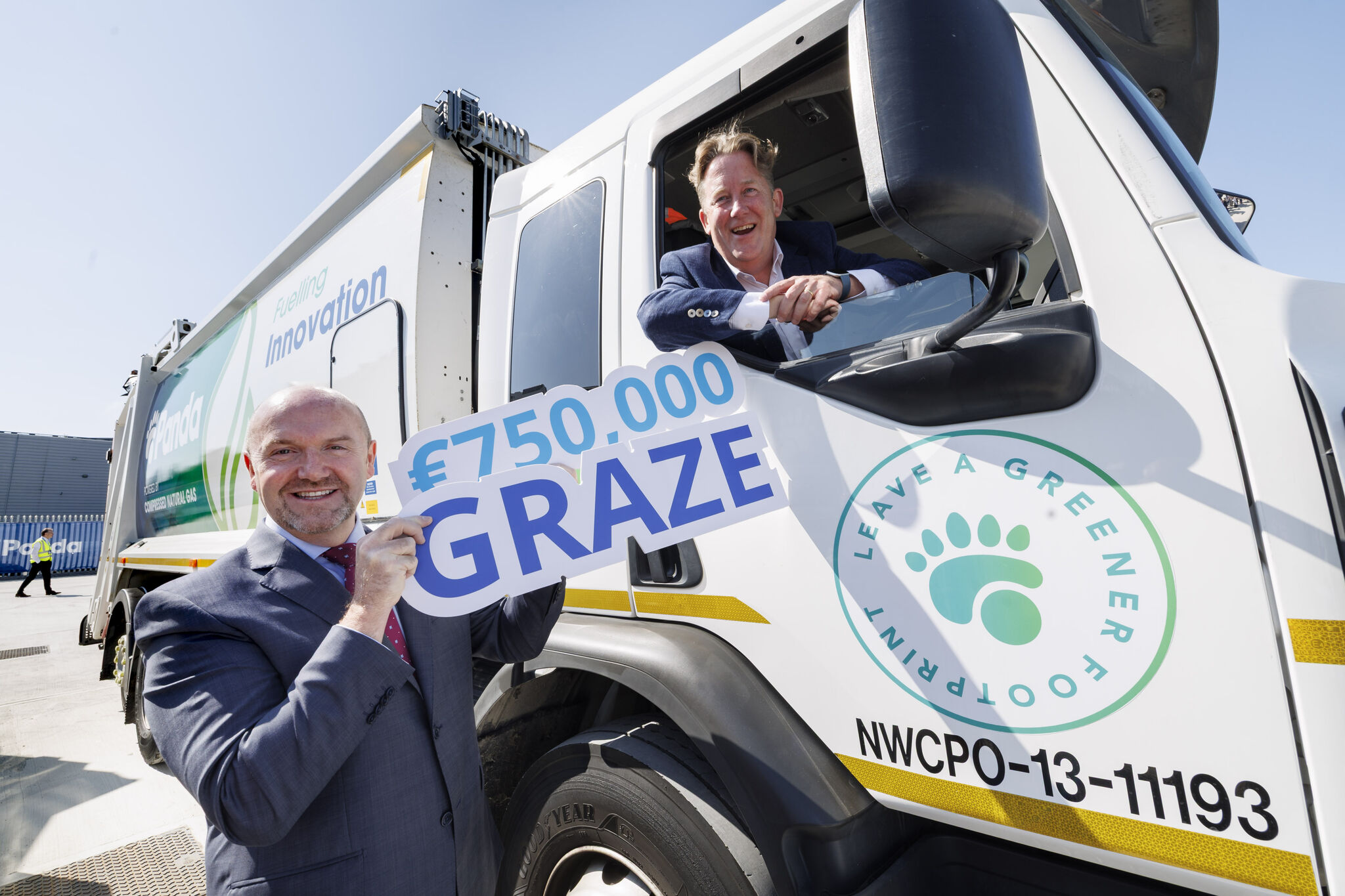
The Irish Government-backed GRAZE Vehicle Grant Scheme is designed to help address that initial cost barrier. Administered by Gas Networks Ireland, it provides grants of up to €10,000 per HGV, covering up to 40% of the cost difference between diesel and gas vehicles, subject to the scheme’s conditions.
The scheme is intended to support the purchase of up to 75 new gas vehicles.
That support is already producing results. In July 2026, Limerick-based waste management company Mr Binman secured GRAZE funding for two additional BioCNG HGVs, bringing its renewable gas truck fleet to four.
It is an example of where gas can make particular sense: high-mileage commercial vehicles operating predictable routes and returning regularly to base.
Infrastructure remains the challenge
The biggest argument against CNG remains infrastructure.
Ireland may now have 12 operational stations, but compare that with the enormous network of diesel forecourts available to the haulage industry and the difference is obvious.
A diesel driver generally doesn’t have to think too much about where the next filling station is.
A CNG operator does.
That makes route planning important. CNG is particularly attractive to fleets operating regular routes between established fuelling points or those with their own private depot infrastructure.
Gas Networks Ireland is also supporting the development of private CNG stations, allowing larger fleet operators to install refuelling facilities at their own premises.
For a large fleet returning to the same depot every evening, this can significantly change the economics and practicality of the technology.
For an owner-driver travelling throughout Ireland and continental Europe, the proposition is more complicated.
What about long-distance haulage?
This is where CNG faces perhaps its biggest question mark.
Heavy long-haul trucks require substantial range, high payload capacity and maximum operational flexibility.
Diesel currently remains exceptionally difficult to beat on those criteria.
CNG can work very effectively on appropriate long-distance routes, but the operator needs to understand the vehicle’s range, tank configuration and fuelling network before making the investment.
For regional distribution, waste collection, food distribution and other predictable operations, however, the proposition is much stronger.
The technology does not have to replace every diesel truck to make an impact.
It only needs to work particularly well in the applications where it is best suited.
CNG versus the electric future
There is another issue that hauliers need to consider: the rapid development of zero-emission trucks.
The European Union is imposing increasingly stringent CO₂ targets on heavy-duty vehicle manufacturers. The EU’s current framework requires a 15% reduction in average emissions from new heavy-duty vehicles from 2025, increasing to 43% in 2030 and 90% in 2040.
That inevitably raises the question of whether investing in CNG today risks buying into a technology that could eventually be overtaken by battery-electric or hydrogen vehicles.
There is no simple answer.
Battery-electric HGVs are developing rapidly, but charging infrastructure, vehicle cost, range, payload and charging time remain significant considerations for many operators.
CNG, by contrast, is available now and can be deployed using familiar operating practices.
That gives gas a potential role as a transition technology.
So, can gas challenge diesel?
The answer is yes — but probably not across the entire HGV market.
CNG is unlikely to displace diesel overnight, and it doesn’t need to.
Its strongest opportunity lies in fleets where the operational conditions suit it: predictable routes, high utilisation, depot-based operations, access to CNG infrastructure and, increasingly, access to renewable BioCNG.
The most compelling argument isn’t necessarily CNG versus diesel.
It is BioCNG versus diesel.
That distinction is important.
Conventional CNG offers a reduction in emissions compared with diesel. BioCNG has the potential to deliver a much more substantial reduction while allowing operators to continue using a familiar gas-powered vehicle platform.
And Ireland is beginning to develop the renewable gas infrastructure necessary to support that transition.
Interestingly, Gas Networks Ireland reported that gas demand from the transport sector increased by 10% in 2025, reflecting increased use of both CNG and BioCNG in heavy transport fleets.
That suggests the market is moving, albeit from a relatively small base.
The road ahead
The Irish haulage industry is unlikely to have a single fuel solution.
Diesel will remain important. HVO has an immediate role to play in reducing the carbon intensity of existing fleets. Battery-electric vehicles will increasingly enter suitable applications, while hydrogen may eventually find a role in long-distance heavy transport.
CNG and BioCNG can sit somewhere between today’s diesel fleet and tomorrow’s zero-emission fleet.
For some operators, the choice may be straightforward: stick with diesel until electric technology becomes viable.
For others, particularly high-mileage fleets with predictable operations, BioCNG could offer a practical way to reduce emissions today without fundamentally changing how their trucks operate.
The real test will be whether Ireland can develop enough renewable gas production, refuelling infrastructure and competitive vehicle supply to make the proposition attractive on a large scale.
If it can, gas may have a much bigger role to play in Irish road transport than many people currently expect.
CNG may not be the final destination for the HGV industry. But with BioCNG, it could prove to be an important part of the journey.