Ireland’s haulage industry does not need sympathy from Government. It needs certainty, meaningful fuel support and a clear recognition that the current diesel crisis is threatening the viability of businesses that keep the Irish economy moving.
With Budget 2027 now just days away, the message from the road transport sector should be impossible to misunderstand: doing nothing is not an option.
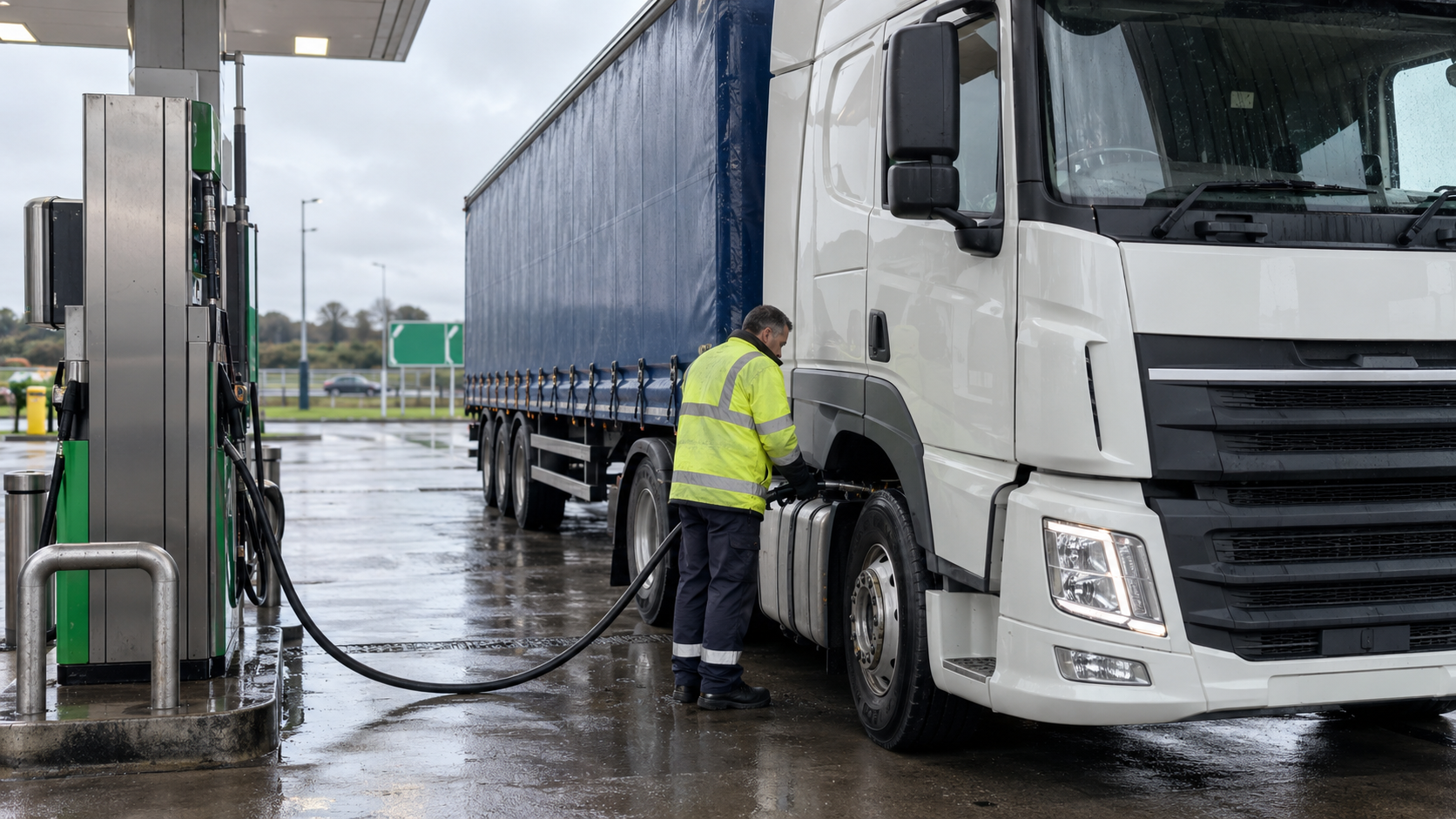
Diesel prices have again moved above €2.10 per litre at many forecourts, with Irish Road Haulage Association (IRHA) president Ger Hyland warning that some prices are heading towards €2.20. He has argued that many haulage operations become unviable once diesel moves beyond €1.90 per litre.
That is the economic reality facing operators.
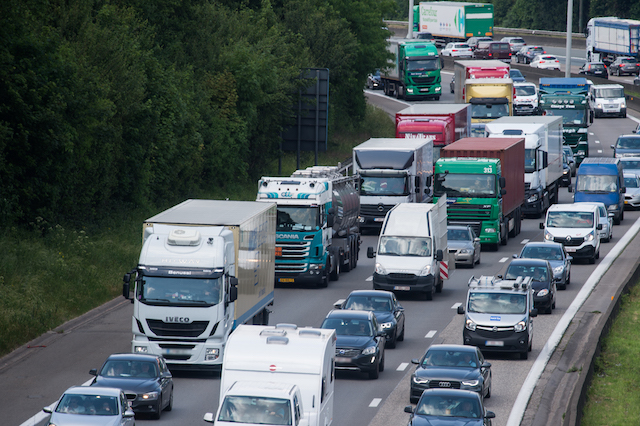
A truck cannot be parked for half the week to save fuel and still service customers. A refrigerated load cannot wait until diesel becomes cheaper. Supermarkets, factories, farms, construction sites, ports and exporters need their goods moved every day.
And somebody has to pay for the diesel.
Extending the excise cut is the minimum requirement
There are now strong indications that the Government understands the folly of allowing the current excise reductions to begin unwinding in November.
Tánaiste and Minister for Finance Simon Harris told the Dáil this week that Government will provide “certainty for the winter period on excise”, with reports indicating that the current reductions could be extended until late February or early March.
That would be welcome.
But it should be viewed as the starting point, not the solution.
Increasing fuel taxation while diesel remains at crisis levels would simply pile another cost onto businesses that are already struggling to absorb extraordinary increases.
The first thing Budget 2027 must therefore deliver is a firm extension of the existing excise reductions, with no November increase.
Hauliers need to know what diesel taxation will look like over the coming months. They cannot price contracts, negotiate rates or plan cash flow when Government fuel policy operates from one short-term deadline to another.
The Diesel Rebate Scheme must go further
The second requirement is an enhanced and extended Diesel Rebate Scheme (DRS).
Earlier this year, the maximum repayment available to qualifying operators was temporarily increased to 12 cent per litre. Government figures presented to the Dáil in June showed the importance of that rebate in reducing the effective mineral oil tax burden on qualifying road transport operators.
Budget 2027 should provide a longer-term commitment to the enhanced DRS and examine every available avenue for providing additional targeted relief to licensed professional operators.
There are EU taxation rules that restrict what Ireland can do. That is a legitimate constraint, and the Government has previously sought a temporary derogation from the European Commission because of the exceptional circumstances created by the Middle East conflict.
Those restrictions should not become an excuse for inaction. Government should use every mechanism legally available to it and continue pressing Brussels for whatever flexibility is required.
Hauliers cannot absorb the difference
There is another reality that customers of the haulage industry must understand.
Government support alone cannot completely insulate transport operators from international energy markets.
Where diesel costs rise sharply, those increases ultimately have to be reflected in haulage rates.
The IRHA has already advised members to review fuel surcharges against current fuel prices and adjust rates regularly. It has also highlighted the impact of fuel-linked shipping surcharges on international operators.
That advice is commercially unavoidable.
For too long, some hauliers have effectively financed their customers by absorbing fuel increases while waiting 60, 75 or even 90 days to be paid.
Hyland has highlighted precisely this cash-flow problem, pointing out that operators can be buying expensive fuel today but may not see payment for the work for another 60 to 90 days.
That model cannot survive a prolonged fuel crisis.
Every haulage business should have a transparent fuel-surcharge mechanism built into its customer agreements. Where existing long-term contracts make that difficult, customers need to come to the table.
A contract agreed when diesel was dramatically cheaper cannot reasonably require the transport operator alone to carry the full consequences of an international energy shock.
This is bigger than the haulage industry
Government must also recognise that supporting haulage is not simply about helping one business sector.
Road haulage is part of Ireland’s economic infrastructure.
Virtually everything sitting on a supermarket shelf has travelled by truck at some point. Manufacturers depend on trucks for raw materials and finished products. Irish exporters depend on road transport to reach ports. Farmers, builders, retailers, pharmaceutical companies and thousands of SMEs rely on dependable transport every day.
If haulage costs rise, those increases eventually move through the supply chain.
If haulage capacity disappears because operators cannot make the numbers work, the consequences are considerably more serious.
That is why fuel support for professional road transport should not be portrayed simply as a concession to hauliers. It is an intervention designed to protect supply chains, competitiveness and ultimately consumers.
Give operators certainty
Perhaps the greatest frustration within the industry is the constant uncertainty.
Operators cannot run businesses indefinitely on temporary measures extended by a few weeks or months at a time.
They are buying trucks that can cost well into six figures. They are employing drivers and technicians. They are paying insurance, tyres, finance, maintenance, tolls and wages before a wheel turns.
Fuel then represents one of their biggest variable operating costs.
Budget 2027 therefore needs to deliver a credible package built around continued excise relief, an enhanced Diesel Rebate Scheme, maximum use of available EU flexibility and sufficient certainty to allow businesses to plan ahead.
There is also a longer-term discussion to be had about alternative fuels, HVO, electrification, charging infrastructure and the decarbonisation of road freight.
Those conversations are important.
But they will not pay next week’s diesel bill.
Ireland still depends overwhelmingly on diesel-powered HGVs to move its goods today. Government policy must deal with the transport system we actually have while helping the industry transition towards the one we ultimately want.
The warning signs are already flashing.
Hyland has said further fuel protests cannot be ruled out, while warning that some operators are approaching the point where they must decide whether to park vehicles or continue trading.
Nobody should want to see trucks parked because otherwise viable businesses can no longer afford to fuel them.
Budget 2027 is the Government’s opportunity to prevent that.
Extending the excise reduction would be a welcome first move.
But Ireland’s hauliers need more than an extension. They need a fuel-support package substantial enough to keep trucks moving, businesses viable and Ireland’s supply chains functioning.
The Government now knows the scale of the problem.
On Budget Day, the industry will expect it to act.