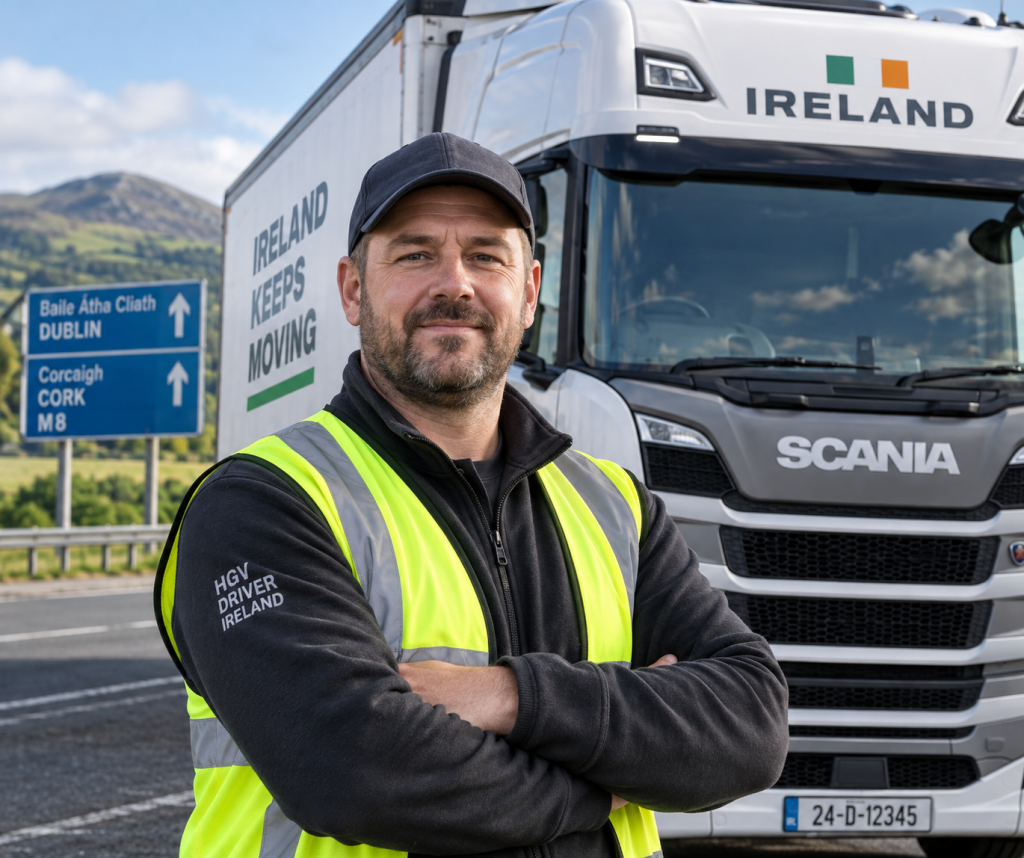
Anyone who wants to drive a truck professionally in Ireland generally needs more than the appropriate driving licence. They must also hold a valid Driver Certificate of Professional Competence, commonly known as Driver CPC.
Driver CPC is intended to ensure that professional truck and bus drivers maintain high standards of road safety, vehicle knowledge and professional competence throughout their careers.
This guide explains who needs Driver CPC, how new drivers qualify, the rules for established drivers, periodic training requirements and what happens when a Driver CPC card expires.
What is Driver CPC?
Driver CPC is a professional qualification for people who drive trucks or buses as a principal part of their occupation.
For an HGV driver, holding a Category C or CE driving licence confirms that the person is licensed to drive the vehicle. The Driver CPC card provides separate evidence that the driver is professionally qualified to use that vehicle for work.
Most professional drivers must carry both:
- A valid driving licence covering the vehicle being driven
- A valid Driver CPC card
Driver CPC should not be confused with Transport Manager CPC. Driver CPC applies to the person driving the vehicle, while Transport Manager CPC is the professional qualification normally required by the nominated transport manager of a licensed road transport operator.
Who needs Driver CPC in Ireland?
Driver CPC is generally required if a person drives a truck professionally, whether that person is:
- Employed as an HGV driver
- Self-employed as a driver
- Working as a sole transport operator
- Driving for a haulage, logistics or distribution company
- Carrying goods as a principal part of their job
A professional truck driver needs the appropriate full driving-licence category and a valid Driver CPC qualification.
Having a Category C or CE licence alone does not automatically permit someone to work as a professional HGV driver.
Are any drivers exempt?
Certain vehicles and driving activities are exempt from Driver CPC requirements. The exemptions can include:
- Vehicles with a maximum authorised speed not exceeding 45km/h
- Vehicles used by, or under the control of, the Defence Forces, Civil Defence, fire services or forces responsible for maintaining public order
- Emergency and rescue vehicles
- Vehicles undergoing road tests for technical development, repair or maintenance
- New or rebuilt vehicles that have not yet entered service
- Vehicles used for non-commercial carriage of passengers or goods
- Vehicles carrying goods or equipment which the driver uses in the course of their work, provided driving is not the driver’s principal activity
- Vehicles used by registered RSA Approved Driving Instructors while providing relevant instruction
- Certain non-commercial driving undertaken by unpaid volunteers
An exemption should never be assumed simply because driving is occasional or the journey is short. Its application depends on the vehicle, the purpose of the journey and the driver’s principal activity.
Drivers and operators who are uncertain should obtain clarification from the Road Safety Authority before relying on an exemption.
Minimum requirements for a new truck driver
A person beginning the qualification process must generally:
- Hold a full Category B car or light-van licence
- Be normally resident in Ireland
- Meet the required medical fitness standards
- Be at least 18 years old when applying for a first Category C or C1 learner permit
- Pass the relevant theory and practical tests
- Obtain the appropriate full truck licence
- Apply for and receive a Driver CPC card before driving professionally
The minimum age and licensing position can vary for different bus and truck categories, so applicants should check their specific category with the RSA and National Driver Licence Service.
How to obtain Driver CPC for the first time
A new professional HGV driver must complete four examination stages:
- Truck theory test
- Driver CPC case-study test
- Practical truck-driving test
- Driver CPC walkaround test
The driver must also obtain a learner permit, undertake suitable professional instruction and add the relevant truck category to their full driving licence.
1. Truck theory test
The Category C theory test examines areas including:
- Rules of the Road
- Road signs
- Hazard awareness
- Risk perception
- Safe driving behaviour
- Eco-driving
- Vehicle operation and road safety
The Category C test contains 100 multiple-choice questions. A candidate must answer at least 74 correctly to pass.
A combined Category C and D test is available for people seeking both truck and bus entitlements. It contains 140 questions, with at least 104 correct answers required.
The individual Category C or D theory-test fee is currently €72, while the combined C and D test costs €84. Applicants should confirm charges when booking, as fees may change.
A theory-test certificate is valid for two years. The successful candidate should apply for the relevant learner permit within that period. See the RSA theory-test guidance.
2. Driver CPC case-study test
The case-study test assesses how the candidate would respond to situations encountered by a professional driver.
It presents three realistic driving situations, with 15 questions relating to each one. To pass, the candidate must:
- Score at least five out of 15 in each case study
- Obtain an overall score of at least 28 out of 45
The test takes approximately 90 minutes.
A candidate must pass the relevant truck theory test before taking the case-study test. However, the case-study test does not have to be completed before applying for a learner permit or sitting the practical driving test.
It must be passed before the candidate can apply for and complete the Driver CPC walkaround test.
The case-study certificate is valid for two years. Read the RSA case-study requirements.
3. Learner permit and professional training
After passing the theory test, the candidate can apply for a Category C learner permit through the NDLS. The current fee for a Category C learner permit is €45.
A medical report may be required as part of the application.
Although the RSA recommends professional lessons rather than specifying a standard number for every applicant, HGV candidates should undertake sufficient tuition with an RSA Approved Driving Instructor who is qualified in the relevant category.
A learner driver must be accompanied by someone who has held a full licence in the same category for at least two years. The vehicle must be properly taxed, insured, roadworthy and, where applicable, hold a valid Commercial Vehicle Roadworthiness Test certificate.
4. Practical driving test
The practical truck-driving test takes approximately 100 minutes. It examines the candidate’s ability to:
- Control the vehicle safely
- Apply the Rules of the Road
- Identify and respond to hazards
- Demonstrate appropriate observation
- Position the vehicle correctly
- Drive safely in different traffic and road conditions
- Answer questions about roadworthiness and vehicle controls
The candidate must supply a suitable test vehicle and ensure that it meets all RSA requirements.
From 9 March 2026, candidates must also present a valid Certificate of Motor Insurance demonstrating that they are insured to drive the vehicle being presented for the test.
Passing the test produces a certificate of competency, but this does not by itself permit the candidate to drive professionally. The relevant full category must first be added to the driving licence.
5. Driver CPC walkaround test
The walkaround test checks whether a driver can examine a commercial vehicle, identify safety problems and deal with practical situations associated with professional driving.
It normally takes around 30 minutes and covers five topic areas. These include:
- Vehicle safety and daily checks
- Safe loading and load security
- Emergency situations
- Preventing physical risks
- Vehicle and cargo security
The candidate must score at least 15 out of 20 in each topic and achieve at least 80 out of 100 overall.
The walkaround test can normally be booked at the same centre and on the same day as the practical driving test. Its result remains valid for two years. See the RSA walkaround-test guide.
Applying for the first Driver CPC card
After passing the four CPC test stages, the new driver must add the relevant truck category to their full driving licence.
Only then should the driver apply for a Driver CPC card by submitting the appropriate application form and photograph to the RSA’s Driver Education Section in Ballina, Co. Mayo.
There is currently no charge for the first Driver CPC card. The RSA advises allowing at least 20 working days for the card to arrive.
A newly qualified driver cannot drive professionally while waiting for the card. The driver must have received the valid Driver CPC card before beginning professional work. Driver CPC card application information.
Acquired or grandfather rights
Some established drivers received Driver CPC through acquired rights.
A truck driver has acquired rights if they obtained the relevant truck licence before 10 September 2009. For bus drivers, the corresponding date is before 10 September 2008.
A driver with acquired rights does not have to complete the four initial CPC examinations. However, acquired rights do not remove the obligation to undertake periodic training.
An established driver must complete the required training to obtain and maintain a valid Driver CPC card.
Periodic Driver CPC training
Driver CPC is not a once-off qualification. Professional drivers must maintain it through periodic training.
A truck driver must complete:
- 35 hours of training during each five-year CPC cycle
- Five different seven-hour modules
- Normally one module during each year of the cycle
A driver maintaining both truck and bus CPC must complete 42 hours, comprising six modules over five years.
Training must be completed through an RSA-approved Driver CPC training organisation. Training delivered by an unapproved provider will not count.
The modules cover areas such as:
- Vehicle control and eco-driving
- Rules and regulations for professional drivers
- Health, safety and emergency situations
- The role of the professional driver
- Safe loading and passenger safety
- Workplace and vehicle security
Repeating the same module during a five-year cycle does not count towards the training requirement.
Drivers should obtain a certificate of attendance after every course and check that the training has been added to their record.
Checking a CPC training record
Drivers can check their completed modules through the RSA’s MyCPC portal.
Registration generally requires:
- Driver number or PPS number
- Date of birth
- Email address supplied for CPC training
The approved training provider uploads the driver’s attendance record. The RSA advises allowing up to 21 days for a completed module to appear.
If it is still missing after that period, the driver should contact the training provider directly.
How is a Driver CPC card renewed?
A Driver CPC card is generally valid for five years.
The RSA automatically renews the card when the driver has completed all the required periodic training for the relevant cycle and the details held on file are correct.
Drivers should not wait until the final months of the cycle to discover that a module is missing. They should check their MyCPC record regularly and ensure their address is up to date.
If the training is complete but the current card is not close to expiry, the replacement card may not be issued immediately. It is normally sent nearer the existing card’s expiry date.
What happens if a Driver CPC card expires?
A driver whose CPC has expired must not continue driving professionally.
Where someone previously held Driver CPC but failed to maintain it—or has been away from professional driving for more than five years—it may be possible to return without repeating all four initial tests.
The driver will generally have to re-establish the qualification by completing:
- 35 hours of periodic training for truck or bus CPC
- 42 hours if restoring both truck and bus CPC
- The relevant Driver Qualification Card application
The exact procedure should be confirmed with the RSA before the driver resumes professional work.
Foreign Driver CPC qualifications
A Driver CPC qualification or periodic training completed in another EU country may be recognised in Ireland.
Drivers holding a foreign licence or CPC qualification should contact the RSA to confirm:
- Whether their existing qualification is recognised
- Whether overseas modules can count towards an Irish training cycle
- What documentation is required
- Whether a card exchange or new application is necessary
Drivers arriving from outside the EU may face different requirements.
Must drivers carry the card?
Yes. A professional truck or bus driver must carry a valid Driver CPC card while driving professionally and produce it when requested by an RSA transport officer or a member of An Garda Síochána.
Driving professionally without the required qualification or failing to carry the card can result in enforcement action and penalties.
Operators should also have systems in place to check CPC expiry dates and training progress. Allowing an unqualified driver to undertake professional work can create serious compliance, insurance and road-safety risks.
Driver CPC checklist for HGV drivers
Before driving professionally, check that you have:
- The correct full driving-licence category
- A valid Driver CPC card
- Completed the required periodic training
- Confirmed that your MyCPC record is accurate
- Updated the RSA if your address has changed
- Checked the expiry dates on both your licence and CPC card
- A valid digital tachograph card where required
- Met all medical fitness requirements
The bottom line
Driver CPC is a legal and professional requirement for most people employed to drive trucks in Ireland.
New drivers generally qualify by completing the truck theory test, CPC case-study test, practical driving test and walkaround test. Established drivers with acquired rights can avoid the initial examinations, but they must still complete periodic training.
Once qualified, a truck driver must complete 35 hours of approved training during every five-year cycle and carry a valid Driver CPC card whenever driving professionally.
Because fees, procedures and regulatory requirements can change, drivers should check the latest information on the RSA Driver CPC website before booking training or making an application.
Information checked against RSA guidance in September 2026. This article is a general guide and should not be treated as legal advice.