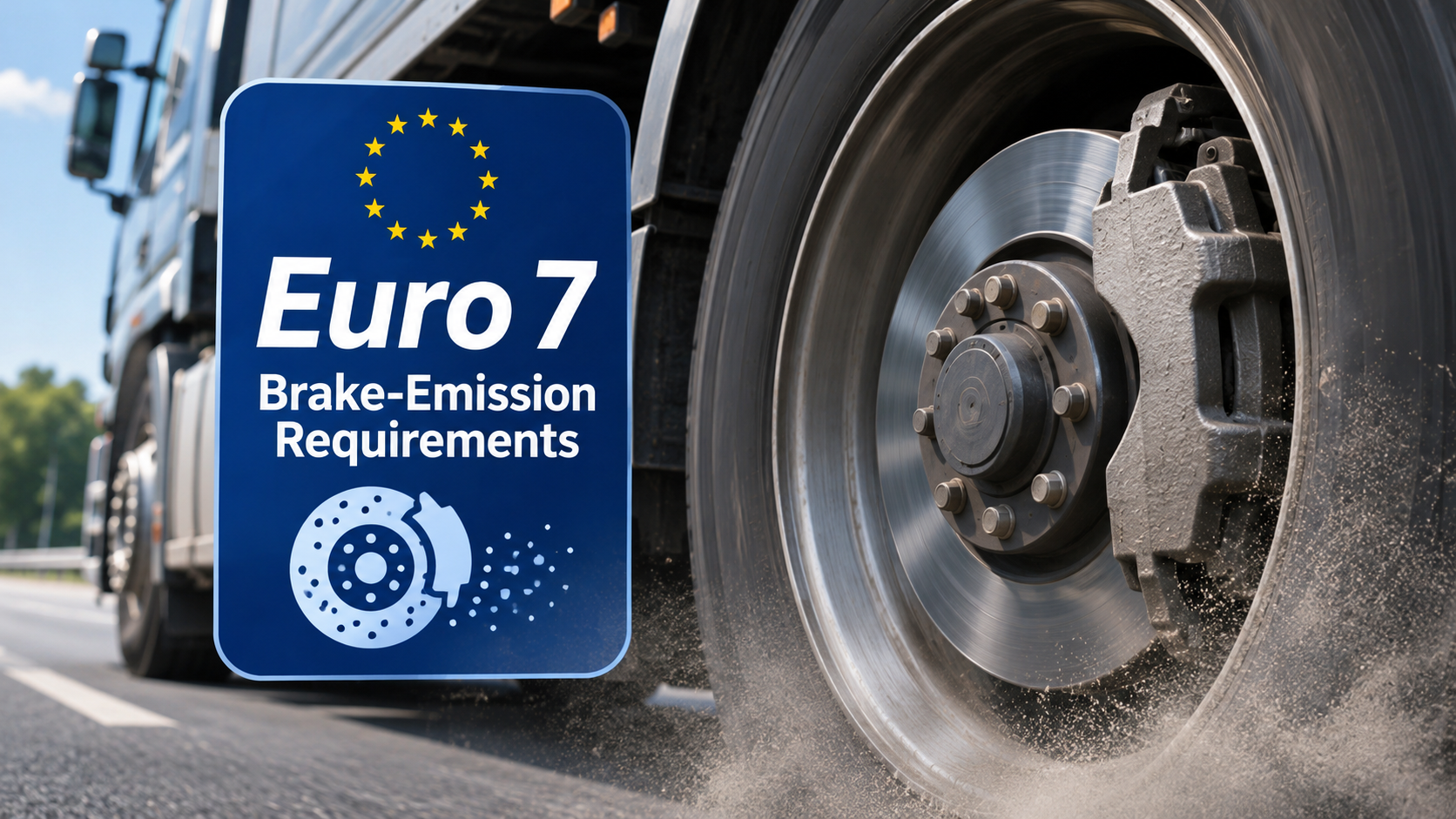
Europe’s truck manufacturers are calling for a five-year postponement of Euro 7 brake-emission requirements for heavy-duty vehicles, warning that crucial testing procedures have yet to be finalised and validated.
The European Automobile Manufacturers’ Association (ACEA) has also called for a two-year postponement of the current Euro 7 application dates for heavy-duty vehicles, arguing that manufacturers and suppliers need more time to prepare for the new regulatory requirements.
The proposals reflect growing concerns within Europe’s commercial vehicle industry about the practical challenges of implementing Euro 7, particularly the introduction of limits on emissions generated by braking systems.
Unlike previous emissions standards, which have largely focused on pollutants from vehicle exhausts, Euro 7 introduces requirements addressing non-exhaust emissions, including particles released through brake wear.
These requirements will affect manufacturers of trucks and buses, as well as suppliers of braking systems and associated components.
Testing Procedures Still Not Finalised
According to ACEA, several important elements of the Euro 7 regulatory framework remain incomplete, including the testing procedures and methodologies that manufacturers will need to demonstrate compliance.
The association argues that these procedures must be properly developed, validated and made available before manufacturers can confidently design and certify compliant vehicles.
Heavy-duty vehicles present particular challenges because of the wide variety of vehicle configurations, operating weights, braking systems and applications.
A long-distance articulated truck, for example, operates under very different braking conditions from an urban delivery vehicle or a city bus.
Manufacturers must also account for differences in braking technologies, including conventional friction brakes, regenerative braking and auxiliary braking systems.
ACEA maintains that additional time is essential to ensure testing procedures are reliable, repeatable and representative of real-world operating conditions.
Vehicle Safety Must Remain a Priority
One of the industry’s key concerns is ensuring that new brake-emission requirements do not compromise vehicle safety.
Commercial vehicle braking systems must deliver dependable performance under demanding operating conditions, including heavy loads, steep gradients and repeated braking.
Any changes to brake components or materials designed to reduce particulate emissions must therefore undergo extensive testing and validation.
ACEA warns that uncertainty surrounding the final regulatory requirements could disrupt vehicle development programmes, safety validation and production planning.
The association believes manufacturers need a realistic timetable that allows new technologies to be developed and introduced without undermining existing safety standards.
Implications for Irish Hauliers
For Irish haulage operators, the proposed postponements could have implications for future truck purchasing decisions and fleet replacement programmes.
- Every key deadline: diesel rebate, fuel excise, carbon tax
- Tick-box checklist for tacho, CVRT, CPC & operator licence
- Where drivers get caught at RSA roadside checks
Although Euro 7 compliance is primarily a responsibility for vehicle manufacturers, the regulations will ultimately influence the specification, development and potentially the cost of new commercial vehicles entering the European market.
New braking technologies and additional compliance requirements may also have implications for maintenance procedures, replacement parts and workshop equipment.
For operators planning significant fleet investment over the coming years, certainty over the introduction of new vehicle standards is particularly important.
A postponement could give manufacturers more time to introduce compliant vehicles and allow operators to plan fleet replacements with greater confidence.
However, ACEA’s proposals remain requests for changes to the regulatory timetable, rather than confirmed postponements.
Balancing Environmental Targets and Industry Competitiveness
ACEA insists that its call for additional time should not be interpreted as opposition to the environmental objectives of Euro 7.
Instead, the association argues that a more realistic implementation timetable would help ensure the regulations deliver meaningful environmental improvements while protecting the competitiveness of Europe’s commercial vehicle manufacturing sector.
Truck manufacturers are already facing substantial investment demands as they develop battery-electric and hydrogen-powered vehicles, improve conventional powertrains and adapt to increasingly demanding European CO₂ reduction targets.
The introduction of new brake-emission standards adds another layer of technical and financial complexity.
ACEA believes that regulatory certainty is essential if manufacturers and suppliers are to make the necessary investment decisions and bring compliant technologies to market.
What Happens Next?
ACEA is seeking changes to the Euro 7 implementation timetable, including a five-year postponement of the heavy-duty brake-emission requirements and a separate two-year postponement of the current application dates for heavy-duty vehicles.
The association argues that these changes would provide sufficient time to complete and validate the necessary testing methodologies, while maintaining the environmental ambitions of the legislation.
For Europe’s truck manufacturers, the immediate priority is securing a regulatory framework that is technically achievable and provides sufficient time for development, testing and production.
For Irish hauliers, the key issue will be whether the proposed changes are accepted and what impact any revised timetable might have on the availability, specification and cost of future trucks.
The message from Europe’s truckmakers is clear: Euro 7 must be introduced on a timetable that allows manufacturers to meet the new environmental standards without compromising vehicle safety or industrial competitiveness.