Irish HGV operators could face more targeted roadside emissions checks under proposed EU rules designed to identify trucks producing excessive nitrogen oxide and particulate emissions.
The measures form part of a major revision of the EU Roadworthiness Package, covering periodic vehicle testing and technical roadside inspections. Detailed negotiations continued in Brussels on 3 November, with further Council working-group meetings scheduled during November. No final agreement has yet been reached.
This distinction is important: the proposals do not create an immediate new roadside test for Irish trucks. The eventual legislation must first be agreed by the European Parliament and Council before being implemented nationally.
Remote sensing could identify suspect trucks
The European Commission wants inspection authorities to use more advanced methods to detect high-emitting vehicles, including trucks with defective or deliberately altered emissions-control systems.
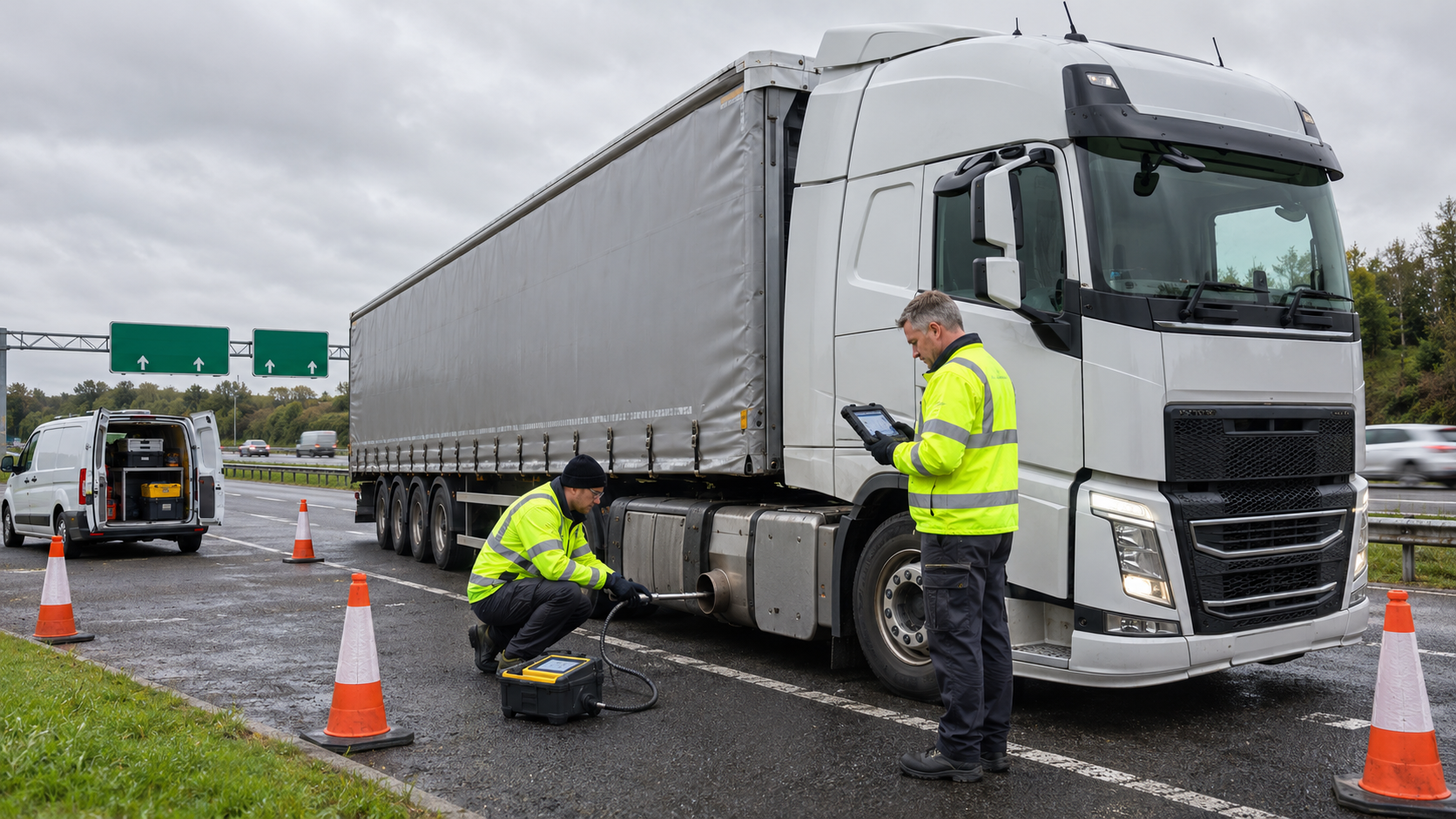
Proposed testing methods include measuring nitrogen oxide, or NOx, and particle-number emissions. Remote-sensing equipment could also be used to screen vehicles as they pass through the road network.
Vehicles producing suspicious readings could then be directed into a more detailed roadside or technical inspection. Remote sensing would therefore operate primarily as a targeting tool—not necessarily as the sole basis for an immediate penalty.
The Commission argues that a relatively small number of defective or tampered vehicles can be responsible for a disproportionate share of harmful road-transport emissions.
Parliament backs emissions screening
The European Parliament’s negotiating position supports emissions screening during roadside inspections of cars, vans, trucks and buses. Vehicles identified as potentially high emitters could be referred for further technical examination.
MEPs also want the existing EU target—under which technical roadside inspections cover the equivalent of 5% of registered buses and trucks—to become a national target for each Member State.
The Council supports new methods for measuring NOx and particle numbers but has raised concerns about costs and whether all the necessary testing technology is sufficiently developed for widespread deployment. Its position allows these methods to be supplemented by remote emissions sensing.
The final rules will depend on the outcome of negotiations between the institutions.
What could inspectors be looking for?
The revised system is intended to improve the detection of vehicles with defective, poorly maintained or manipulated emissions equipment.
- Every key deadline: diesel rebate, fuel excise, carbon tax
- Tick-box checklist for tacho, CVRT, CPC & operator licence
- Where drivers get caught at RSA roadside checks
For truck operators, likely areas of attention would include:
- Diesel particulate filter condition and operation
- Selective catalytic reduction and AdBlue systems
- NOx sensors and exhaust after-treatment warning lights
- Engine-management faults affecting emissions
- Software or hardware used to bypass emissions controls
- Excessive smoke or other evidence of incomplete combustion
The precise roadside procedures, failure thresholds and enforcement consequences have not yet been settled. Operators should therefore be wary of claims that a particular EU roadside emissions test has already been confirmed.
Implications for Irish fleets and workshops
If adopted, the changes could eventually influence both roadside enforcement and Ireland’s Commercial Vehicle Roadworthiness Testing system.
A truck may continue to perform normally from the driver’s perspective while producing excessive emissions because of a failed sensor, damaged particulate filter or underperforming SCR system. More sophisticated testing would make those faults harder to overlook.
Independent workshops may consequently need greater access to emissions diagnostics, manufacturer repair data and equipment capable of checking real-world NOx and particulate performance. Simply clearing a fault code without establishing its cause would become increasingly risky.
The proposals could also affect Irish trucks travelling elsewhere in Europe. Greater exchange of vehicle and inspection data is intended to make it easier for enforcement authorities to identify previous defects and target potentially non-compliant vehicles across borders.
What operators should do now
There is no new legal inspection requirement to meet immediately, but operators can reduce their exposure by treating emissions equipment as a core roadworthiness item.
Persistent warning lights should be investigated, AdBlue consumption should be monitored and recurring NOx or particulate-filter faults should be properly diagnosed. Maintenance records should also show what action was taken rather than merely recording that a warning was reset.
The final EU agreement will determine the tests, implementation period and national responsibilities. For Irish hauliers, however, the direction is already clear: future roadside enforcement will increasingly examine what comes from the exhaust—not just tyres, brakes, lights and drivers’ hours.