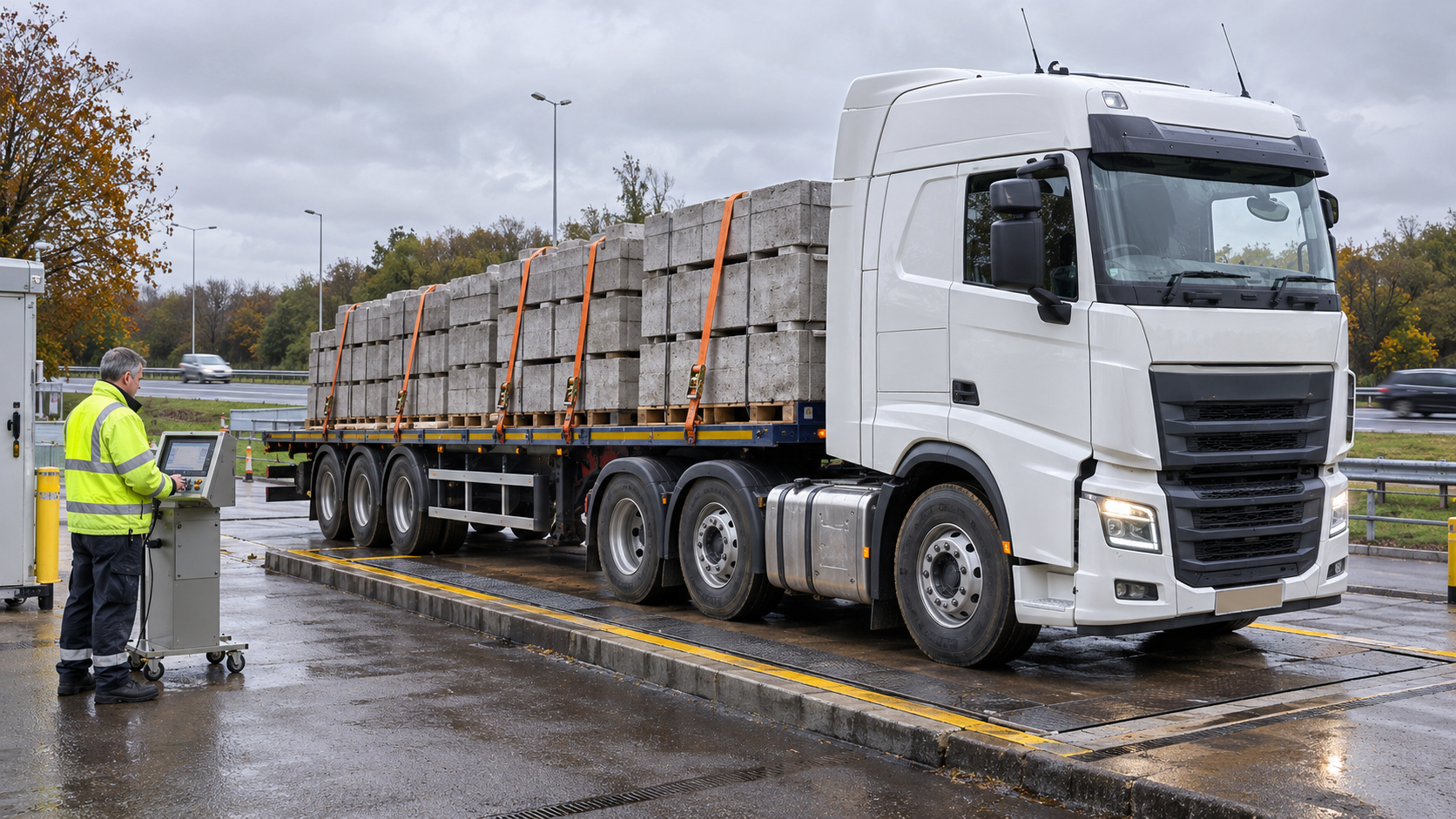
Irish hauliers travelling to Britain are reminded to check vehicle and axle weights before departure, as an overload can leave a truck prohibited from continuing its journey.
For operators working to tight delivery windows and ferry schedules, a roadside weight check can have consequences beyond an enforcement penalty. Correcting an overload may require goods to be transferred to another vehicle, adding cost and disrupting the remainder of the journey.
The reminder concerns existing requirements, rather than a newly announced rule or enforcement campaign.
Total weight is only part of the check
Drivers and transport managers must establish that the loaded vehicle complies with the limits applicable to its configuration and route.
Checking the overall weight alone is insufficient. Poor load distribution can overload an individual axle even where the vehicle remains within its permitted total weight.
The Road Safety Authority’s professional driver guidance specifically reminds drivers to check the maximum permitted weights and dimensions of countries they visit or pass through, including the UK. It also highlights the need to check loads whenever goods are added or removed. www.rsa.ie
That matters particularly on multi-drop work, where unloading changes the distribution of weight across the remaining load.
Overloading can stop the journey
The Driver and Vehicle Standards Agency (DVSA) states that an overloaded vehicle will receive an immediate prohibition notice and may be immobilised.
Officers can direct the vehicle to a nearby location where goods can be removed or redistributed. A copy of the prohibition notice is also sent to the vehicle’s owner or operator. Prosecution is another possible consequence. www.gov.uk
- Every key deadline: diesel rebate, fuel excise, carbon tax
- Tick-box checklist for tacho, CVRT, CPC & operator licence
- Where drivers get caught at RSA roadside checks
For an Irish fleet, a roadside delay in Britain could mean a missed return sailing, revised delivery arrangements and additional vehicle or driver costs.
Establish the actual loaded weight
DVSA guidance reminds operators that vehicle weights include more than the goods being carried. Drivers, passengers, pallets and packaging must also be accounted for.
Lift or tag axles must be used correctly, and drivers should understand the difference between gross vehicle weight and gross train weight.
Overloading also affects safety: it can reduce stability, impair steering, increase stopping distances and place additional strain on tyres. Responsibility for preventing it is shared by the operator and driver. www.gov.uk
Checks before departure
A practical departure check should include:
- Confirming the applicable vehicle, combination and axle limits.
- Obtaining reliable information about the load’s weight.
- Checking load positioning and distribution across the axles.
- Using a suitable weighbridge where weights are uncertain.
- Rechecking the remaining load after collections or deliveries.
The RSA also reminds operators that loads can settle or shift during a journey and that some roads and bridges carry their own weight restrictions. www.rsa.ie
For Irish hauliers, the practical message is straightforward: resolve uncertainty about the load before departure. Discovering an overload at a British roadside check can bring the entire transport operation to a halt.