A daily walkaround check is one of the most important safety procedures carried out by an HGV driver. It can identify a potentially dangerous defect before the vehicle enters service, reduce the risk of a roadside prohibition and help protect the operator’s roadworthiness record.
The check should be completed before the vehicle is driven on a public road. It must cover the truck, trailer and any equipment being used for that journey.
Drivers should not treat the inspection as a box-ticking exercise. A defect that appears minor in the depot can become a serious safety problem once the vehicle is fully loaded and travelling at motorway speeds.
Who is responsible for the check?
The vehicle operator has the overall responsibility for ensuring that every commercial vehicle is roadworthy.
Drivers also have a vital role. They are expected to examine the vehicle before use, report defects and avoid driving a truck or trailer that presents a danger.
The operator should provide drivers with:
- a clear walkaround-checking procedure;
- sufficient time to carry out the inspection;
- a reliable defect-reporting system;
- appropriate training;
- access to previous defect information; and
- a clear process for taking an unsafe vehicle out of service.
Drivers should never be pressured to take a defective vehicle onto the road.
Begin with the vehicle parked safely
The inspection should be carried out in a safe, well-lit location. Apply the parking brake, switch off the engine when appropriate and keep the keys under the driver’s control.
Walk around the entire vehicle methodically. Following the same sequence every day reduces the likelihood of overlooking an item.
Where a trailer has been changed, the replacement trailer must also be inspected—even if somebody else checked it earlier.
Lights, indicators and reflectors
Check that all required lights and indicators are working, clean and the correct colour.
This includes:
- headlights and daytime running lights;
- direction indicators and hazard lights;
- brake lights;
- rear lights;
- side-marker lights;
- number-plate lights;
- fog lights;
- warning beacons, where fitted; and
- trailer lighting connections.
Lenses should not be cracked, excessively faded or obscured by dirt. Reflectors, conspicuity markings and rear-marker boards must be clean, secure and clearly visible.
Ask another person to help check the brake lights or use a suitable reflection, monitoring system or other safe method.
Tyres and wheels
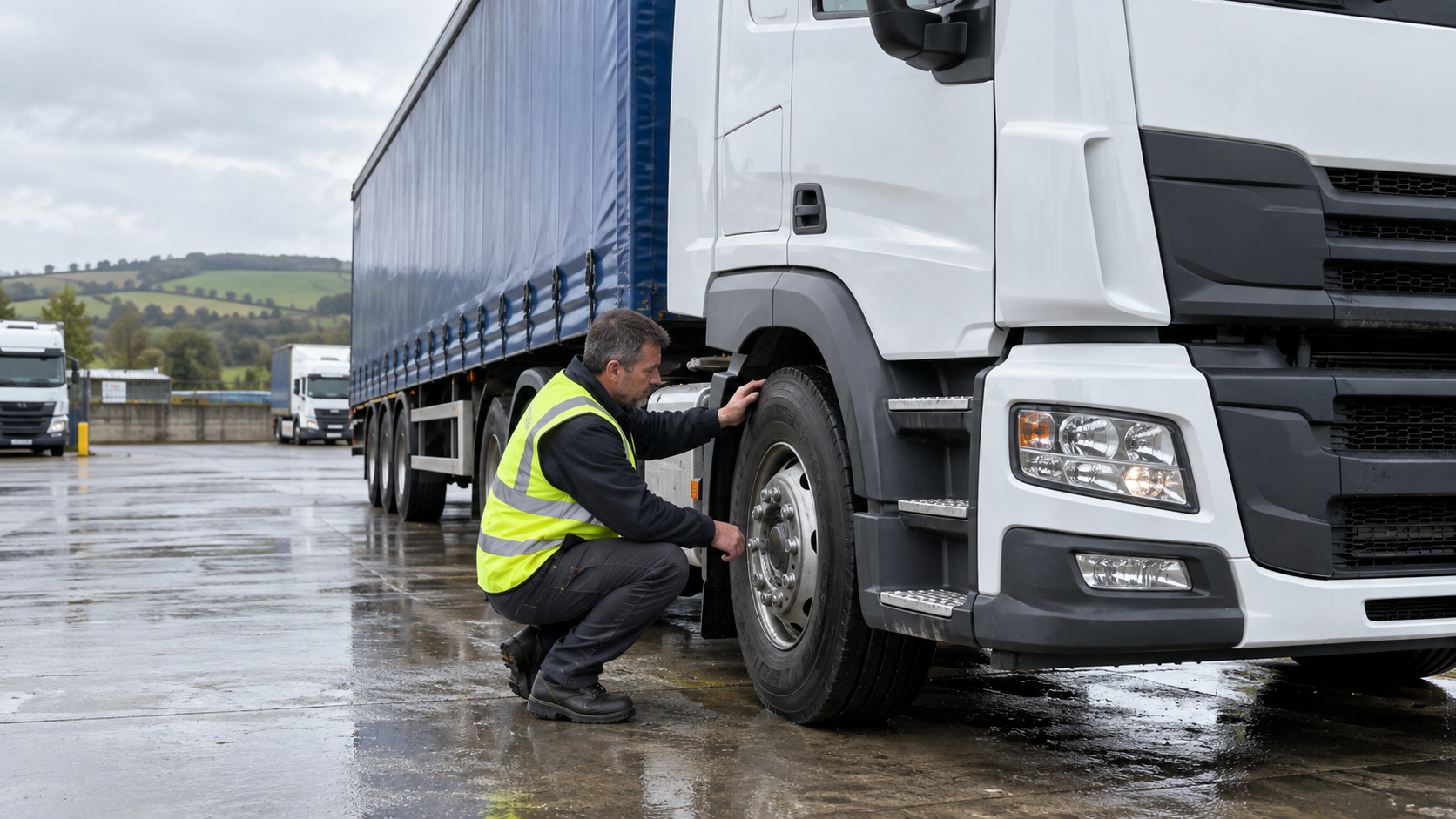
Inspect every visible tyre, including those fitted to the trailer.
Look for:
- cuts, bulges or exposed cords;
- objects embedded in the tread;
- inadequate tread depth;
- signs of underinflation;
- uneven or abnormal wear;
- tyres rubbing against another component;
- missing valve caps; and
- inappropriate tyres fitted together.
Check that wheel nuts appear secure and that wheel-nut indicators, where fitted, have not moved. Look for cracks, damage, rust marks or other evidence that a wheel nut may be loose.
Inspect wheels for visible damage and check that mudguards and spray-suppression equipment are secure.
A tyre-pressure monitoring system does not remove the need for a physical inspection.
Brakes and air system
Before moving off, check that the braking system builds and maintains sufficient air pressure. Warning devices should operate correctly and extinguish when the required pressure is reached.
Listen for obvious air leaks and ensure that brake lines and couplings are secure and undamaged.
When the vehicle begins moving, test the service brake at low speed where it is safe to do so. The vehicle should stop in a controlled manner without pulling sharply to either side.
The parking brake and trailer brake connections should also operate correctly.
Any warning light relating to the braking system, ABS or electronic stability control must be investigated.
Steering, mirrors and visibility
Check for excessive movement in the steering and make sure the steering operates normally.
All mirrors and camera-monitor systems must be clean, secure and correctly adjusted. Drivers should have a clear view through the windscreen and side windows.
Check:
- the windscreen for serious damage;
- windscreen wipers and washers;
- washer-fluid level;
- demisting equipment;
- mirrors and camera lenses;
- sun visor; and
- anything obstructing the driver’s view.
Loose objects on the dashboard can also obstruct visibility and should be removed.
Cab safety equipment
Inside the cab, confirm that:
- the horn works;
- seatbelts are serviceable;
- warning lights operate correctly;
- instruments display normally;
- the speedometer functions;
- the driver’s seat is secure;
- doors close properly; and
- any required fire extinguisher or first-aid equipment is present and accessible.
Registration plates, statutory discs and other required documentation should be valid, legible and displayed correctly.
Coupling the truck and trailer
A poor coupling can have catastrophic consequences.
Check that the fifth wheel and kingpin are properly engaged and that the locking mechanism is secure. Carry out an appropriate tug test before travelling.
Ensure that:
- the trailer parking brake is applied during coupling;
- air and electrical lines are connected correctly;
- lines will not become stretched or trapped;
- the landing legs are fully raised;
- the winding handle is secured;
- the trailer number plate matches the vehicle records where required; and
- sideguards, rear underrun protection and trailer doors are secure.
Drivers using drawbar combinations should inspect the coupling, locking devices and safety attachments.
Load security
The driver must ensure that the load is stable and adequately restrained before departure.
Check curtains, doors, locks, straps, chains, bars and other securing devices. Nothing should be capable of falling from the vehicle or moving sufficiently to affect stability, steering or braking.
Curtains alone should not be treated as load restraint unless the body and curtain system are specifically designed and certified for that purpose.
Confirm that the vehicle is not visibly overloaded or loaded in a way that could exceed an individual axle limit.
Bodywork and fluid leaks
Examine the vehicle and trailer for loose panels, damaged bodywork or equipment that could detach while travelling.
Look underneath for signs of fuel, oil, coolant or other fluid leaks. Check that the fuel cap, battery compartment, storage lockers and exhaust components are secure.
Any hydraulic equipment, tail lift, crane or tipping mechanism should be properly stowed and locked for travel.
What should happen when a defect is found?
Every defect should be recorded clearly and reported through the operator’s established system.
The report should identify:
- the vehicle or trailer;
- the date and time;
- the defect found;
- the driver reporting it;
- the action taken; and
- confirmation of repair where required.
A safety-critical defect means the vehicle must not be driven until it has been repaired and declared safe.
Drivers should not attempt to decide that an obvious safety defect is acceptable simply because a delivery is urgent. Commercial pressure never overrides roadworthiness.
A written “nil defect” report is also useful because it confirms that the inspection was completed and provides an audit trail.
Checks continue throughout the day
The driver’s responsibility does not end after the morning inspection.
Tyres, lights, coupling security and load restraint should be checked again during the working day, particularly after:
- collecting or delivering part of a load;
- changing trailers;
- travelling over poor road surfaces;
- taking a statutory break;
- receiving a dashboard warning; or
- noticing a change in vehicle handling.
A final check after parking can identify defects that require attention before the next journey.
A few minutes that could prevent a serious incident
A proper HGV walkaround check usually takes only a short time, but it can prevent a collision, breakdown, roadside prohibition or costly delivery failure.
It also demonstrates that the driver and operator are actively managing vehicle safety rather than relying solely on the annual Commercial Vehicle Roadworthiness Test.
The CVRT confirms a vehicle’s condition at the time of testing. It does not guarantee that the vehicle will remain roadworthy throughout the following year.
Daily inspections, effective defect reporting and planned maintenance must work together.
For Irish HGV operators, the message is straightforward: if a vehicle is not safe, compliant and fit for the journey, it should not leave the yard.