Irish hauliers operating through north-west England are being warned to prepare for potential delays on the M6 motorway, as major bridge-joint replacement works get underway at the Thelwall Viaduct near Warrington.
National Highways has confirmed that the extensive maintenance programme, between junctions 20 and 21 of the M6, is expected to continue until winter 2027–28, creating the potential for prolonged disruption on one of Britain’s busiest freight corridors.
The works are particularly significant for Irish transport operators using the Holyhead ferry routes and travelling onwards to Manchester, Liverpool, northern England and Scotland.
Contraflow and 40mph speed restrictions
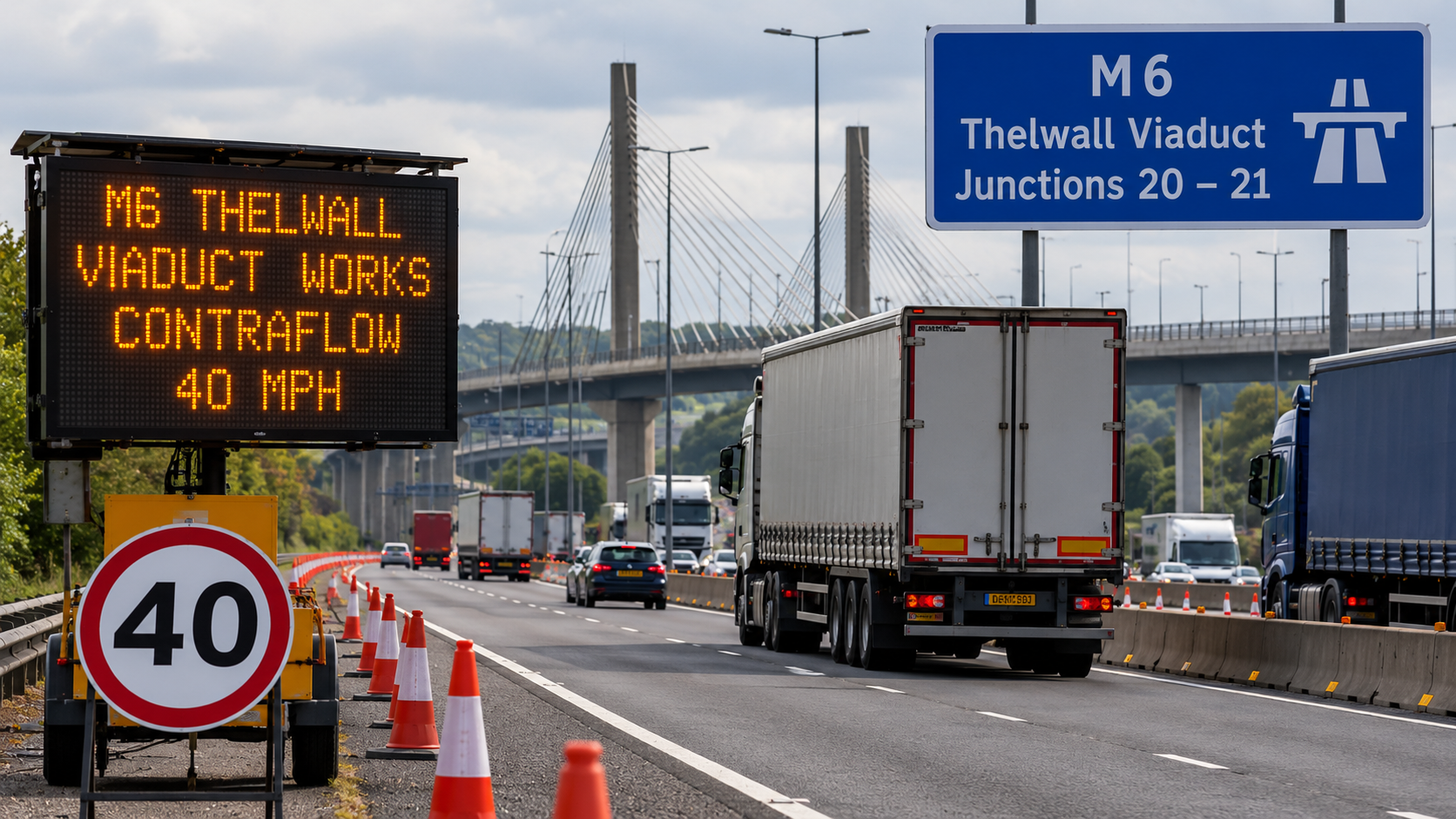
According to an update issued by National Highways on 15 October, a 24-hour contraflow system came into operation on Monday, 19 October, allowing essential bridge-joint replacement works to proceed while keeping traffic moving.
A temporary 40mph speed limit has been introduced in both directions.
National Highways says four lanes will generally remain available in each direction during daytime operations, although additional restrictions will be necessary overnight.
At certain stages of the project, the northbound carriageway may be reduced to just one lane overnight, potentially creating significant delays for HGV traffic.
The arrangements will remain subject to change as the project progresses.
Important route for Irish freight traffic
The M6 is a vital transport artery for Irish hauliers moving goods between Ireland and Britain, particularly those using the Dublin–Holyhead ferry services.
For operators heading north from Holyhead towards Manchester, Lancashire, Cumbria and Scotland, the M6 forms a key part of the onward journey.
The Thelwall Viaduct carries substantial volumes of commercial traffic across the Manchester Ship Canal and River Mersey, making it a strategically important section of the motorway network.
Any disruption at this location can have consequences for journey times, delivery schedules and transport costs.
For Irish hauliers operating to tight ferry schedules, even relatively modest delays can create difficulties, particularly when drivers’ hours regulations and delivery appointments must also be taken into account.
Overnight restrictions could hit HGV operators hardest
While National Highways intends to maintain four lanes in each direction during the day, the planned overnight restrictions could prove particularly challenging for Irish transport operators.
Many Irish hauliers travel through Britain overnight to maximise vehicle utilisation, meet early-morning delivery deadlines or connect with ferry departures.
A reduction to a single northbound lane could result in queues and extended journey times, especially when combined with other motorway maintenance works across the north-west of England.
- Every key deadline: diesel rebate, fuel excise, carbon tax
- Tick-box checklist for tacho, CVRT, CPC & operator licence
- Where drivers get caught at RSA roadside checks
Operators may need to build additional contingency time into their schedules and review journey planning arrangements.
Additional operating costs for hauliers
The extended duration of the project raises concerns about the cumulative impact on transport costs.
Delays caused by congestion, reduced motorway speeds and temporary traffic management can increase fuel consumption, reduce vehicle productivity and place additional pressure on drivers’ working schedules.
For Irish operators already dealing with high fuel costs, toll charges, insurance premiums and other operating expenses, further disruption on a major international freight route is an unwelcome development.
There is also the potential for knock-on effects where delayed deliveries interfere with vehicle turnaround times or planned return loads.
Project scheduled to continue into 2028
The bridge-joint replacement programme is a major infrastructure maintenance project designed to ensure the long-term safety and reliability of the Thelwall Viaduct.
However, with work scheduled to continue until winter 2027–28, Irish hauliers should regard the restrictions as a long-term operational consideration rather than a short-term inconvenience.
Traffic management arrangements are expected to change as different phases of the project are completed.
Operators are being advised to monitor National Highways traffic updates, check planned overnight closures and allow sufficient time when scheduling journeys through the area.
Advice for Irish hauliers
Irish transport operators using the M6 corridor should check the latest traffic restrictions before departure, particularly when planning overnight journeys.
Additional journey time may be necessary for vehicles travelling north towards Scotland or south towards the Midlands and the Holyhead ferry connections.
Drivers and transport managers should also ensure that any potential delays are factored into drivers’ hours compliance and ferry booking arrangements.
With the project expected to run for more than a year, advance planning will be essential to minimise disruption.
Further information: National Highways – M6 Thelwall Viaduct Bridge Joint Replacement Scheme.