The International Road Transport Union (IRU) and Transport & Environment (T&E) are calling on European Commission President Ursula von der Leyen to launch a strategic dialogue on heavy-duty vehicle decarbonisation. For Ireland, where road freight remains overwhelmingly dependent on diesel, the outcome could have major implications for hauliers, fleet operators and the wider economy.
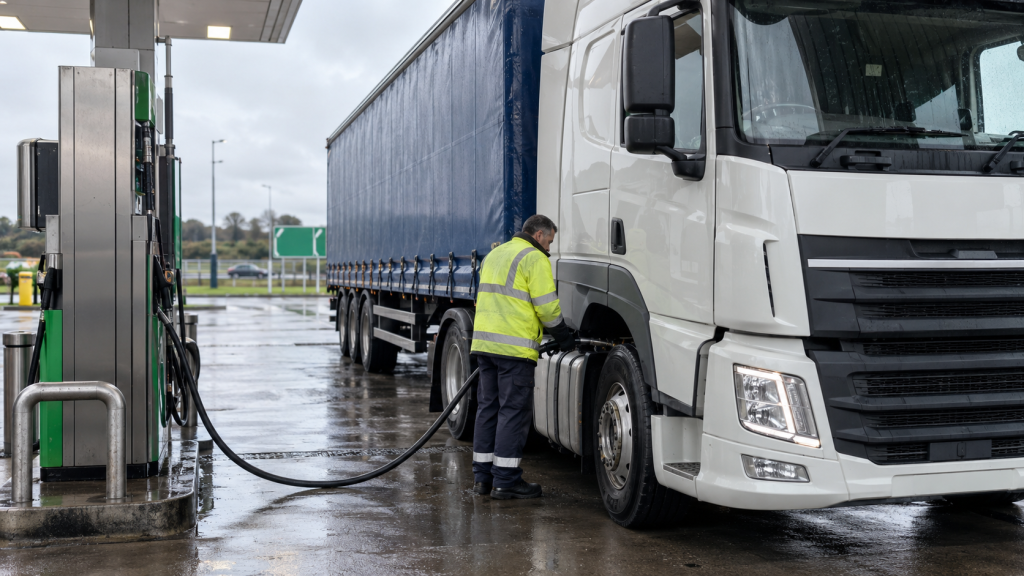
Europe’s road transport sector is under growing pressure. The energy and geopolitical crises triggered by the wars in Iran and Ukraine have pushed diesel prices sharply higher and renewed concerns about Europe’s dependence on imported oil.
At the same time, increasingly frequent extreme weather events are disrupting transport operations, damaging infrastructure and adding further pressure to already stretched supply chains.
Ireland faces a particularly difficult transition. As an island economy on the western edge of Europe, it depends heavily on road freight and ferry connections to move goods domestically and into its main export markets. Irish hauliers also operate predominantly small and medium-sized fleets, making the higher purchase cost of zero-emission trucks a significant obstacle.
Ireland has committed to reducing transport emissions by 50 per cent by 2030, compared with 2018 levels. However, the Government acknowledges that decarbonising the country’s heavy goods vehicle fleet—comprising approximately 40,000 vehicles and still almost entirely powered by diesel—will remain a major challenge. Ireland’s Climate Action Plan
The IRU and T&E have written jointly to President von der Leyen calling for renewed political leadership and a high-level dialogue involving transport operators, vehicle manufacturers, infrastructure and energy providers, and civil society.
The objective would be to address the practical and economic barriers preventing the widespread deployment of zero-emission trucks.
IRU EU Advocacy Director Raluca Marian said the EU had set a clear direction, but European and national policies must work together. She stressed that the operational and economic realities facing transport operators must be at the heart of the next phase of the transition.
T&E Executive Director William Todts described the diesel crisis as a wake-up call for Europe, arguing that expanding the use of electric trucks powered by clean, domestically generated electricity would reduce dependence on imported oil.
The intervention comes ahead of reviews of two important pieces of EU legislation: the Alternative Fuels Infrastructure Regulation, which supports the rollout of charging and hydrogen infrastructure, and the Heavy-Duty Vehicle CO₂ Standards, which establish emission-reduction targets for new trucks, buses and coaches.
For Ireland, the strategic dialogue must result in practical measures rather than additional targets imposed on operators. These should include a nationwide heavy-duty charging network, faster grid connections for transport depots, competitive electricity prices and meaningful financial assistance with the cost of purchasing zero-emission vehicles.
The Government’s emerging charging strategy provides a framework for developing Ireland’s EV infrastructure through to 2030, but truck operators need clarity on when high-powered charging facilities will be available at ports, motorway service areas, logistics centres and major freight hubs. Draft National EV Charging Infrastructure Strategy 2026–2028
Ireland must also recognise that battery-electric trucks will not immediately suit every route or operation. Renewable fuels, including HVO and biomethane, could play an important transitional role—particularly for long-distance, heavy-load and specialist transport operations.
Irish hauliers support the need to reduce emissions, but the transition must be commercially and operationally realistic. Without adequate charging infrastructure, affordable vehicles, stronger purchase incentives and a secure supply of competitively priced energy, zero-emission targets will remain beyond the reach of many operators.
Any EU strategic dialogue must therefore include a strong Irish voice and recognise the particular needs of peripheral and island economies. Ireland cannot afford a decarbonisation policy that increases costs, weakens competitiveness or leaves essential road transport operators behind.