Tachograph rules are a central part of life for professional HGV drivers in Ireland. They regulate driving time, breaks and rest periods, while providing an official record of a driver’s activities.
Failure to comply can result in roadside penalties, prosecution and enforcement action against both the driver and the transport operator. Drivers must therefore understand not only the daily driving limits, but also how to operate the tachograph correctly and keep complete records.
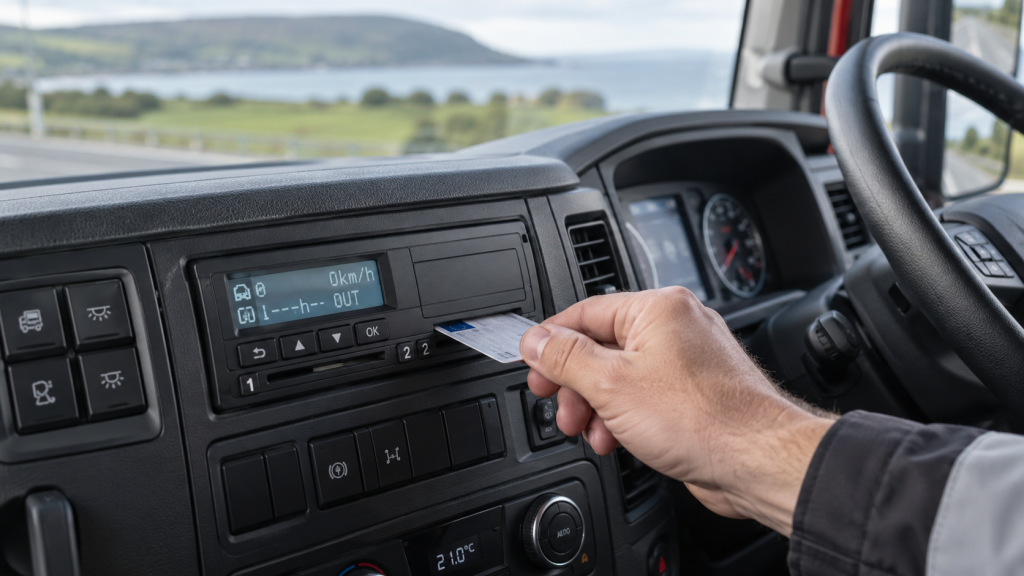 Who must use a tachograph?
As a general rule, a tachograph must be fitted and used when a vehicle is engaged in the carriage of goods and its maximum permissible mass—including any trailer or semi-trailer—exceeds 3.5 tonnes.
Since 1 July 2026, tachograph rules have also applied to vehicles or vehicle-and-trailer combinations exceeding 2.5 tonnes when used for international goods transport or cabotage. The extension does not generally cover light commercial vehicles used exclusively for domestic transport within Ireland.
Certain vehicles and operations are exempt, but drivers and operators should never assume that an exemption applies without checking the precise conditions.
HGV drivers’ hours at a glance
| Rule | Normal limit |
|---|---|
| Daily driving time | 9 hours |
| Extended daily driving | 10 hours, no more than twice a week |
| Weekly driving time | 56 hours |
| Driving over two consecutive weeks | 90 hours |
| Break after driving | 45 minutes after no more than 4½ hours |
| Regular daily rest | 11 continuous hours |
| Reduced daily rest | At least 9 hours |
| Regular weekly rest | At least 45 continuous hours |
| Reduced weekly rest | At least 24 hours, subject to compensation |
These are driving-time rules. They must be considered alongside working-time legislation, which also covers loading, unloading, vehicle cleaning, maintenance and other duties.
Daily driving limit
A driver may normally drive for a maximum of nine hours in a day.
This may be extended to 10 hours on no more than two occasions during a fixed week. A fixed week runs from 00:00 on Monday until 24:00 on Sunday.
The daily driving period is the total accumulated driving between the end of one daily or weekly rest period and the beginning of the next daily or weekly rest period.
For example, a driver could drive for four hours, take a qualifying break, drive for another three hours, carry out other work and then drive for a further two hours. The total daily driving time would be nine hours.
The 4½-hour driving rule
A driver must not drive for more than four-and-a-half hours without taking a qualifying break.
The required break is at least 45 minutes. It may be taken:
- As one continuous 45-minute break; or
- As a split break consisting of at least 15 minutes followed by at least 30 minutes.
The parts must be taken in that order. A 30-minute break followed by a 15-minute break does not satisfy the split-break requirement.
Once a qualifying 45-minute break has been completed, a new driving period of up to four-and-a-half hours begins.
A break must be a period during which the driver performs no driving or other work and uses the time exclusively for recuperation. Loading, unloading, paperwork, cleaning the vehicle or helping another driver with work cannot normally be counted as a break.
Weekly and fortnightly driving limits
A driver must not exceed:
- 56 hours of driving in any fixed week; or
- 90 hours of driving across any two consecutive fixed weeks.
The fortnightly limit often catches drivers who work a particularly busy first week. If a driver completes 56 hours in week one, only 34 hours may be driven in week two.
The limits apply to all in-scope driving, even where the driver works for more than one operator.
Daily rest periods
A regular daily rest period is at least 11 continuous hours.
It may also be split into two periods:
- The first period must be at least three uninterrupted hours; and
- The second must be at least nine uninterrupted hours.
This produces a total split daily rest of at least 12 hours.
A driver may reduce the daily rest period to at least nine continuous hours. No more than three reduced daily rest periods may be taken between two weekly rest periods.
Unlike a reduced weekly rest, a reduced daily rest does not normally have to be compensated later.
The required daily rest must generally be completed within each 24-hour period following the end of the previous daily or weekly rest.
Multi-manning
Where a vehicle is genuinely double-manned, each driver must normally take a new daily rest period of at least nine hours within 30 hours of the end of the previous daily or weekly rest.
During the first hour, the presence of the second driver is optional. After that, both drivers must generally be present in the vehicle, although one may take a break or period of availability while the other drives.
A driver sitting beside the person driving may record a break in qualifying circumstances, provided no work is being performed and the driver is free to recuperate.
Weekly rest periods
In any two consecutive weeks, a driver must take either:
- Two regular weekly rest periods of at least 45 hours each; or
- One regular weekly rest period of at least 45 hours and one reduced weekly rest period of at least 24 hours.
Any reduction below 45 hours must be compensated by an equivalent period of rest. The compensation must be taken in one uninterrupted block and attached to another rest period of at least nine hours before the end of the third week following the week in which the reduction occurred.
A weekly rest period must begin no later than the end of six consecutive 24-hour periods following the end of the previous weekly rest.
Weekly rest in the vehicle
A regular weekly rest period of 45 hours or more must not be taken inside the vehicle.
The same prohibition applies to a weekly rest period of more than 45 hours that includes compensation for an earlier reduction. The rest must be taken in suitable, gender-friendly accommodation with adequate sleeping and sanitary facilities.
The employer must meet the cost of accommodation away from the driver’s home.
A reduced weekly rest may be taken in a stationary vehicle if it has suitable sleeping facilities for each driver.
Operators engaged in international transport must also organise work so that drivers can return to their home or the operator’s operational centre for a regular weekly rest at least once in every four consecutive weeks, subject to the detailed rules applying to reduced rests taken abroad.
Ferry and train journeys
A regular daily rest period—and, in certain circumstances, a reduced weekly rest—may be interrupted when a driver accompanies a vehicle transported by ferry or train.
The rest may generally be interrupted no more than twice, with the interruptions totalling no more than one hour. The driver must have access to a sleeper cabin, bunk or couchette as required by the particular rule being used.
Drivers should record the ferry or train mode on the tachograph and retain supporting documents such as ferry tickets or booking records.
Recording activities correctly
A digital tachograph normally provides four principal activity modes:
- Driving: Automatically records when the vehicle moves.
- Other work: Loading, unloading, cleaning, maintenance, paperwork and other duties.
- Availability: Waiting time known in advance during which the driver is not required to work.
- Break or rest: Time used exclusively for recuperation.
Selecting the wrong mode can create an inaccurate record and may lead to an infringement. One of the most common mistakes is leaving the tachograph on “other work” or “availability” when a genuine break is being taken—or recording a break while carrying out work.
Drivers must also make manual entries for relevant activities that occurred while their card was not inserted. This may include other work, availability, breaks and rest completed before beginning the current shift.
Driver card responsibilities
A driver card is personal to the driver. It must not be loaned to another person or used to record somebody else’s driving.
Drivers should:
- Insert the card before beginning in-scope driving;
- Make accurate manual entries;
- Select the correct activity mode;
- Enter the country where the working period begins and ends;
- Add border-crossing information where it is not recorded automatically;
- Protect the card from loss or damage; and
- Produce the card and supporting records when requested by an enforcement officer.
Drivers operating analogue tachographs must use the correct chart and complete the required personal, vehicle and journey details.
How many days of records must a driver carry?
Drivers must be able to produce records covering the current day and the previous 56 days when checked at the roadside.
This can include:
- Data recorded on the driver card;
- Analogue tachograph charts;
- Manual records and printouts;
- Records of other work;
- Records of leave, sickness or rest where relevant; and
- Supporting documentation for exceptional circumstances.
The 56-day roadside record requirement replaced the previous 28-day period from 31 December 2024.
Lost, stolen or damaged driver cards
A lost, stolen, damaged or malfunctioning card must be reported promptly, and the driver must apply for a replacement within the required period.
Where permitted to continue driving temporarily without the card, the driver must produce printouts from the vehicle unit at the beginning and end of the journey or working period. These should be marked with the driver’s name, licence or card details and signature, together with any necessary manual activity entries.
Driving without a card is normally limited to a maximum of 15 calendar days, although a longer period may be allowed when necessary to return the vehicle to its base and the driver can prove why continued driving was necessary.
Vehicle-unit and card downloads
Operators are responsible for downloading, securely storing and analysing tachograph data.
In Ireland, digital driver-card data should generally be downloaded at least every 28 days, while vehicle-unit data should normally be downloaded at least every 90 days. Downloads may be required sooner when a driver leaves the business, a vehicle is sold or transferred, a card is due to expire, or enforcement officers request the data.
Operators must retain relevant tachograph records for at least one year. Longer retention may be necessary to comply with working-time, payroll, tax or other employment requirements.
Tachographs must also be inspected and recalibrated by an approved workshop at the prescribed intervals—normally at least every two years—and following certain repairs or changes affecting the recording system.
Smart Tachograph Version 2
Smart Tachograph Version 2 is now central to international road transport enforcement. It can record or assist with recording:
- Border crossings;
- Vehicle position at specified points;
- Loading and unloading events;
- Driving and rest activity; and
- Information that can support remote roadside checks.
The phased retrofit deadlines for heavy vehicles engaged in international transport passed during 2024 and 2025. Operators sending vehicles outside Ireland must therefore ensure that the vehicle has the correct generation of tachograph for the work being undertaken.
From 1 July 2026, Smart Tachograph Version 2 also became mandatory for affected vehicles above 2.5 tonnes used in international transport or cabotage.
Exceptional circumstances
A driver may depart from the normal driving-time rules where necessary to reach a suitable stopping place and ensure the safety of people, the vehicle or its load. This is intended for genuinely unforeseen events—not predictable traffic congestion, poor scheduling or pressure to complete a delivery.
Limited additional driving may also be permitted in exceptional circumstances to reach home or the operator’s operational centre for a weekly rest, provided the specific conditions are met. Where two additional hours are used, the driver must take an uninterrupted 30-minute break immediately before the additional driving.
The driver must manually record the reason for the departure on a tachograph printout, analogue chart or duty record no later than arrival at the suitable stopping place. Any extension must not endanger road safety, and the additional time must be compensated with equivalent rest within the prescribed period.
Working-time rules also apply
Tachograph compliance does not automatically mean that a driver has complied with the Road Transport Working Time rules.
For mobile workers, working time normally includes driving and other work. The general limits include:
- An average working week of no more than 48 hours;
- A maximum of 60 working hours in an individual week, provided the required average is maintained;
- No more than six hours of consecutive work without a break;
- A minimum 30-minute working-time break where total working time is between six and nine hours; and
- A minimum 45-minute working-time break where total working time exceeds nine hours.
Driving breaks can also count towards working-time break requirements when the relevant conditions are satisfied.
Tachograph exemptions
Some operations may qualify for an EU or Irish national exemption. Examples can include certain emergency, rescue, agricultural, utility, road-maintenance, vehicle-testing and non-commercial operations.
Several exemptions are limited by:
- The type or weight of the vehicle;
- The nature of the goods carried;
- The distance travelled from the operator’s base;
- Whether driving is the driver’s main activity; or
- Whether the operation is commercial.
An exemption from using a tachograph does not necessarily remove every obligation concerning working time, record-keeping or safe management of fatigue. Operators should obtain confirmation from the RSA where there is any doubt.
Enforcement in Ireland
Compliance is enforced through roadside checks and inspections at operators’ premises. RSA transport officers and An Garda Síochána can examine driver cards, charts, printouts, vehicle-unit data and supporting business records.
They may investigate:
- Excessive daily, weekly or fortnightly driving;
- Missing or insufficient breaks;
- Inadequate daily or weekly rest;
- Incorrect activity selections;
- Missing manual entries;
- Failure to use a driver card;
- Use of another person’s card;
- Failure to download or retain data; and
- Interference with or manipulation of a tachograph.
Enforcement can cover infringements detected in Ireland and, in appropriate circumstances, offences committed in other jurisdictions. Serious or repeated breaches may affect an operator’s compliance record and transport-operator licensing position.
Practical compliance checklist for drivers
Before moving the vehicle, make sure that:
- Your driver card is valid and inserted correctly;
- Manual entries are complete;
- The correct start country has been entered;
- The tachograph time and vehicle registration details are correct;
- You know how much driving and duty time remains;
- Previous reductions and compensation requirements have been checked; and
- You carry any charts, printouts or supporting records required for the previous 56 days.
During the day, check the activity mode whenever you change from driving to loading, availability, break or rest.
At the end of the shift, enter the finishing country, complete any manual records and review the day before removing the card.
Responsibility rests with drivers and operators
Drivers are responsible for using the tachograph correctly and complying with driving, break and rest limits. Operators must schedule work realistically, provide training, monitor records and take action when infringements occur.
A delivery schedule, customer deadline or instruction from a transport manager is not a defence for breaking drivers’ hours rules. Drivers should report schedules that cannot be completed legally and should never allow commercial pressure to override safety.
Tachographs are not simply administrative devices. Used properly, they protect drivers from excessive hours, help operators demonstrate compliance and reduce fatigue-related risk across the road transport industry.
Drivers and operators should consult the Road Safety Authority’s commercial vehicle resources and the European Commission’s driving-time and rest-period guidance for detailed official guidance.
This guide provides general information and should not be treated as legal advice. Individual exemptions and specialised operations should be checked directly with the RSA or an appropriately qualified transport-compliance adviser.