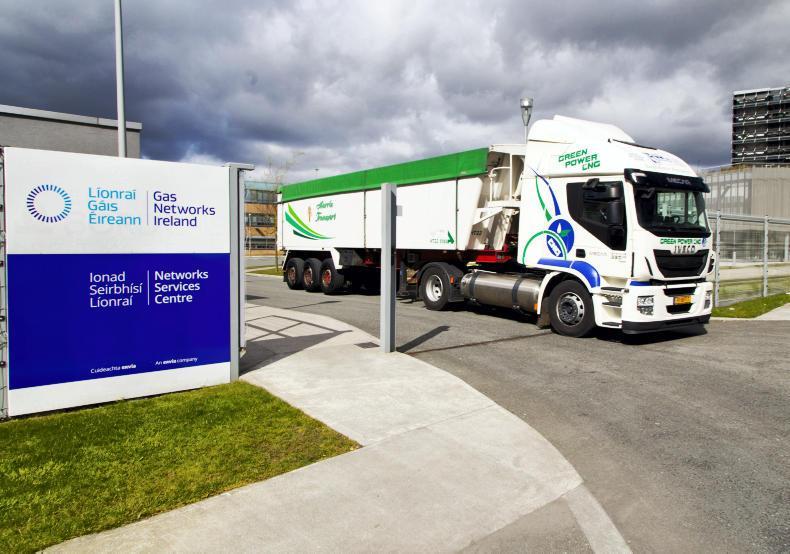
The GRAZE Vehicle Grant Scheme is an important Irish Government-backed initiative aimed at helping hauliers and commercial fleet operators move from diesel to gas-powered vehicles, particularly as Ireland looks to decarbonise the HGV sector.
What is GRAZE?
GRAZE stands for Green Renewable Agricultural Zero Emissions. It is led by Gas Networks Ireland and supported by Government funding.
The wider GRAZE project is designed to accelerate the development of renewable gas/biomethane in Ireland, while the vehicle grant specifically encourages commercial operators to put new CNG vehicles on the road.
The vehicle scheme has a €750,000 fund, with support for up to 75 vehicles in its first phase.
How much can a haulier get?
For HGV operators, the headline figure is up to €10,000 per vehicle.
The grant covers up to 40% of the additional cost of a gas vehicle compared with an equivalent diesel vehicle, where that cost difference exceeds €25,000.
| Vehicle | Maximum grant |
| Artic HGV >12t unladen | €10,000 |
| Rigid HGV >3.5t unladen | €10,000 |
| Large van >3.5t | €2,500 |
| Small van <3.5t | €1,500 |
| Waste collection vehicle >3.5t | €10,000 |
| Large passenger vehicle | €5,000 |
There is also an overall €100,000 maximum per applicant, with funding subject to the applicable State-aid/de minimis rules. An applicant can receive funding for up to 10 vehicles under the scheme.
Why is this particularly interesting for Irish haulage?
The really interesting part isn’t simply the €10,000 grant. It is the transition from CNG to BioCNG.
Gas Networks Ireland says switching from diesel to conventional CNG can reduce carbon emissions by up to 20%, while switching an HGV to renewable BioCNG can reduce emissions by up to 90%.
That potentially gives gas-powered HGVs a role as a bridge between today’s diesel fleet and the longer-term zero-emission transport sector.
For certain operations—particularly high-mileage regional and national haulage, waste collection and fleets where battery-electric HGVs are difficult to deploy—this is worth looking at seriously.
The infrastructure is growing
This is another important part of the story.
Ireland now has a growing network of CNG refuelling facilities. Gas Networks Ireland said in June 2025 that the number of CNG stations had reached 12, with strategic locations including Dublin, Cavan, Kildare, Limerick and Tipperary.
Gas Networks Ireland is also developing the infrastructure necessary to bring Irish-produced biomethane into the national gas network.
A major part of the GRAZE project is the Central Grid Injection facility at Mitchelstown, Co. Cork, which is being developed to allow biomethane produced at anaerobic digestion plants to enter the national network. The project has received more than €8.4 million in Climate Action Fund support.
There is evidence that operators are already taking it up
This isn’t just a theoretical scheme.
In July 2026, Gas Networks Ireland announced GRAZE funding support for Mr Binman, the Limerick-based waste management company, to expand its renewable-gas fleet.
Gas Networks Ireland also reported in 2025 that there were already more than 170 gas-powered HGVs on Irish roads, with HGV gas consumption having increased by more than 90% over the previous year.
Important conditions
The scheme is specifically targeted at new dedicated OEM CNG vehicles. Among the conditions are that:
- the applicant must be an Irish-registered business;
- the vehicle must be registered in Ireland;
- the vehicle must remain registered in Ireland for at least five years;
- the applicant must retain ownership for at least five years;
- the applicant must have valid Irish tax clearance;
- funding is subject to State-aid/de minimis restrictions.
Applications are made through Gas Networks Ireland, and submitting an application does not itself guarantee funding.
GRAZE Vehicle Grant Scheme – Gas Networks Ireland
The bigger story for Irish haulage
GRAZE is more significant than the €10,000 grant suggests.
It is effectively trying to establish a market for renewable gas-powered heavy transport in Ireland.
The strategy is:
Diesel → CNG → BioCNG/biomethane
The attraction is that the vehicle and refuelling technology can remain broadly the same while the fuel becomes progressively renewable.
That makes GRAZE particularly interesting in the debate over how Ireland decarbonises HGVs. Battery-electric trucks will undoubtedly have an important role, but for some long-distance and heavy-duty applications, BioCNG could provide a practical lower-carbon alternative without the weight, range and charging challenges associated with very large batteries.