Calls for the Government to reduce the cost of HVO for Irish hauliers are growing, but one important question remains: does Ireland really have to wait for Brussels before it can act?
The answer may be more complicated than simply saying EU rules prevent Ireland from reducing tax on renewable diesel.
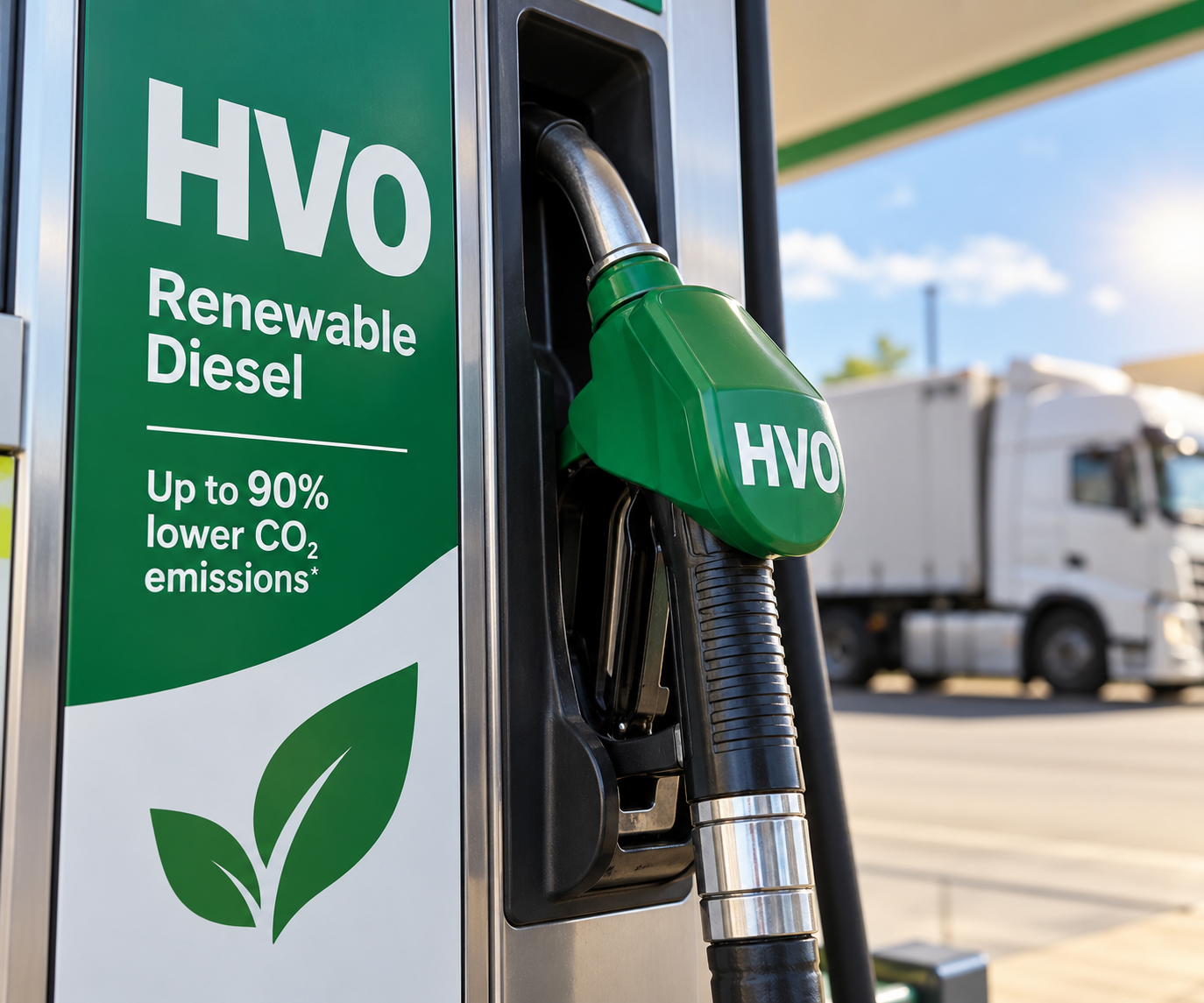
Ireland already gives qualifying HVO favourable tax treatment compared with fossil diesel. However, HVO used as a road fuel still carries a significant element of Mineral Oil Tax (MOT), raising the possibility that the Government could go considerably further under existing European rules.
For hauliers looking for an immediate way to reduce fleet emissions without replacing diesel trucks, that could be significant.
HVO still carries more than 18 cent per litre in excise
According to Revenue, qualifying HVO produced from biomass is exempt from the carbon component of Mineral Oil Tax.
However, it remains subject to the non-carbon component.
The current rate is €181.81 per 1,000 litres — equivalent to 18.181 cent per litre.
That compares with total Mineral Oil Tax of €371.85 per 1,000 litres on conventional road diesel.
HVO therefore already enjoys a substantial tax advantage, but there is still more than 18 cent per litre of excise remaining.
For a haulage company consuming 100,000 litres a year, that represents €18,181 in excise.
For larger fleets consuming 500,000 litres, the figure rises to more than €90,000.
The question for Government is obvious: could some or all of that remaining tax be removed?
EU rules may provide a route
Ireland cannot simply ignore European energy taxation legislation.
The EU Energy Taxation Directive sets the framework within which Member States tax fuels and establishes minimum taxation levels for many energy products.
However, the same legislation also contains specific provisions relating to biofuels.
Article 16 of Directive 2003/96/EC allows Member States, subject to conditions, to apply exemptions or reduced rates of taxation to certain products produced from biomass.
Importantly, the Directive provides scope for taxation resulting from these exemptions or reductions to fall below normal EU minimum levels.
That means the position is not simply that Ireland must wait for the EU to rewrite its entire energy taxation system before it can consider further HVO tax reductions.
There may already be a mechanism available.
Any Irish scheme would have to be carefully designed to comply with the Directive, sustainability requirements and EU State-aid rules, and engagement with the European Commission could still be necessary.
But that is very different from saying Ireland has no room to act.
Could Government remove the remaining HVO excise?
That is now the question worth asking.
If Ireland could legally remove the remaining 18.181 cent per litre MOT from qualifying sustainable HVO, it would immediately narrow the price gap between HVO and conventional diesel.
There would also be a secondary VAT effect because VAT is charged on the excise-inclusive fuel price.
At Ireland’s 23 per cent VAT rate, removing 18.181 cent of excise would reduce the VAT charged on that component by approximately another 4.18 cent.
The gross pump-price difference could therefore theoretically approach 22.4 cent per litre, assuming the tax saving was passed through completely.
For VAT-registered haulage businesses capable of reclaiming VAT, however, the more meaningful operating-cost saving would principally be the 18.181 cent excise reduction.
That is still substantial.
Why not create an HVO rebate for hauliers?
There is another possibility.
Rather than cutting HVO excise for every road user, Government could investigate a targeted mechanism specifically for commercial transport operators.
Ireland already operates the Diesel Rebate Scheme, under which qualifying road transport operators can reclaim part of the Mineral Oil Tax paid on diesel.
That raises an increasingly difficult policy question.
If Ireland is prepared to rebate some of the tax paid by hauliers on fossil diesel, why could it not investigate an equivalent — or more favourable — mechanism for qualifying sustainable HVO?
An HVO rebate could potentially be restricted to licensed commercial operators and linked to certified sustainable fuel.
It could also be capped, time-limited or reviewed annually to control the cost to the Exchequer.
Such a scheme would potentially give hauliers a direct financial incentive to reduce emissions while continuing to operate their existing diesel-powered trucks.
VAT is a different problem
It is important, however, to distinguish excise from VAT.
The Government has much less room to manoeuvre on VAT.
The Department of Finance has previously stated that HVO used as motor fuel must attract Ireland’s standard VAT rate under the existing EU VAT framework and that Ireland does not have discretion simply to introduce a reduced VAT rate for the fuel.
So if the objective is to make HVO substantially cheaper in the short term, excise appears to be the more realistic avenue for Government to investigate.
That distinction matters.
Saying “Europe won’t allow us to cut the tax on HVO” risks combining two separate taxes governed by different rules.
VAT presents a genuine European constraint.
Excise appears to offer considerably more scope for national intervention, although any proposed measure would still need to satisfy EU legal and State-aid requirements.
Government’s own HVO study highlights the challenge
There are other issues that cannot be ignored.
The Department of Transport’s assessment of HVO availability for Ireland’s heavy goods freight sector warned that simply encouraging greater HVO consumption in trucks could move existing renewable fuel supplies around the market rather than necessarily generating equivalent additional emissions reductions.
That means any major HVO incentive may have to be accompanied by changes to Ireland’s Renewable Transport Fuel Obligation to ensure additional demand translates into additional renewable fuel.
There is also the question of cost.
A permanent subsidy designed to completely equalise the price of HVO and fossil diesel across large volumes could become extremely expensive for the Exchequer.
But that is not necessarily what the haulage industry needs.
A targeted reduction in the 18.181 cent per litre excise currently imposed on HVO would be a much narrower intervention.
Ireland doesn’t necessarily have to wait for Brussels
This is ultimately where the debate needs to move.
Ireland may need to engage with the European Commission over the detailed design of any new HVO tax measure.
It would have to ensure that any reduction complies with European energy taxation, sustainability and State-aid rules.
But engaging with Brussels over an Irish HVO measure is not the same thing as waiting for Brussels to reform Europe’s entire fuel-tax regime.
Existing EU legislation already contains provisions allowing Member States to give qualifying biofuels preferential excise treatment.
Ireland is already using those provisions to some extent by exempting qualifying HVO from the carbon component of Mineral Oil Tax.
The obvious question is whether it could go further.
HVO could offer hauliers an immediate transition option
Battery-electric and hydrogen trucks will undoubtedly form part of the long-term decarbonisation of road freight.
But fleet replacement takes time, charging infrastructure remains limited and zero-emission heavy trucks still require significant capital investment.
HVO offers something different.
Where approved by the vehicle manufacturer, it can allow operators to reduce lifecycle greenhouse-gas emissions from existing diesel vehicles without immediately replacing the truck or fundamentally changing fleet operations.
The biggest obstacle remains price.
Government therefore has a straightforward question to answer:
Has it fully examined the scope available under existing EU rules to reduce or eliminate the remaining 18.181 cent per litre excise on qualifying HVO?
And if that cannot be done across the entire market, has it examined a targeted HVO rebate for licensed hauliers?
Ireland does not necessarily have to wait for an EU-wide tax reform to start answering those questions.
For an industry being asked to decarbonise while simultaneously battling high fuel costs, the case for finding out exactly how far Ireland can go under the existing rules has rarely been stronger.