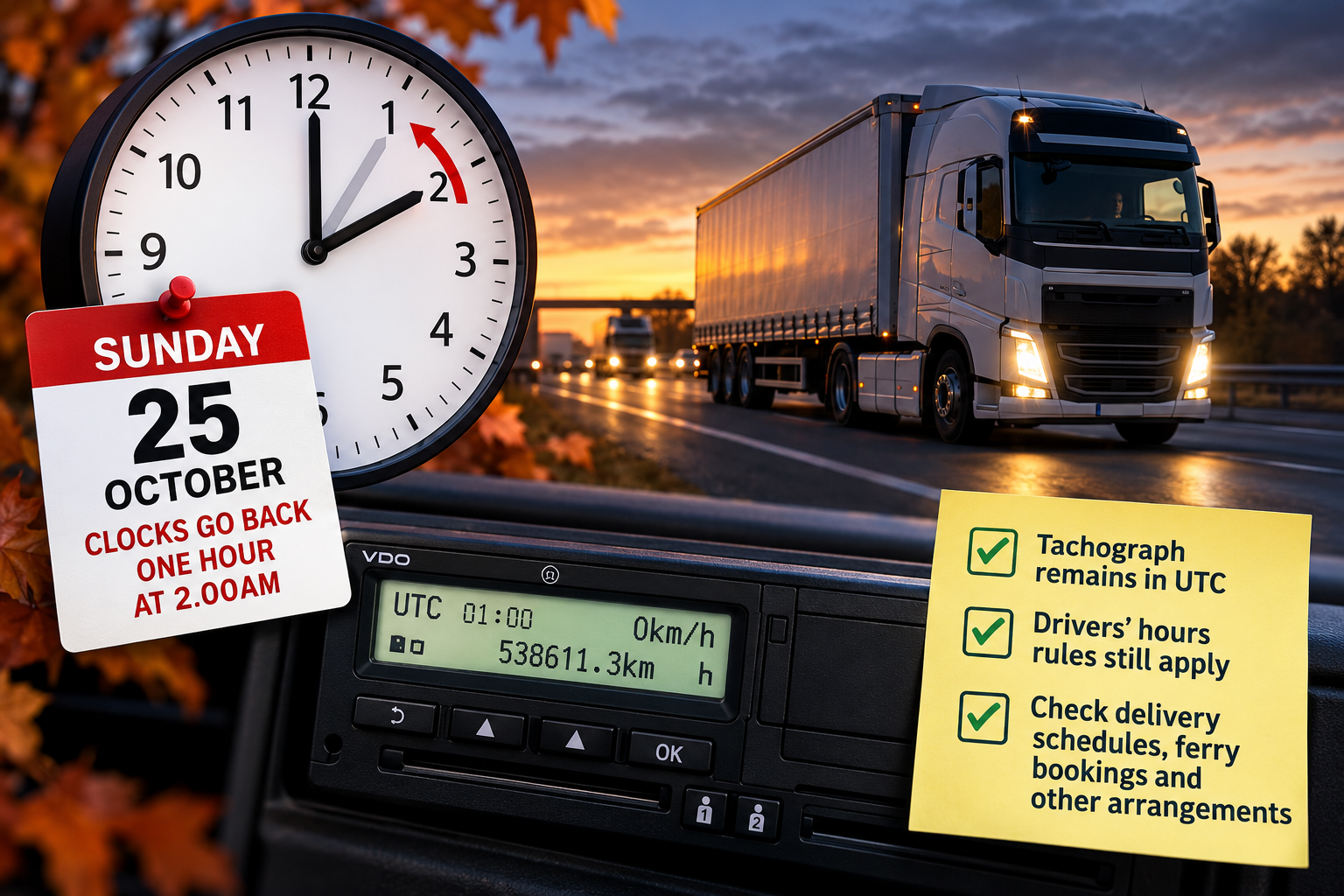
transport operators as the clockwent back one hour this Sunday morning, 25th October, marking the end of daylight saving time.
At 2.00am on Sunday, clocks in Ireland went back back to 1.00am, giving most people an extra hour in bed. However, for HGV drivers working through the night, the change brings some important considerations, particularly around tachograph settings, drivers’ hours and delivery schedules.
The IRHA is reminding drivers that while local time changes, the rules governing driving time, breaks and rest periods remain exactly the same.
Writing on its LinkedIn page, an IRHA spokesperson explained: “If you’re working through the night, your tachograph continues to record in UTC and the usual drivers’ hours and rest requirements still apply.
“An extra hour on local time doesn’t mean an extra hour of permitted driving.”
Tachographs continue to record in UTC
Digital tachographs record driving and rest activity using Coordinated Universal Time (UTC), which is not affected by the seasonal clock change.
While drivers may need to adjust the local time displayed on their tachograph, the underlying UTC recording remains unchanged.
The IRHA has highlighted the availability of online guidance to help drivers make the necessary adjustments to their tachograph displays.
Guidance is available for two commonly used tachograph systems:
- Siemens VDO: Tachograph guidance
- Stoneridge: Tachograph guidance
Drivers should familiarise themselves with the appropriate procedures for their particular tachograph model.
Extra hour does not mean extra driving time
The IRHA is emphasising that the clocks going back must not be confused with an extension to legally permitted driving hours.
Drivers must continue to comply with all applicable EU drivers’ hours regulations, including daily and weekly driving limits, mandatory breaks and minimum rest periods.
Although the clock change creates an additional hour in local time, it does not provide drivers with an extra hour of permitted driving.
Check ferry bookings and delivery schedules
The Association is also advising transport operators and drivers to double-check overnight transport arrangements to avoid confusion caused by the time change.
Particular attention should be paid to ferry departures, delivery appointments, collection times and other scheduled activities that span the overnight changeover.
The IRHA spokesperson added:
“Outside of the tacho, it’s also a good idea to double-check any overnight delivery schedules, ferry bookings or other arrangements that may have been made before the time change but to be completed afterwards – just to make sure there is no confusion on timing.”
For operators involved in international transport, particularly those using ferry services between Ireland, Britain and continental Europe, ensuring that drivers and traffic planners are working from the correct local times is especially important.
A simple check can prevent costly disruption
The IRHA’s message is straightforward: check tachograph settings, remain compliant with drivers’ hours regulations and confirm any time-sensitive transport arrangements.
A few minutes spent checking schedules and equipment could help prevent missed ferry departures, delayed deliveries or unnecessary confusion during the overnight change.
For further information, contact the Irish Road Haulage Association at info@irha.ie or telephone +353 (0)1 801 3380.