The European Commission has stepped up its monitoring of Europe’s increasingly strained diesel market, amid growing concerns over high fuel prices, global supply pressures and the impact on road transport operators.
Senior representatives from the European Commission and EU Member States met on 2 October under the Energy Union Task Force to assess diesel supplies, examine possible responses and coordinate action as fuel costs continue to put pressure on businesses across Europe.
While Brussels maintains that diesel supplies remain stable for the time being, it acknowledges that prices remain elevated because of tight conditions in global markets.
For Irish hauliers, already struggling with rising operating costs, the development raises an important question: will European intervention bring meaningful relief at the pumps, or will transport operators be left carrying the burden of another prolonged fuel-price crisis?
Energy
Diesel supplies stable – but prices remain stubbornly high
The Commission’s assessment suggests that Europe is not currently facing an immediate physical shortage of diesel.
However, the wider market remains under considerable pressure.
At a separate meeting on 29 September, the Commission’s Oil Coordination Group reported that commercial fuel stocks at the Amsterdam-Rotterdam-Antwerp trading hub were below their five-year average.
European refineries were operating close to maximum capacity, limiting their ability to increase production quickly in response to additional demand.
Although emergency oil stocks remain available, the Commission has warned that further disruption cannot be ruled out.
Emergency fuel reserves back on the agenda
The diesel crisis has also brought renewed attention to Europe’s strategic oil reserves.
On 2 October, G7 leaders agreed to implement a coordinated release of 100 million barrels of oil and petroleum products through the International Energy Agency over four months, including an accelerated release of diesel during the initial 20 days.
The agreement also called for greater coordination of refinery maintenance and efforts to increase production of refined fuels.
However, subsequent reporting on 7 October indicated that EU countries broadly viewed the G7 announcement as implementing previously agreed commitments rather than authorising an entirely new release of additional reserves.
European Commission Cyprus
The distinction matters because releasing emergency reserves may provide temporary market relief, but it cannot permanently resolve the underlying problems affecting diesel production and international supply chains.
US diesel export threat adds further uncertainty
The European diesel market is also facing uncertainty over potential restrictions on American diesel exports.
The Trump administration has considered limiting exports as part of efforts to address rising domestic fuel prices.
European officials have expressed opposition to such a move, warning that export restrictions could further destabilise international energy markets.
A restriction on American diesel exports could tighten the availability of refined fuel in Europe and potentially push wholesale prices higher.
The European Commission has stressed that any coordinated emergency stock release should take place through the International Energy Agency rather than through unilateral action by individual countries.
What does this mean for Irish hauliers?
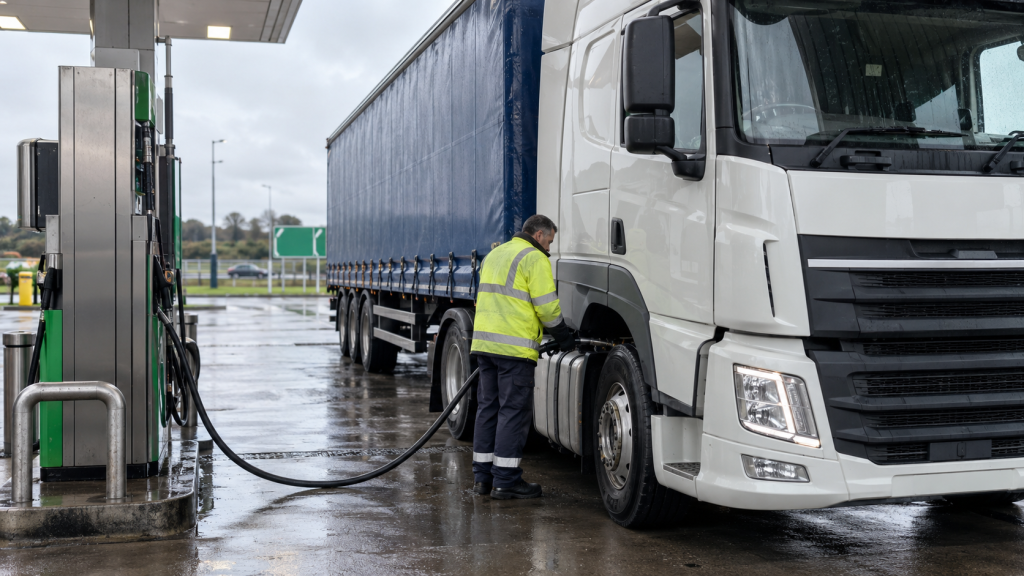
For Irish road transport operators, the immediate concern is the continued escalation of diesel costs.
Fuel remains one of the largest operating expenses for haulage businesses, particularly those involved in international transport, refrigerated distribution and long-distance freight.
Even relatively small increases can have significant financial consequences.
For example, a haulier purchasing 100,000 litres of diesel per month faces an additional €10,000 in monthly fuel costs for every 10-cent increase in the price per litre.
That equates to €120,000 annually if the increase is sustained.
These additional costs are particularly difficult for operators working under fixed-price transport contracts or where fuel surcharge mechanisms fail to reflect changes quickly enough.
The situation also places further pressure on cash flow, with operators frequently having to absorb higher fuel bills before recovering increased costs from customers.
Ireland has a role in European discussions
Ireland is particularly well placed to raise the concerns of its haulage industry, given its Presidency of the Council of the European Union during the second half of 2026.
Irish officials have already participated in discussions with European partners on the diesel market and possible emergency measures.
The Department of Climate, Energy and the Environment has acknowledged the exceptionally tight market conditions and confirmed Ireland’s involvement in coordinating the European response.
For the Irish haulage industry, however, the challenge goes beyond ensuring sufficient diesel supplies.
Operators also need greater certainty around fuel taxation, the Road Transport Support Scheme and the longer-term treatment of alternative fuels such as HVO.
While emergency oil releases may help moderate international prices, they do not directly address the full range of costs faced by Irish transport businesses.
Further EU discussions scheduled
The Commission’s Oil Coordination Group is scheduled to meet again on 15 October, with industry participation, to review market conditions and the security of European fuel supplies.
That meeting could provide a further indication of whether additional coordinated action is being considered.
For Irish hauliers, the outcome will be worth watching closely.
Europe may have sufficient diesel available today, but the combination of elevated prices, constrained refining capacity and international uncertainty means there is little room for complacency.
The key issue for the road transport industry is no longer simply whether Europe can maintain diesel supplies. It is whether hauliers can continue to afford the fuel needed to keep Europe’s supply chains moving.