Seven in ten European road transport operators say their customers are unwilling to pay more for greener freight services, raising serious questions about how the industry can finance its transition to low-emission transport.
A new survey from the International Road Transport Union (IRU) and Trimble reveals that rising vehicle costs have overtaken infrastructure shortages as the biggest obstacle to decarbonisation.
The 2026 Green Compact survey, involving more than 1,000 transport operators across 36 countries, found that 70 per cent of Western European operators and 71 per cent in Eastern Europe believe customers are unwilling to absorb the additional costs of greener transport.
IRU Secretary General Habib Turki warned that operators cannot be expected to finance the transition alone.
“The next phase of decarbonisation requires much greater investment. Operators cannot carry that cost alone, particularly when their customers are unwilling or unable to pay more for greener transport.”
Electric truck prices remain major obstacle
The cost of purchasing alternative-fuel vehicles has emerged as the industry’s biggest concern.
In Western Europe, 66 per cent of operators now identify vehicle prices as a barrier, compared with 49 per cent in 2025.
The situation is even more pronounced in Eastern Europe, where the figure has jumped from 52 to 78 per cent.
With battery-electric trucks costing two to three times as much as equivalent diesel models, the financial burden remains particularly challenging for smaller haulage businesses operating on tight margins.
Despite these difficulties, operators are already taking steps to reduce emissions.
Some 90 per cent of Western European operators have introduced at least one emissions-reduction measure, including route optimisation, fuel-efficient driving techniques and driver training.
However, only 41 per cent have established formal emissions-reduction targets.
HVO gaining ground
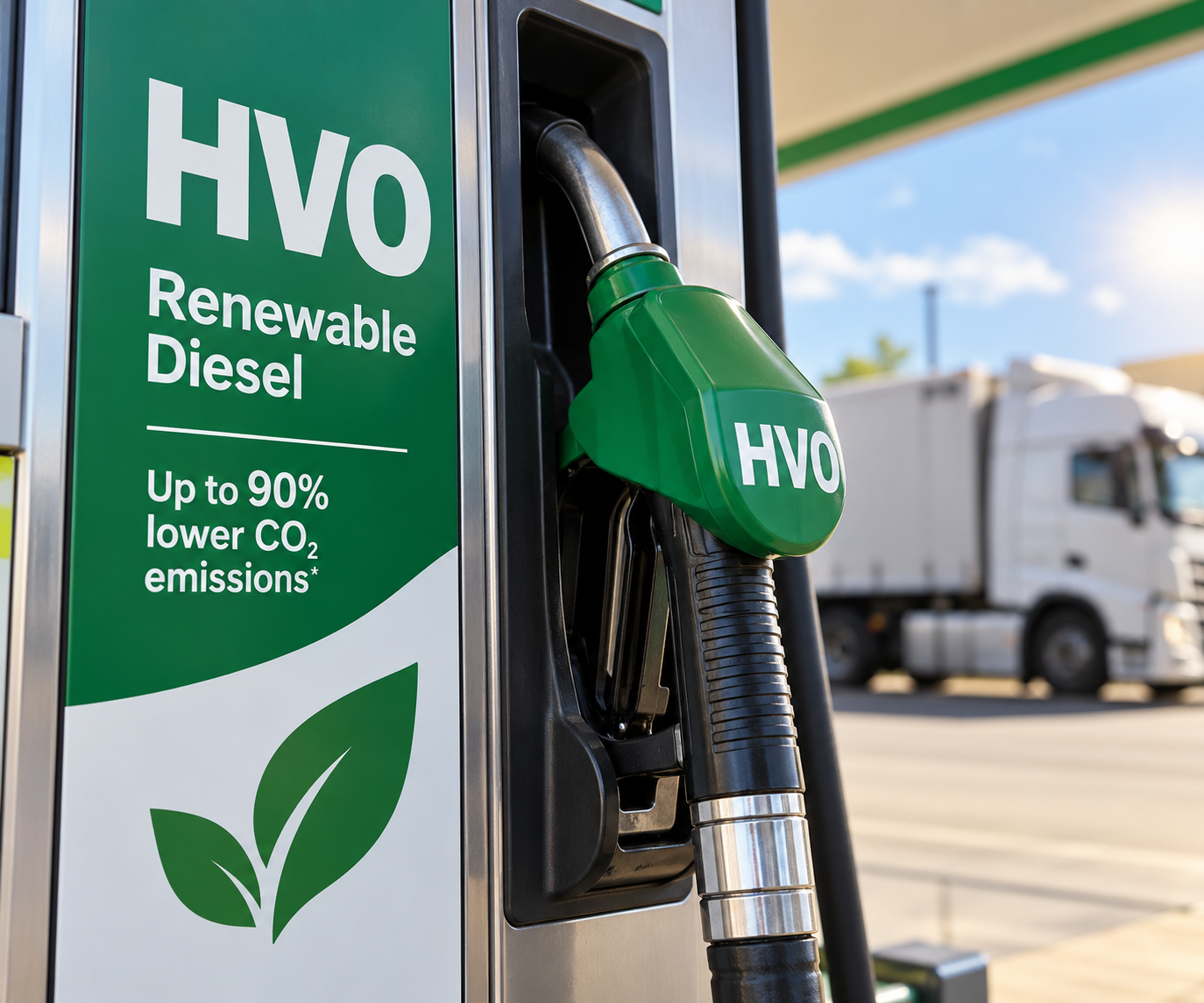
Hydrotreated Vegetable Oil (HVO) is emerging as an increasingly attractive option because it can be used in compatible existing diesel engines without major vehicle modifications.
The survey found that 29 per cent of Western European operators currently use HVO, with that figure expected to increase to 54 per cent within five years.
Meanwhile, 29 per cent are planning investments in battery-electric trucks.
However, investment intentions vary considerably according to company size and operating patterns, with larger fleets and regional transport operators significantly more likely to embrace electrification.
Infrastructure and government support
Charging infrastructure remains another significant challenge.
According to IRU estimates, Europe currently has just 1,225 public truck-capable charging stations, compared with an estimated requirement for 50,000 high-power charging points.
Operators also face lengthy delays securing electricity grid connections for depot charging facilities.
The survey highlights growing concerns about government incentives, with 38 per cent of Western European operators considering existing financial support insufficient.
For Irish hauliers, the findings underline the importance of affordable alternative fuels, realistic investment incentives and charging infrastructure capable of supporting commercial operations.
With European emissions regulations continuing to evolve, the central challenge is ensuring that smaller transport businesses are not priced out of the transition.
As Turki concluded: “Decarbonisation will move faster when it makes commercial sense for operators of all sizes.”