European truck toll costs have increased by approximately 20 per cent since 2023, adding another major expense for Irish hauliers already struggling with high diesel prices, driver costs and tightening margins.
The figure comes from analysis published by the International Road Transport Union (IRU), rather than an official EU-wide tariff. It reflects the general rise in toll charges across European road networks as countries expand distance-based charging and link HGV rates more closely to carbon dioxide emissions.
Toll regimes changed almost every month somewhere in the European Union during 2026, according to IRU, with further substantial changes scheduled for 2027.
For Irish international operators, the message is clear: European tolls can no longer be treated as a relatively predictable background cost.
Kilometre and CO₂ charges expanding
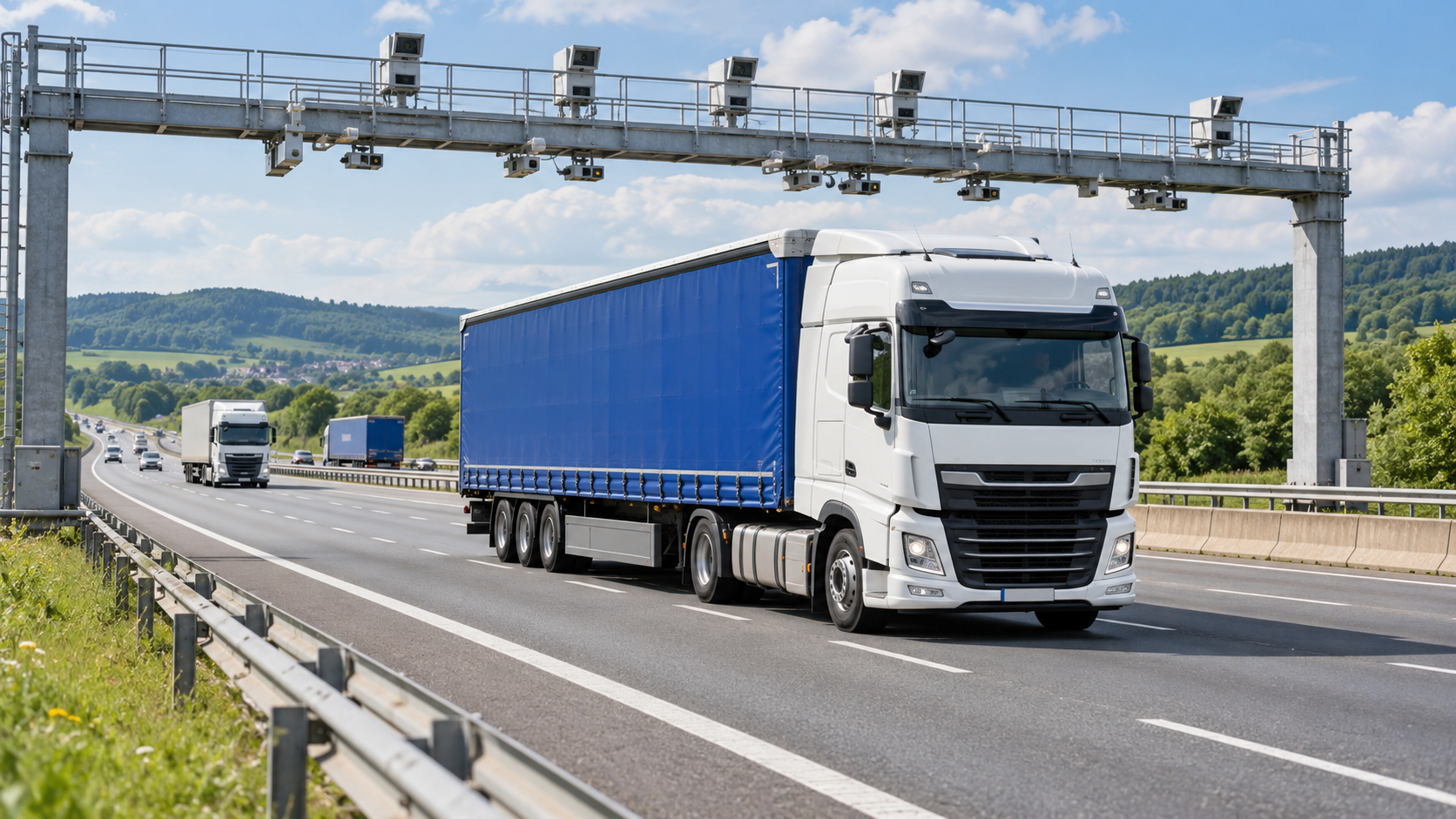
European countries operate a patchwork of motorway tolls, vignettes, satellite-based charging systems and bridge or tunnel fees. The amount payable can depend on:
- Distance travelled
- Vehicle weight and axle configuration
- Euro emissions standard
- Registered CO₂ class
- Road type and location
- Time of travel
- National inflation adjustments
The Netherlands replaced its Eurovignette with kilometre-based truck charging during 2026. Its tariffs will increase by 2.6 per cent from 1 January 2027 through an inflation adjustment. Trucktoll
Flanders has introduced a CO₂-related toll component, while other countries have changed chargeable road networks, vehicle classifications and onboard-unit requirements.
Further reforms are expected in countries including Lithuania, Slovakia, France and Croatia during 2027. Operators must therefore check each country separately rather than applying one general “European toll” allowance to international work.
Shortest route may not be the cheapest
The growing difference between national toll regimes changes how European journeys should be planned.
A route with fewer kilometres may carry higher charges than a longer alternative. The final calculation can also differ substantially between an older Euro VI truck, a newer vehicle assigned to a better CO₂ class and a zero-emission HGV.
Vehicle registration data must be accurate. If a toll provider does not hold the necessary CO₂ or technical information, a truck could be placed in a more expensive default category.
Irish fleet operators should ensure that registration documents, axle details, maximum permissible mass and emissions information supplied to toll-service providers are complete and current.
Fixed rates risk absorbing the increase
The immediate commercial question is whether hauliers are recovering these rising charges from customers.
Fuel-surcharge clauses do not normally cover road tolls. Operators working under fixed-price contracts could therefore be absorbing repeated national increases unless agreements contain a separate mechanism for tolls, ferry charges and other statutory route costs.
Quotations for continental work should identify tolls as a variable or separately indexed expense. Transport managers should also compare the toll calculation used when a job was priced with the amount ultimately charged by the onboard unit.
The cost should be assessed across the complete journey—including repositioning and empty running—not simply the loaded section invoiced to the customer.
More increases are coming
Europe’s tolling direction is firmly towards kilometre-based charging and wider use of CO₂ differentiation. The policy is intended to make cleaner vehicles less expensive to operate relative to higher-emitting trucks.
However, the financial incentive works only where operators can purchase suitable vehicles, access dependable charging infrastructure and obtain a competitive total cost of ownership.
For Irish hauliers, the practical priority is more immediate: update route-costing systems, verify every truck’s classification and ensure that European toll increases are passed through rather than quietly deducted from already narrow margins.