With diesel remaining one of the biggest costs facing any haulage operation, operators looking to improve fuel economy should not overlook the part of the truck actually in contact with the road – the tyres.
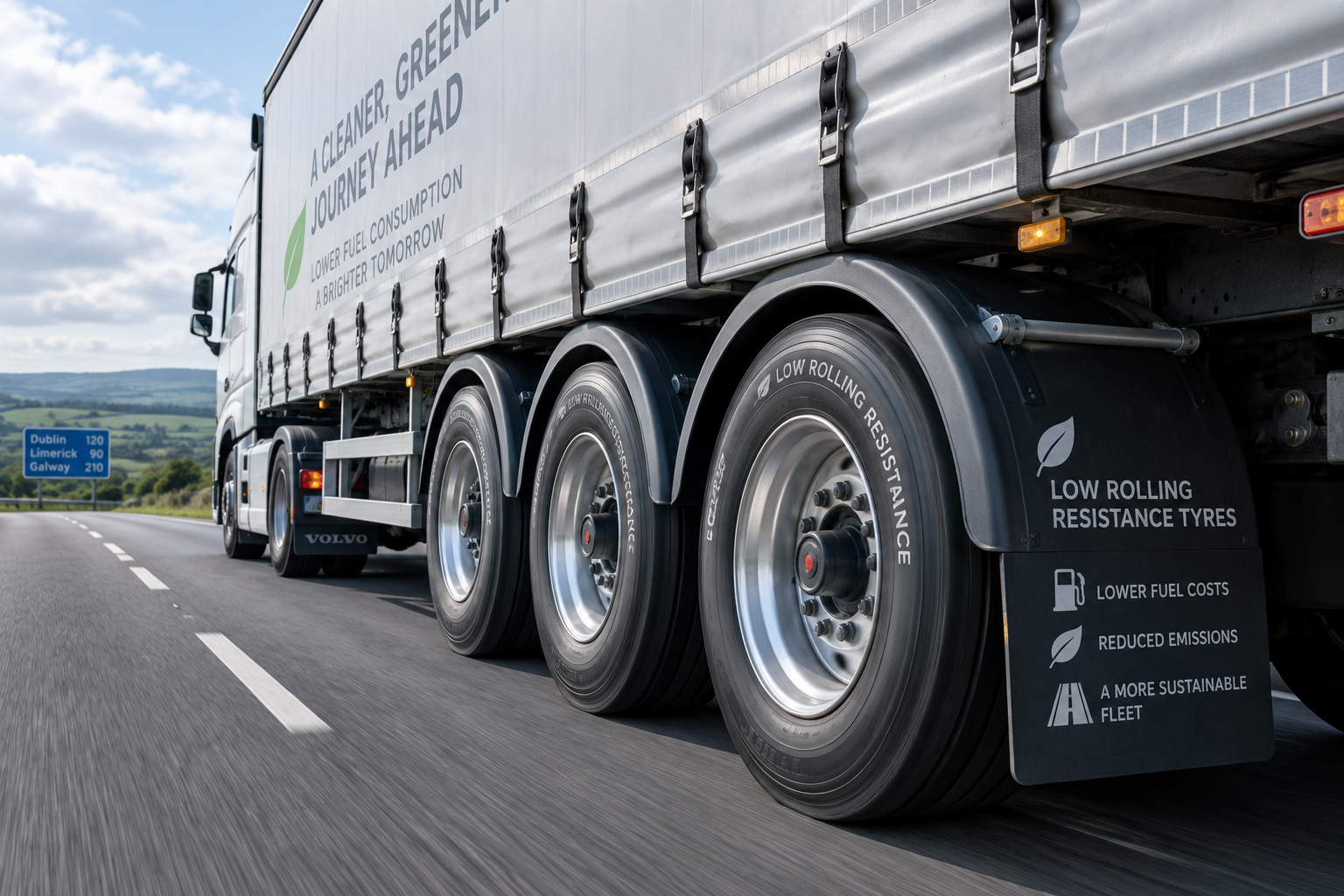
Low rolling resistance (LRR) truck tyres are designed to reduce the amount of energy lost as a tyre rolls, helping a truck travel further using the same amount of fuel.
For high-mileage HGVs, even a relatively small improvement in fuel consumption can translate into a worthwhile annual saving.
What is rolling resistance?
As a truck tyre rotates, it continually flexes and deforms where it meets the road. Some of the energy required to deform the tyre is converted into heat and lost.
This is known as rolling resistance.
The greater the rolling resistance, the more energy the engine has to produce to keep the vehicle moving. Reduce that resistance and, all other things being equal, less fuel is required.
The effect is significant. Depending on the application and operating conditions, rolling resistance can account for roughly 15 to 35 per cent of a truck’s fuel consumption.
That makes tyres an important part of any fleet’s fuel-efficiency strategy.
How do low rolling resistance tyres work?
Tyre manufacturers use combinations of advanced rubber compounds, tread designs, casing construction and other technologies to reduce the amount of energy lost as the tyre flexes.
The objective is straightforward: allow the tyre to roll more efficiently while maintaining the grip, durability, load capacity and mileage required from a commercial vehicle tyre.
For a long-distance truck covering 100,000 km or more annually, seemingly small differences in rolling resistance can accumulate into substantial savings.
As one example, Michelin estimates that moving from a C-rated to a B-rated truck tyre can produce fuel savings of around 0.6 litres per 100 km in certain applications. Actual savings will vary according to vehicle, tyre position, route, load, pressure, driving style and operating conditions.
At 120,000 km a year, a 0.6 litre/100 km reduction would equate to around 720 litres of fuel annually.
Multiply that across a fleet and tyre choice starts becoming a much bigger financial decision.
Check the EU tyre label
One of the simplest ways of comparing the energy efficiency of new truck tyres is the EU tyre label.
C3 tyres, the category commonly used on trucks and buses, are rated for rolling resistance from A to E, with A representing the lowest rolling resistance. The label also provides information on wet grip and external rolling noise.
Operators therefore shouldn’t look at rolling resistance in isolation. Wet grip, durability, mileage potential and suitability for the intended application remain important considerations.
A tyre that produces excellent fuel economy but is unsuitable for the work being undertaken is unlikely to deliver the lowest overall operating cost.
Don’t forget the trailer
Fuel-efficient tyre selection shouldn’t stop at the tractor unit.
Every tyre on a tractor and trailer contributes to the overall rolling resistance of the combination.
That means trailer tyres deserve attention too, particularly on vehicles spending much of their working lives covering long motorway distances.
When purchasing tyres, operators should therefore consider the efficiency of the complete combination, rather than concentrating solely on the steer and drive axles.
Tyre pressure can undo the savings
There is little point investing in fuel-efficient tyres and then running them incorrectly inflated.
An under-inflated tyre deforms more as it rotates. This increases rolling resistance, generates additional heat and can increase fuel consumption as well as contributing to premature or irregular tyre wear.
Michelin estimates that on a typical long-distance tri-axle semi-trailer, just one under-inflated tyre can increase the vehicle’s overall fuel consumption by around 1.7 per cent under the conditions it cites.
Regular pressure checks – or the use of tyre pressure monitoring systems – should consequently form part of a fleet’s fuel-saving programme.
Correct wheel alignment is important too. A poorly aligned axle effectively forces tyres to scrub against the road rather than roll cleanly, wasting energy and accelerating wear.
Cheapest tyre doesn’t necessarily mean lowest cost
Purchase price remains important, but judging a truck tyre purely by its invoice price can be false economy.
The real calculation should consider cost per kilometre and total operating cost.
A more expensive tyre that delivers better mileage, lower rolling resistance, strong casing integrity and good retreadability may ultimately cost considerably less to operate than a cheaper alternative.
Fuel consumption is particularly important because the tyre is purchased once, while the truck continues consuming fuel every day it is working.
Even a small fuel penalty can eventually outweigh the saving made by buying a cheaper tyre.
Low rolling resistance also means lower emissions
The benefits aren’t restricted to the diesel bill.
If a truck burns less fuel to cover the same distance, it also produces less CO2.
This makes low rolling resistance tyres one of the relatively straightforward measures fleets can adopt to reduce the carbon intensity of existing diesel vehicles without replacing trucks or making major changes to their operation.
The same principle is increasingly important for battery-electric trucks. Lower rolling resistance reduces the energy required to move the vehicle and can therefore contribute to improved driving range.
Driver behaviour still matters
Low rolling resistance tyres aren’t a magic solution.
Their benefits can easily be eroded by aggressive acceleration, excessive speed, harsh braking, prolonged idling, poor route planning or incorrect tyre pressures.
The strongest results come when efficient tyres form part of a broader fuel-management strategy incorporating:
- correct tyre pressures and regular inspections;
- good wheel and axle alignment;
- aerodynamic equipment;
- preventative vehicle maintenance;
- driver training and eco-driving;
- sensible speed management;
- effective route planning; and
- monitoring fuel consumption on a vehicle-by-vehicle basis.
Measure the results
Operators considering switching to lower rolling resistance tyres should measure the results rather than relying solely on theoretical savings.
Fuel consumption should be monitored over a meaningful distance, preferably comparing vehicles carrying out similar work with similar loads.
Telematics and fuel-management systems can make this much easier.
For larger fleets, controlled tyre trials can provide valuable information about fuel consumption, tyre mileage, wear patterns and overall cost per kilometre.
The lowest rolling resistance tyre isn’t automatically the best tyre for every application. A long-haul motorway fleet will have different requirements from a tipper, refuse vehicle, construction truck or vehicle working predominantly on regional roads.
The objective should be to find the best balance between fuel efficiency, mileage, grip, durability and purchase cost.
Small percentage, big saving
Fuel economy improvements of one or two per cent may not sound particularly dramatic.
But haulage is a high-mileage, high-fuel-consumption business.
If a truck consumes 30 litres/100 km and covers 120,000 km annually, it will use approximately 36,000 litres of fuel a year.
A two per cent reduction represents around 720 litres of diesel saved per truck per year.
Across ten trucks, that’s around 7,200 litres.
That is why rolling resistance deserves much more attention when fleets specify replacement tyres.
The tyre bill may be highly visible when it arrives.
The additional diesel consumed by inefficient tyres is much harder to see – but over hundreds of thousands of kilometres, it could prove considerably more expensive.
HGVIreland.com Tip: When buying your next set of truck tyres, don’t ask only, “How much are they?” Ask about the EU rolling-resistance rating, expected mileage, suitability for your operation and estimated cost per kilometre. The cheapest tyre to buy isn’t necessarily the cheapest tyre to run.