A trailer swap, a different load or a raised piece of equipment can change the height of your truck. Before every journey, know the height of the vehicle you are actually driving—and check that the route will accommodate it.
A bridge strike can happen in seconds. The consequences can last much longer: injury, damage to the vehicle and infrastructure, a missed delivery and disruption for everyone using the road or railway.
Knowing your truck’s height sounds straightforward. In practice, the answer can change during a working day. The tractor may be familiar, but the trailer might not be. A load may sit above the trailer roof. A collection may alter the vehicle’s dimensions before the return trip.
Here is how drivers and operators can make the height check part of every journey.
Which height do you need to know?
The figure that matters is the overall travelling height: the distance from the road surface to the highest point of the vehicle or its load in the condition in which it will travel.
That highest point might be the trailer roof, a refrigerated unit, roof mounted equipment, a vehicle being carried on a transporter or part of a load extending above the body. Checking the tractor or trailer specification alone may miss it.
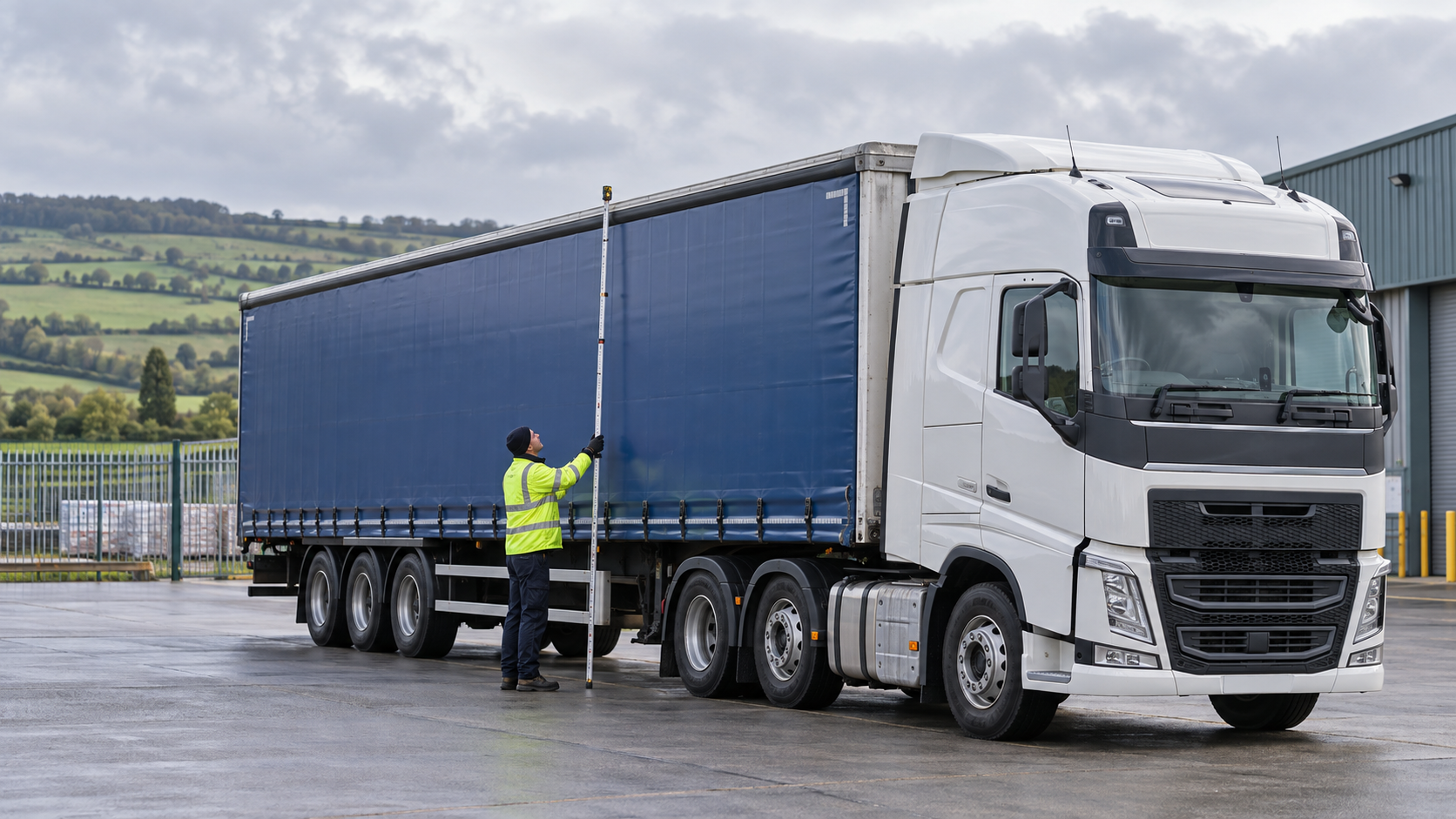
If the height has not been established for the current combination, do not rely on a figure from a previous vehicle or job. Arrange for the combination to be measured safely on level ground, using the operator’s agreed procedure and suitable equipment. Record the result clearly for the driver. If there is any doubt about a projection or the measurement, resolve it before departure.
When should you check it?
Check the height whenever something could have changed:
- At the start of a journey in a vehicle or combination you have not already verified.
- After coupling to a different trailer.
- After loading, particularly with machinery, stacked goods or vehicles.
- After collecting or repositioning a load during a multi-drop trip.
- After a change to equipment that could affect the highest point.
The key question is not “What height is this model of truck?” It is “What height is this combination, with this load, right now?”
Keep the figure visible in the cab
Once confirmed, the height should be easy for the driver to find and read. An in-cab height indicator or a clearly displayed record helps when a restriction sign appears ahead.
Make sure the displayed figure matches the current vehicle and load. An old height card left in the cab after a trailer change could be worse than no card at all. Operators should have a simple process for updating the figure and drivers should confirm it during their pre-departure checks.
Where journeys cross between Ireland, Northern Ireland and Britain, drivers may encounter clearance signs in metres or feet and inches. Read the unit on the sign carefully. If you need to convert a figure, use a reliable conversion method; do not make a rough mental estimate when clearance is tight.
Plan the complete route
Height is a route-planning issue as well as a vehicle check. A truck may have no difficulty on the main road and still encounter a low bridge or restricted access road on the final approach to a delivery.
Before setting off, check the route to the customer’s entrance, not just the town or postcode. Pay particular attention to unfamiliar destinations, diversions and routes suggested after a missed turning. If the customer has an approved HGV approach, get those instructions in advance and pass them to the driver.
HGV-specific navigation can help with planning, provided the vehicle dimensions entered are correct. It is still an aid: the driver must respond to the signs and conditions encountered on the road. Network Rail’s bridge-strike prevention guidance stresses both knowing vehicle height and planning routes around low bridges.
Read the restriction before committing
A height sign is a point to make a decision, not an invitation to “try it for size”. Slow down in good time and compare the signed clearance with the confirmed travelling height.
Take particular care at arched bridges, where clearance can vary across the roadway. Follow the signs and road markings that apply to the approach. Do not assume that moving towards the centre of the road will make an uncertain passage safe.
If the figures are close, unclear or inconsistent, stop at a safe place before the bridge. Do not proceed on the assumption that the measurement or sign is approximate enough to allow passage.
What if the planned route is blocked?
Roadworks, closures and diversions can send a driver away from a checked route. Treat the replacement route as a new route that needs checking. A car sat nav’s quickest alternative may lead to a road unsuitable for an HGV.
If a low bridge appears unexpectedly:
- Stop in a safe location before committing to the approach.
- Check the height record and the restriction sign.
- Contact the transport office or seek a suitable alternative route if clearance cannot be confirmed.
- Avoid reversing or turning in a dangerous location; seek appropriate assistance where necessary.
A delay can be explained to a customer. A collision with a bridge is far harder to put right.
If a bridge is struck
Stop safely. Do not assume the bridge is sound because the vehicle can still move or the damage looks minor. Warn others where safe to do so, contact the emergency services when there is a danger to people or traffic, and report the incident to the relevant bridge or railway authority through the appropriate emergency channel. Inform the operator and follow its incident procedure.
Railway bridges in particular may need inspection before trains can pass safely. Prompt reporting allows the infrastructure owner to assess the structure and manage the risk.
A check for the whole transport operation
Drivers make the final decisions on the road, but they need accurate information from the people who plan, load and dispatch the vehicle. A useful operator procedure should establish who confirms the height, when it must be updated, how the driver receives it and what to do when a route is uncertain.
It should also make it easy for a driver to stop and ask for another route. Pressure to meet a delivery slot must never turn an uncertain clearance into a gamble.
Before the next departure, ask three questions: What is my actual travelling height? Is that figure current and visible in the cab? Has the whole route—including the final approach—been checked? Those few checks could prevent a costly and dangerous bridge strike.