With fuel remaining one of the biggest operating costs for Irish haulage companies, the way an HGV is driven can have a significant impact on fuel consumption, emissions and vehicle wear.
Eco-driving is not about driving slowly or compromising safety. It is about driving smoothly, anticipating what is happening ahead and making the most efficient use of the vehicle’s momentum.
Here are 10 practical eco-driving tips for HGV drivers in Ireland.
1. Accelerate smoothly
Avoid harsh acceleration when moving away from traffic lights, junctions and roundabouts. Gradually building speed allows the engine and transmission to work more efficiently while reducing unnecessary fuel consumption.
2. Look well ahead
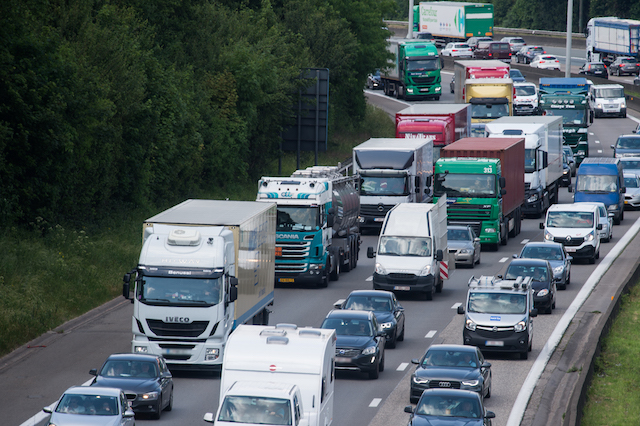
Good observation is one of the most effective eco-driving techniques. By looking further up the road, drivers can anticipate traffic lights, queues, roundabouts and slowing traffic.
Rather than accelerating towards a queue and then braking heavily, ease off the accelerator early and allow the vehicle to slow naturally where it is safe to do so.
3. Maintain a steady speed
Constant acceleration and braking wastes fuel. Where traffic and road conditions allow, try to maintain a consistent speed.
On motorways, avoiding unnecessary speed changes can make a noticeable difference to fuel consumption.
4. Avoid unnecessary idling
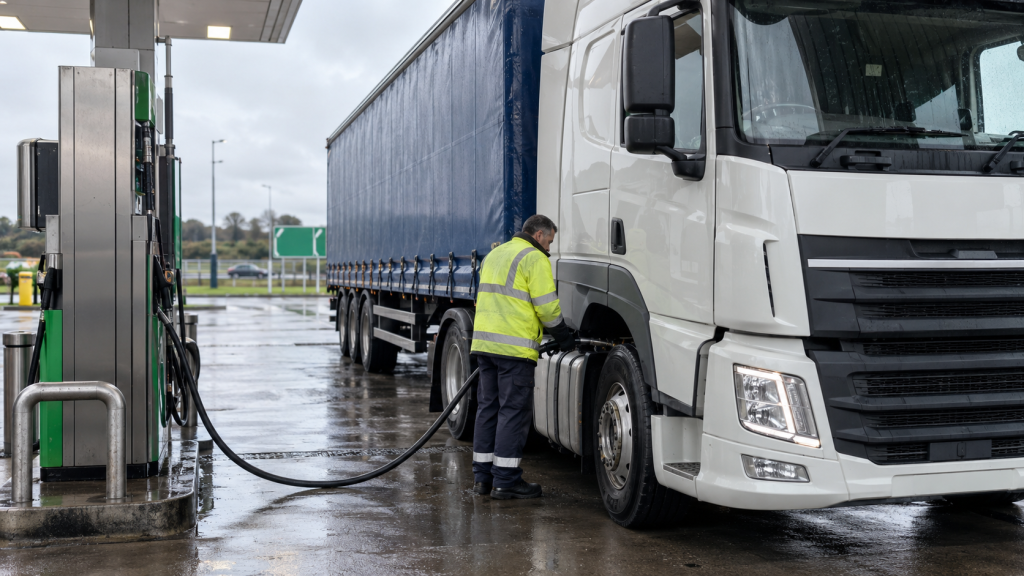
An HGV can consume several litres of fuel every hour while idling, even though it is going nowhere. Unless there is a genuine operational or safety reason to keep the engine running, avoid unnecessary idling during loading, unloading and waiting periods.
5. Use momentum
Think ahead and make the most of the vehicle’s momentum. If you know you are approaching a roundabout, junction or slower-moving traffic, lifting off the accelerator earlier can reduce the need for heavy braking.
Every time energy is converted into heat through braking, fuel has effectively been wasted.
6. Use the correct gear
Modern automated transmissions are designed to select efficient gears, but drivers should still understand how their vehicle performs under different loads and road conditions.
Avoid unnecessarily high engine speeds and allow the transmission to select the most appropriate gear whenever possible.
7. Check tyre pressures
Tyre pressure has a direct effect on rolling resistance and fuel consumption. Under-inflated tyres require more energy to keep moving and can also increase tyre wear.
A regular tyre-pressure check should therefore be part of every HGV driver’s daily vehicle inspection.
8. Plan the route
Route planning can save both time and fuel. Where possible, avoid unnecessary congestion, roadworks and stop-start traffic.
For Irish operators, choosing the most suitable route around busy urban areas such as Dublin can make a considerable difference over the course of a working week.
9. Use cruise control wisely
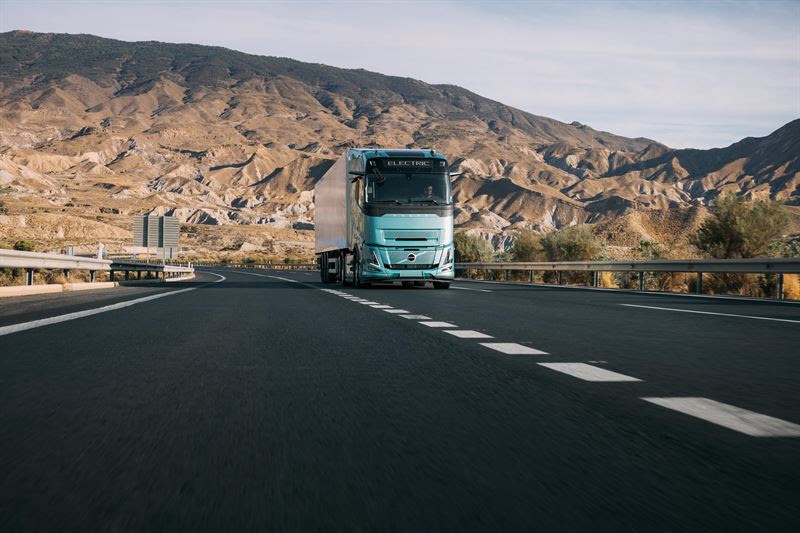
On suitable stretches of motorway and national road, cruise control can help maintain a steady speed and prevent unnecessary acceleration.
However, drivers should always use it according to road, weather and traffic conditions and remain fully alert to what is happening around the vehicle.
10. Learn from telematics
Fleet telematics can provide valuable information about individual driving performance. Data on fuel consumption, idling, acceleration, braking and speed can help drivers identify areas for improvement.
Used positively, telematics should be a coaching tool rather than simply a way of monitoring drivers.
Small changes can make a big difference
Eco-driving is ultimately about anticipation, smoothness and efficiency. A small reduction in fuel consumption on one journey may not seem significant, but multiplied across thousands of kilometres and an entire fleet, the savings can quickly add up.
For HGV drivers, the best approach is simple: look ahead, drive smoothly, maintain the vehicle properly and avoid wasting energy wherever possible.
The result can be lower fuel bills, reduced emissions, less vehicle wear and a more efficient haulage operation.
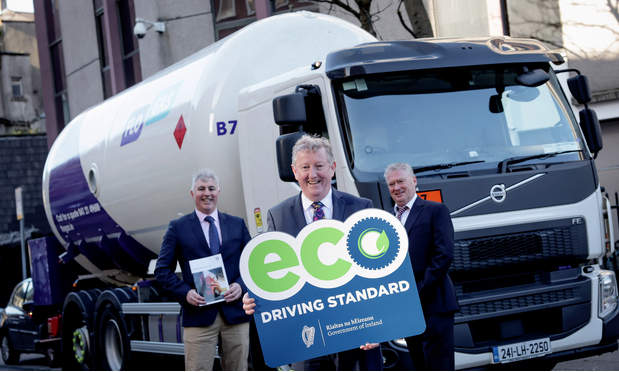
Ireland’s HGV Eco-Driving Standard, which was officially launched in February 2025 is a national framework designed to bring greater consistency and quality to eco-driving training for heavy goods vehicle drivers.
It was developed by the Chartered Institute of Logistics and Transport (CILT) for the Department of Transport and forms part of the Government’s Road Haulage Strategy 2022–2031.
What is the purpose of the standard?
The central aim is to ensure that HGV eco-driving courses deliver measurable and lasting improvements, rather than simply teaching drivers a list of fuel-saving tips.
The standard focuses on three main areas:
- Reducing fuel consumption
- Improving energy management
- Improving vehicle maintenance efficiency
These can reduce operating costs and emissions while also contributing to safer driving.