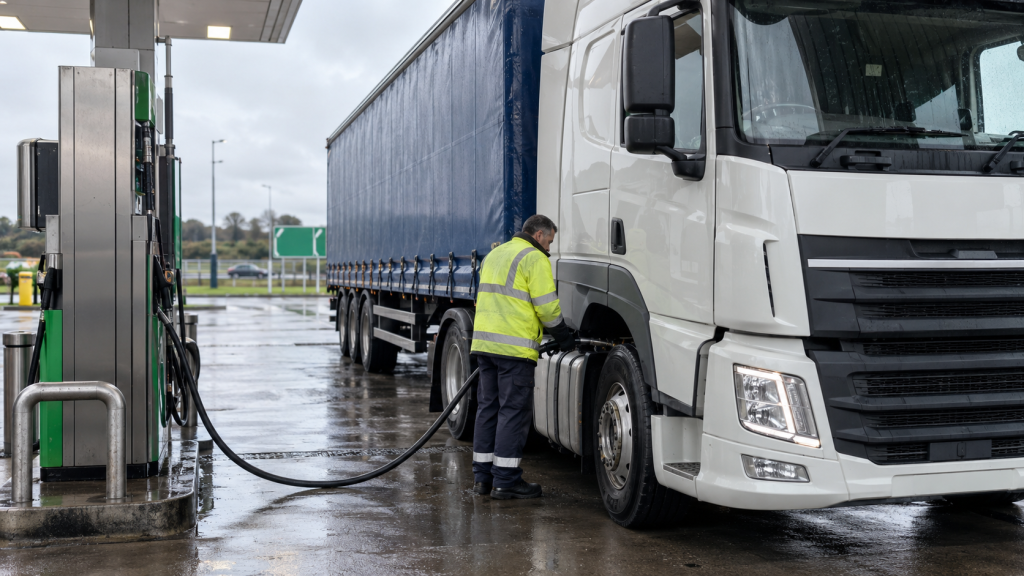
Demand for qualified HGV drivers remains strong across Ireland, creating opportunities for people seeking a new career in transport, distribution and logistics.
However, becoming a professional truck driver involves considerably more than learning how to handle a large vehicle. Drivers must understand road safety, load security, vehicle checks, tachograph rules and the regulations governing professional road transport.
Choosing the right HGV licence
The principal truck licence categories in Ireland are:
- Category C1: Vehicles weighing between 3,500kg and 7,500kg.
- Category C: Vehicles over 3,500kg, with a trailer weighing no more than 750kg.
- Category CE: A category C vehicle towing a trailer weighing more than 750kg. This is generally the licence required to drive an articulated truck.
The normal minimum age for categories C and CE is 21, although drivers may qualify from the age of 18 when they hold the appropriate Driver Certificate of Professional Competence. Full category details are available from the National Driver Licence Service.
How to become an HGV driver
Applicants must normally hold a full category B car licence before beginning the process of obtaining a category C truck learner permit.
The route to qualification generally includes:
- Passing the category C Driver Theory Test.
- Passing the Driver CPC case-study test.
- Obtaining the appropriate learner permit.
- Completing practical lessons with an experienced HGV driving instructor.
- Passing the category C practical driving test.
- Passing the Driver CPC vehicle walkaround test.
- Applying for a full licence and Driver CPC card.
A medical report is required when applying for a learner permit or driving licence in any of the C or D categories. Applicants should therefore factor a medical appointment into their training plans. Further details are available from the NDLS.
Drivers who want to operate articulated trucks will usually progress from category C to category CE.
What does practical training cover?
Professional HGV training should prepare the candidate for both the driving test and the realities of working in the transport industry.
Training normally covers vehicle control, observation, road positioning, reversing, gear selection, roundabouts and safe interaction with vulnerable road users. Candidates must also learn how a truck’s size, weight and braking characteristics affect its performance.
Vehicle inspections are another essential part of the process. Drivers need to check tyres, wheels, lights, mirrors, fluid levels, coupling equipment, load security and other safety-critical components before starting a journey.
A good training provider will also help drivers develop fuel-efficient techniques. Smooth acceleration, careful route planning, correct gear selection and anticipation of traffic conditions can reduce fuel consumption, vehicle wear and emissions.
Driver CPC requirements
Anyone driving a truck professionally must generally hold a valid Driver CPC qualification in addition to the appropriate driving licence.
New professional drivers must pass four elements: the theory test, case-study test, practical driving test and vehicle walkaround test. Once these stages have been completed and the relevant full licence has been issued, the driver can apply for a Driver CPC card.
Qualification does not mark the end of training. Professional truck drivers must complete 35 hours of periodic CPC training during each five-year cycle. This is normally completed through one seven-hour module each year with an RSA-approved training organisation.
Drivers maintaining both truck and bus CPC qualifications must complete 42 hours during the five-year cycle. Training records can be monitored through the RSA’s MyCPC portal. Full requirements are outlined by the Road Safety Authority.
Training must continue in the workplace
Passing the test provides the foundation, but employers also have an important role in developing newly qualified drivers.
Company induction should include familiarisation with specific vehicles, load-restraint procedures, delivery paperwork, route planning, working-time rules and the correct use of tachographs. New drivers may also benefit from spending time with an experienced driver before being assigned more demanding routes.
Regular refresher training is equally valuable for established drivers. Courses covering defensive driving, vulnerable road users, load security, fuel efficiency and new vehicle technology can help operators reduce collisions, fuel costs and vehicle damage.
A career with long-term potential
HGV driving can offer a rewarding career for people who enjoy responsibility, independence and working in a vital industry. Opportunities exist in general haulage, retail distribution, construction, waste management, tanker transport, refrigerated logistics and international road freight.
For prospective drivers, choosing an experienced training provider and gaining as much practical experience as possible can make the transition into employment considerably easier.
Ireland’s transport industry needs a steady supply of safe, skilled and professional drivers. Investment in high-quality HGV driver training will be essential if the sector is to meet that requirement while maintaining the highest possible standards on the road.