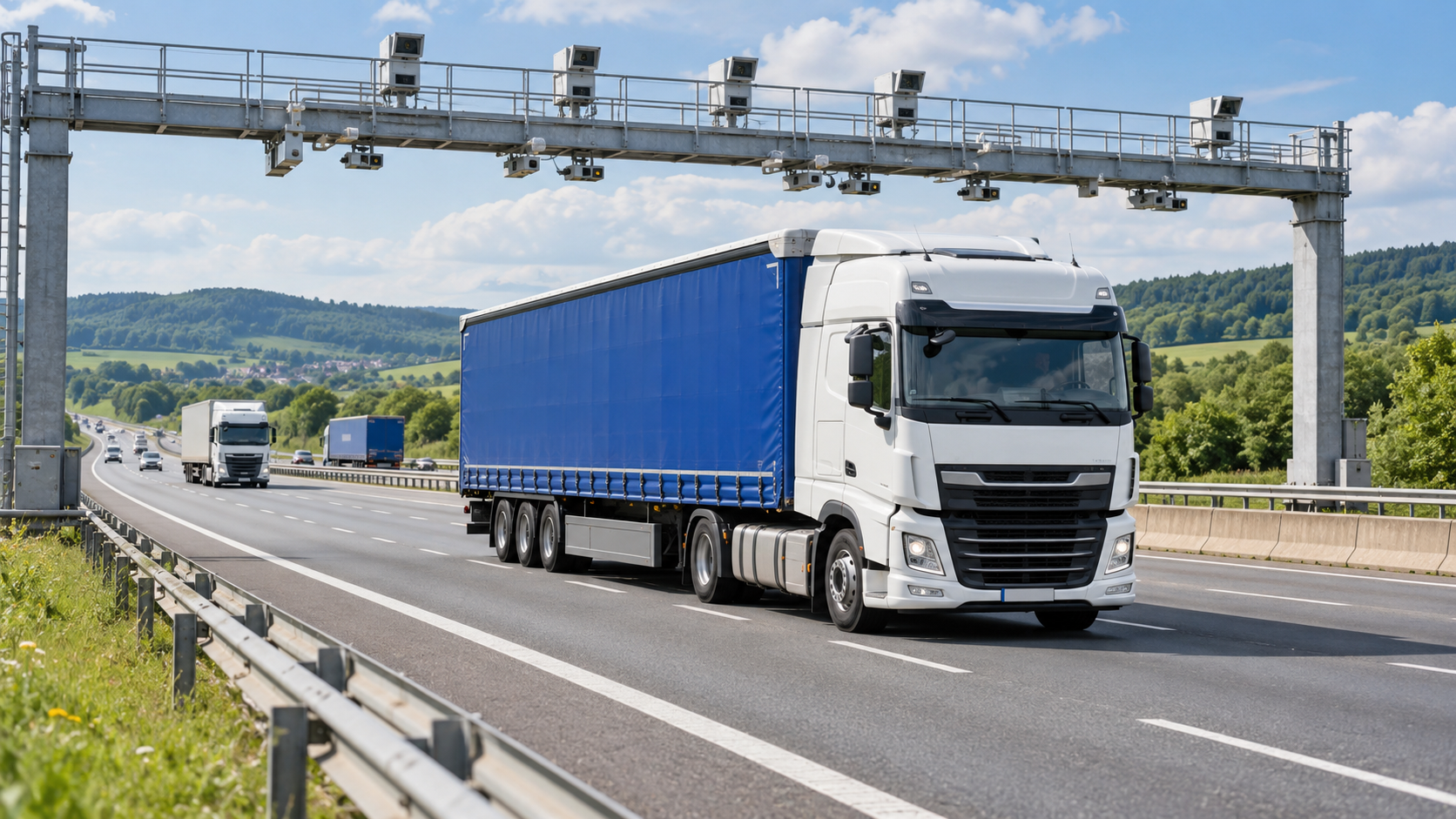
European hauliers operating zero-emission trucks could save between €11,000 and €53,000 per vehicle annually in road tolls, according to a new study examining the impact of the EU’s Eurovignette Directive.
The findings suggest that toll discounts and exemptions could play a major role in improving the financial viability of battery-electric trucks, particularly for operators engaged in international road transport.
However, the study also highlights significant differences in how European countries are implementing the Directive, creating uncertainty for hauliers planning investments in zero-emission fleets.
Toll savings could transform electric truck economics
The study, Impact of the Application of Eurovignette on Toll Savings of European Zero-Emission Trucks, examines how different approaches to road charging could influence the operating costs of electric trucks compared with conventional diesel vehicles.
Under expected implementation scenarios, a representative five-axle, N3-category battery-electric articulated truck could achieve annual toll savings of approximately €11,000 to €23,000 compared with an equivalent diesel-powered vehicle.
These savings could make a significant difference to the total cost of ownership of electric trucks, which generally remain considerably more expensive to purchase than their diesel counterparts.
For transport operators, lower toll charges could help offset higher vehicle acquisition costs and improve the business case for electrification.
Full toll exemptions could deliver €53,000 savings
The study found that the financial benefits become considerably more attractive where governments introduce full toll exemptions for zero-emission trucks.
Under this scenario, annual savings could increase to between €37,000 and €53,000 per truck, depending on the country and tolling arrangements.
The greatest potential benefits were identified in high-toll markets such as France, where road charges represent a substantial operating expense for international hauliers.
For a transport company operating ten qualifying electric trucks on heavily tolled European routes, the upper end of these estimates would translate into potential annual savings of €530,000.
However, such savings would depend on actual mileage, routes travelled and the toll exemptions available in each country.
Europe remains divided on Eurovignette implementation
Despite the potential benefits, the study reveals a fragmented approach to implementing the Eurovignette Directive across Europe.
Germany is identified as the only country examined that has already introduced a comprehensive system combining CO₂-differentiated tolling, air pollution and noise-related charges, alongside full toll exemptions for zero-emission trucks.
France and Spain have transposed the Directive into national legislation, but operational implementation remains limited, largely because of existing motorway concession agreements.
Poland is progressing towards implementation, although important legislative provisions remain under development.
This uneven approach presents challenges for international transport operators, who may encounter substantially different tolling arrangements as their vehicles cross national borders.
It also makes it more difficult to calculate the potential financial return on investments in electric trucks.
Billions could be raised to support greener freight
The study also highlights the potential for emissions-based road charging to generate substantial revenues for governments.
Charges linked to CO₂ emissions and air pollution could raise approximately €1.1 billion to €4.3 billion annually per country under the scenarios examined, with CO₂-related charges accounting for the largest proportion.
- Every key deadline: diesel rebate, fuel excise, carbon tax
- Tick-box checklist for tacho, CVRT, CPC & operator licence
- Where drivers get caught at RSA roadside checks
The study suggests that these revenues could be reinvested in measures designed to accelerate the transition towards zero-emission freight transport.
Such investment could include the development of high-capacity truck charging infrastructure, support for fleet electrification and other initiatives aimed at reducing emissions from road freight.
For hauliers, the critical question is whether additional charges imposed on diesel vehicles will be matched by meaningful investment in the infrastructure and financial supports required to make electric alternatives commercially viable.
What does this mean for Irish hauliers?
The findings have particular relevance for Irish international haulage operators travelling through Britain and continental Europe.
Irish trucks operating through France, Germany, Spain and other European markets already face significant motorway and road-user charges.
As CO₂-based tolling becomes more widespread, the difference in operating costs between diesel and zero-emission trucks could become increasingly important.
For operators running regular European routes, toll savings could eventually become a major factor when deciding whether to invest in electric vehicles.
However, the calculations are not straightforward.
Electric trucks continue to face challenges involving purchase prices, charging availability, vehicle range, payload and the time required to recharge during international journeys.
Furthermore, the toll savings identified in the study are based on modelled scenarios and should not be interpreted as guaranteed savings currently available across Europe.
For Irish hauliers, the wider issue is whether the financial incentives available abroad will be sufficient to justify the additional investment required to operate electric trucks on international routes.
Toll policy could become a deciding factor
The study reinforces the growing importance of road tolling policy in Europe’s transition towards zero-emission freight transport.
While truck manufacturers are investing heavily in battery-electric technology, governments have an equally important role in creating operating conditions that make the vehicles financially attractive.
Full toll exemptions could provide a powerful incentive, particularly for high-mileage international operators.
However, fragmented implementation risks creating a patchwork of national charging systems that complicates fleet investment decisions.
For Irish hauliers, the message is clear: the future cost of operating a truck in Europe may increasingly depend not just on fuel or electricity prices, but on how much governments charge different vehicles to use their roads.
And with potential annual toll savings reaching €53,000 per truck, Eurovignette policy could become an increasingly important consideration in the economics of European road freight.