The Irish Road Haulage Association (IRHA) and International Road Transport Union (IRU) have urged the Government to prioritise financial support for struggling hauliers, tackle late payments and push through critical EU transport legislation during Ireland’s Presidency of the Council of the European Union.
The issues were raised during a meeting in Bussels with Minister of State for International and Road Transport, Logistics, Rail and Ports, Seán Canney, as negotiations on several important pieces of European road transport legislation enter a crucial phase.
With Irish and European haulage operators facing mounting financial pressures, the IRHA and IRU stressed the need for urgent measures to protect the viability of transport businesses, particularly small and medium-sized operators.
Fuel price pressures put hauliers under increasing strain
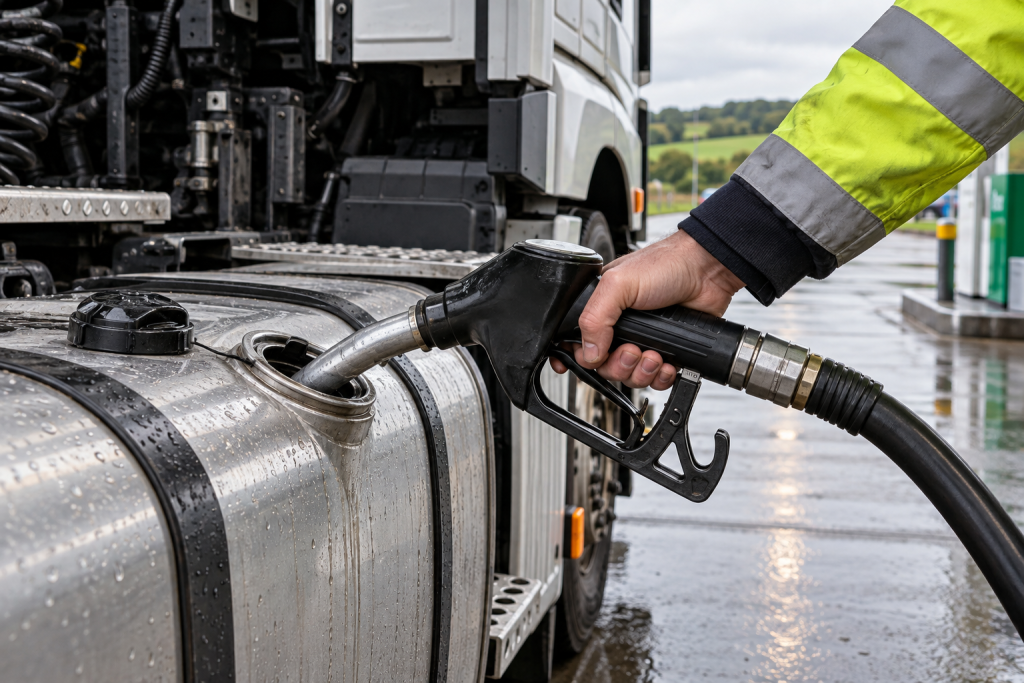
A central focus of the discussions was the difficult economic environment facing road transport operators, with rising operating costs and renewed volatility in fuel prices putting further pressure on already tight margins.
The IRU warned that many operators have increasingly limited capacity to invest in new vehicles, equipment and technology, while dramatic increases in fuel costs threaten to undermine the financial stability of businesses.
Against this background, the organisations called for an extension of the EU State Aid framework designed to respond to the current crisis.
With the existing framework approaching expiry, the IRU believes continued flexibility is essential to allow Member States to provide targeted financial assistance to transport operators.
For Irish hauliers, many of whom operate on extremely tight margins, access to such support could prove particularly important if fuel costs remain elevated.
Late payments remain a major threat to haulage businesses
The meeting also highlighted the longstanding problem of late payments for road transport services.
According to the IRU, delays in settling transport invoices deprive operators of essential working capital, restricting their ability to meet day-to-day expenses and invest in their businesses.
The organisation is advocating a dedicated EU regulation covering payment terms for road transport services, aimed at ensuring that hauliers are paid promptly for work completed.
For smaller Irish operators, who frequently face substantial upfront costs for diesel, wages, insurance, tolls and vehicle maintenance, improved payment terms could make a significant difference to cash flow.
The IRU has previously called for a maximum 30-day payment period for road transport services, arguing that predictable payments are essential to maintaining a financially sustainable industry.
Minister Canney urged to deliver agreement on truck weights and dimensions
Another major issue discussed was the long-awaited revision of the EU Weights and Dimensions Directive.
The proposed changes are intended to improve transport efficiency while removing regulatory obstacles that could discourage operators from investing in zero-emission heavy commercial vehicles.
One of the principal concerns is that battery-electric and other zero-emission trucks can carry additional weight because of their propulsion systems and associated equipment.
Without appropriate allowances, these vehicles could face a payload disadvantage compared with conventional diesel trucks.
The IRU stressed that revising the rules is essential to ensure that operators are not commercially penalised for investing in cleaner vehicles.
The organisation welcomed Minister Canney’s determination to help secure an agreement on the legislation during Ireland’s EU Presidency.
For Irish hauliers, the outcome could have important implications for future fleet investment, vehicle productivity and the economics of transitioning to alternative powertrains.
Driver training rules also on the agenda
Looking beyond the immediate financial pressures, the meeting addressed the need to modernise EU legislation governing professional driver training.
With the European road transport industry continuing to experience a serious shortage of qualified HGV drivers, the IRU believes changes to existing training requirements could help make the profession more accessible and attractive.
Minister Canney was reported to have acknowledged the need to modernise the current framework.
Reforming professional driver training could have particular significance for Ireland, where the haulage industry continues to face challenges in recruiting and retaining qualified drivers.
Irish Presidency offers opportunity to deliver for hauliers
The meeting comes at an important time for European road transport policy, with Ireland holding the Presidency of the Council of the European Union and playing a central role in advancing negotiations between Member States.
The IRHA and IRU are seeking to ensure that the concerns of working transport operators remain central to those discussions.
Irish haulier and IRHA representative Paul Jackman was among those involved in the engagement, bringing a practical operator’s perspective to the discussions.
The IRU acknowledged Jackman’s contribution and commitment to representing the interests of Irish road transport businesses at European level.
What happens next?
For Irish hauliers, the key question now is whether the discussions will translate into meaningful action.
An extension of the EU State Aid framework could provide governments with greater flexibility to support operators struggling with exceptional costs.
New EU rules on late payments could help protect cash flow, while agreement on weights and dimensions could improve transport efficiency and remove obstacles to zero-emission truck investment.
Modernising driver training requirements could also help address one of the industry’s most persistent structural problems.
The message emerging from the IRHA and IRU meeting is clear: Irish and European hauliers need more than recognition of the pressures they face. They need practical measures that protect their businesses today while giving them the confidence to invest in tomorrow.
With Ireland holding the EU Presidency, Minister Canney has an opportunity to help advance legislation that could have lasting benefits for the Irish road haulage industry.