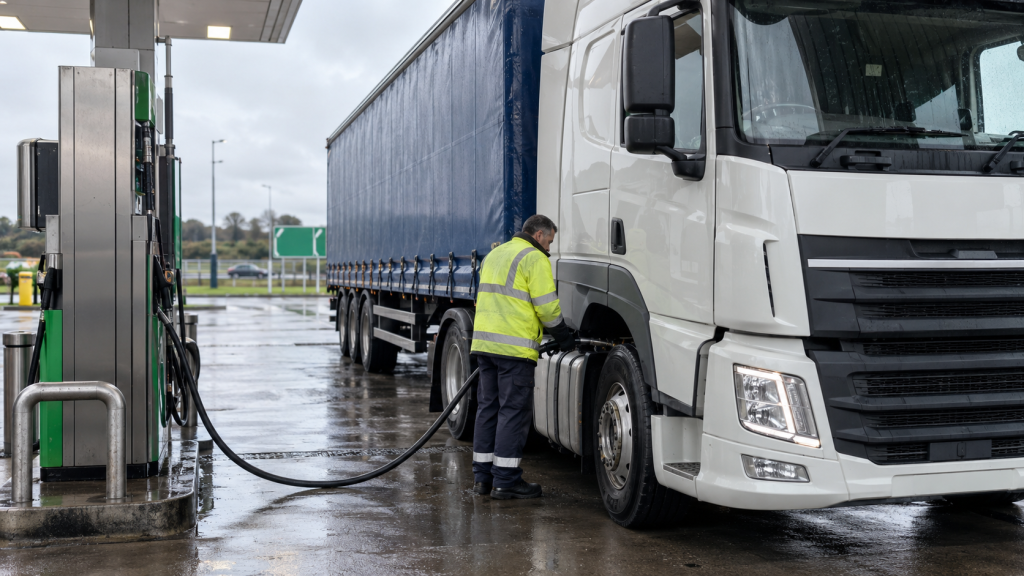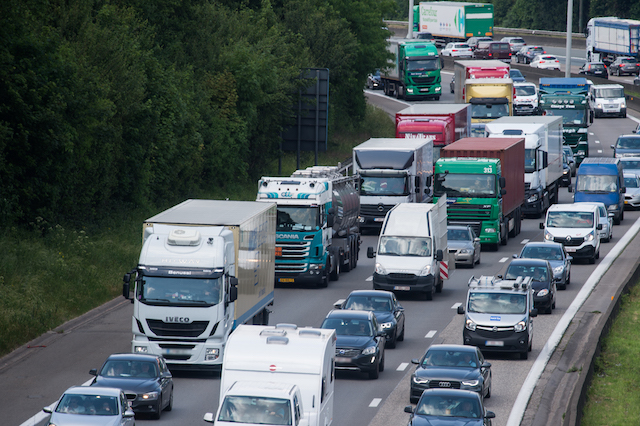
As Ireland’s haulage industry continues to grapple with high diesel costs and the enormous challenge of decarbonising heavy road transport, one question is becoming increasingly difficult to ignore: why isn’t the Government doing more to encourage hauliers to switch from fossil diesel to HVO?
Hydrotreated Vegetable Oil (HVO) offers one particularly important advantage over many other alternative fuels. Subject to vehicle manufacturer approval, it can be used in many existing diesel-powered trucks without operators having to replace their vehicles or completely rethink their refuelling infrastructure.
That potentially makes HVO an important bridge between the diesel fleet operating today and the zero-emission HGV fleet Europe ultimately wants to create.
And European policy already recognises a role for sustainable renewable fuels in reducing transport emissions.
Under the EU’s revised Renewable Energy Directive, RED III, renewable fuels and qualifying biofuels contribute towards transport renewable-energy and greenhouse-gas reduction targets, subject to strict sustainability requirements. The legislation simultaneously gives strong support to electrification, particularly where electrification is technically and economically practical.
For road haulage, therefore, the emerging picture is not necessarily HVO instead of electric trucks.
It is increasingly HVO alongside the transition to electrification, particularly for existing diesel vehicles and operations where battery-electric trucks remain difficult to deploy.
Ireland already accepts the argument
Interestingly, the Irish Government has effectively acknowledged this.
The Department of Transport commissioned an assessment specifically examining the potential role of HVO as a transitional fuel for decarbonising Ireland’s HGV sector.
Published in November 2025, the assessment states that full electrification remains the preferred pathway to zero-emission heavy transport, but examines whether greater HVO use could deliver substantial emissions reductions in the medium term.
That distinction is crucial.
Nobody seriously suggesting greater use of HVO needs to argue that Ireland should abandon electric trucks.
Instead, the question is what Ireland does with the thousands of diesel HGVs that will remain on Irish roads for many years while charging infrastructure, electricity-grid connections and zero-emission truck fleets are developed.
HVO provides an opportunity to begin reducing the lifecycle greenhouse-gas impact of suitable existing trucks immediately.
But price remains the problem
For most hauliers, however, environmental credentials cannot override commercial reality.
Fuel is one of the biggest operating costs facing a transport company. If HVO remains significantly more expensive than conventional road diesel, widespread voluntary adoption by the haulage sector will inevitably be restricted.
This is where Government policy deserves closer examination.
Ireland already gives qualifying biofuels including HVO preferential carbon-tax treatment. Revenue confirms that HVO produced from biomass is treated as a biofuel and is relieved from the carbon component of Mineral Oil Tax.
At current rates, fossil road diesel attracts Mineral Oil Tax of €371.85 per 1,000 litres, comprising a €181.81 non-carbon component and a €190.04 carbon component. A qualifying 100 per cent biofuel used instead of diesel pays the €181.81 non-carbon component but has no carbon component.
In other words, the tax system already recognises an environmental distinction between renewable HVO and fossil diesel.
The question is whether that distinction goes far enough.
Should HVO actually be cheaper than diesel?
There is a straightforward argument that Government could examine.
If Ireland wants road transport operators to reduce their dependence on fossil fuels, should a demonstrably lower-carbon renewable fuel suitable for existing trucks be made financially more attractive than fossil diesel?
For a haulage operator, the decision is ultimately made on cost per kilometre.
A company running 20, 50 or 100 trucks cannot absorb a substantial fuel premium indefinitely simply because one fuel has a lower lifecycle carbon footprint.
If Government wants operators to change behaviour, taxation could be used to strengthen the commercial incentive.
That could mean examining a targeted reduction in the remaining tax burden on qualifying HVO used by licensed road haulage operators, rather than attempting to subsidise every litre of HVO consumed throughout the economy.
Government has already identified the cost problem
There is an important caveat.
The Department of Transport’s HVO study warned that simply subsidising HVO sufficiently to equalise its price with diesel could become extremely expensive.
Its modelling estimated that a subsidy designed to achieve HVO/diesel price parity in 2030 could cost the Exchequer €502 million in that year alone. The Department also cautioned that increasing HVO consumption in the HGV sector without reforming the Renewable Transport Fuel Obligation could simply shift available biofuel away from other road users, limiting the overall emissions benefit.
Those are significant concerns.
But they do not necessarily rule out a more targeted approach for commercial road transport.
Rather than subsidising unlimited HVO consumption, Government could investigate incentives specifically aimed at licensed HGV operators, sustainable feedstocks and fuels delivering verified greenhouse-gas savings.
Ireland is already using more renewable fuel
The wider direction of policy is clear.
Ireland’s Renewable Transport Fuel Obligation increased to 32 per cent for 2026, while the combined advanced biofuel and renewable fuel of non-biological origin obligation was set at 5 per cent.
The Department of Transport says biofuels must satisfy the sustainability criteria contained in RED III, including requirements designed to ensure feedstocks do not cause significant environmental harm and that the resulting fuels achieve substantial greenhouse-gas savings compared with fossil fuels.
Ireland’s Renewable Transport Fuel Policy also explicitly includes HVO among the renewable fuels capable of contributing to the country’s transport decarbonisation objectives.
So the argument is no longer about whether renewable fuels have a role.
They already do.
The debate should increasingly be about where limited supplies of sustainable renewable fuels can deliver the greatest benefit.
HGVs make a strong case
Heavy road transport presents a particularly interesting case because replacing a diesel truck is very different from replacing a diesel passenger car.
An electric HGV represents a substantial capital investment. Operators may also need high-capacity depot chargers, upgraded grid connections and changes to vehicle scheduling.
Long-distance operations additionally depend upon the development of reliable public high-power HGV charging infrastructure.
HVO can avoid many of those immediate barriers.
A compatible truck can continue doing essentially the same job while switching away from conventional fossil diesel.
That makes HVO particularly relevant to the existing fleet during the transition.
Don’t make HVO compete with electric trucks
Perhaps the most productive way of looking at HVO is therefore not to position it against battery-electric trucks.
Ireland will need zero-emission trucks, charging infrastructure and substantial investment in the electricity network if it is to decarbonise road freight over the long term.
But fleet replacement takes time.
The more immediate choice for thousands of trucks already on Irish roads is often not between HVO and electricity.
It is between HVO and fossil diesel.
That is the comparison policymakers should consider.