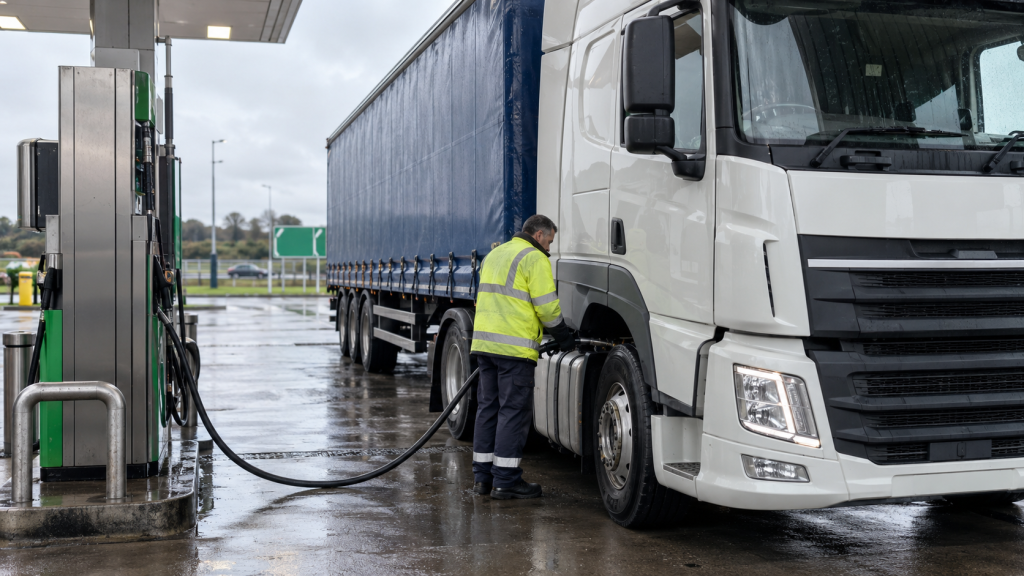
With diesel costs surging and margins being squeezed, fuel surcharges are becoming an increasingly important tool for UK transport operators — and Irish hauliers are being urged to follow suit rather than absorb spiralling fuel costs.
Fuel surcharges are increasingly being used by transport operators in the UK to pass rapidly rising diesel costs on to customers — and Irish hauliers look set to follow the same path as the fuel crisis intensifies.
With diesel representing one of the biggest operating costs for a haulage business, operators on both sides of the Irish Sea are finding that absorbing the latest increases is simply no longer sustainable.
Evidence from the UK shows how quickly fuel surcharges can move.
UK haulier BM Stafford & Sons, for example, is applying a 19 per cent fuel surcharge for the week commencing 21 September, based on bulk fuel costs. That compares with 18 per cent the previous week, 17 per cent at the beginning of September and 12 per cent in July.
Maersk has also been operating an Intermodal Fuel Fee in the UK, while DP World has retained a weekly Emergency Fuel Escalator on UK road and intermodal transport. According to The Loadstar, DP World’s escalator had climbed to 14.86 per cent by mid-September, having fallen as low as 4.72 per cent in July.
The trend is not confined to Britain. Across European road freight, rising operating costs are increasingly being passed through into contract and spot rates. The IRU reported last month that fuel had become the dominant cost driver, with operators unable to absorb the scale of diesel increases indefinitely.
Irish hauliers urged to act
Irish operators now face precisely the same commercial dilemma.
The Irish Road Haulage Association has already advised members that fuel surcharges should be reviewed against current pump and bulk diesel prices and that rates should be adjusted weekly to reflect actual fuel costs.
The IRHA’s message is clear: failing to recover increases through transparent fuel surcharges leaves the additional cost with the haulier and threatens the viability of the operation.
The Association has also warned operators involved in international transport to take account of increasing ferry fuel surcharges, including BAF charges, and to clearly identify and recharge these to customers as pass-through costs.
Hauliers cannot be expected to absorb the increase
For Irish operators, the issue is particularly acute because many are working on contracts negotiated when diesel was substantially cheaper.
A contract rate that was viable at one diesel price can quickly become loss-making when fuel rises sharply.
Operators therefore face a choice: renegotiate rates, introduce or increase a fuel surcharge, or continue absorbing the additional cost themselves.
The latter is becoming increasingly difficult to justify.
Fuel surcharges also provide a more transparent solution than repeatedly renegotiating the underlying haulage rate. A properly structured mechanism can move upwards or downwards according to an agreed diesel benchmark, allowing both haulier and customer to see exactly why the charge has changed.
That is particularly important during periods of extreme fuel-price volatility.
Customers will have to share the burden
There will inevitably be resistance from some customers, particularly where transport contracts do not contain an existing fuel-escalation clause.
But the experience in the UK and elsewhere in Europe demonstrates that the additional cost of diesel cannot simply disappear inside the transport operator’s margin.
Ultimately, somebody has to pay for it.
For Irish hauliers operating on already tight margins, continually absorbing increases in diesel prices is not a sustainable business model.
The increasingly widespread use of fuel surcharges in the UK could therefore be a sign of what is coming next in Ireland.
Rather than waiting until margins have been completely eroded, operators may increasingly have to tell customers that extraordinary movements in diesel prices must be reflected in transport charges.
The principle is straightforward: when diesel rises dramatically, the cost of moving freight rises with it.
And with fuel markets remaining volatile, a transparent, regularly reviewed fuel surcharge could become less of an optional extra and more of an essential part of doing business for Irish hauliers.