Ireland wants hauliers to invest in zero-emission trucks, but it has failed to provide the infrastructure needed to operate them.
Electric trucks are now available for urban distribution, regional deliveries and an expanding range of long-distance work. Yet Ireland still lacks a dependable national charging network designed specifically for HGVs.
That failure is actively hampering the decarbonisation of Irish road freight.
Operators cannot be expected to spend significantly more on an electric truck when they have no certainty about where it can be charged, how long charging will take or whether a suitable grid connection can be secured at their depot.
Ireland has installed thousands of charging points for electric cars, but car chargers and truck chargers are not interchangeable.
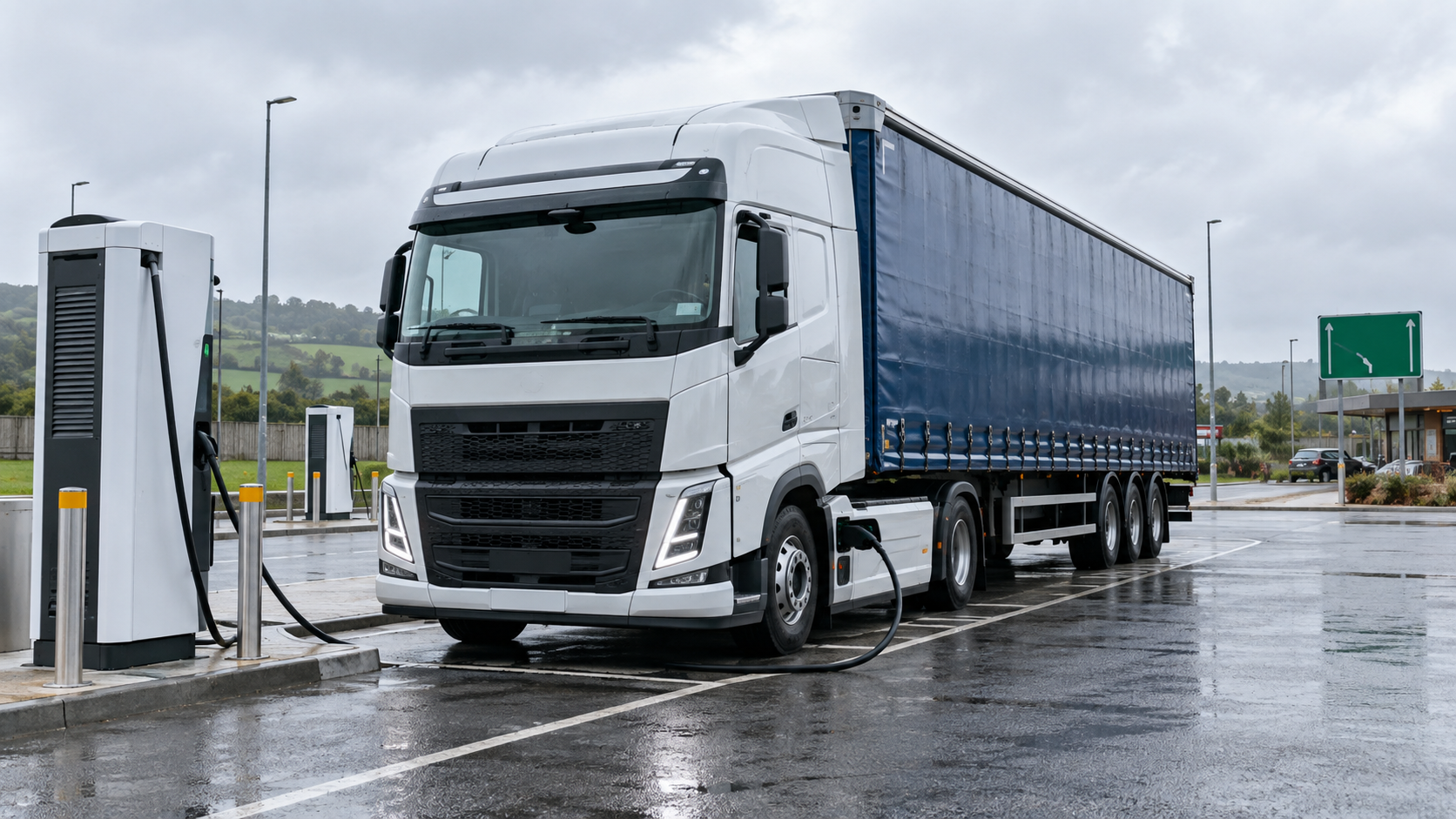
An articulated truck needs sufficient turning space, a drive-through charging bay and enough room to remain connected with its trailer attached. It also requires substantially more electricity than a passenger car.
Many public charging locations have restricted entrances, short parking bays, low canopies or layouts that are completely unsuitable for large commercial vehicles.
A charger appearing on an EV map does not mean an HGV can use it.
Hauliers are being asked to take all the risk
The Government wants transport companies to replace proven diesel vehicles with expensive new technology, yet hauliers are being left to solve the charging problem themselves.
For vehicles returning to the same depot every evening, private charging may provide part of the answer. However, even depot charging can require costly electrical work, new transformers and a major grid connection.
Securing sufficient power can take years, particularly in areas where the electricity network is already constrained.
The situation is even more difficult for long-distance operators. A truck travelling between Dublin, Cork, Galway, Belfast or Rosslare needs reliable high-powered charging along its route.
That network simply does not exist at the scale required.
Without it, an electric truck may be suitable for a carefully controlled trial but not for the unpredictable demands of general haulage.
Token funding will not build a network
The scale of the problem was exposed when it emerged in April 2026 that only €12,000 of a €1 million State allocation for zero-emission HGV charging points had been spent.
That should not be interpreted as evidence that hauliers have no interest in electric vehicles. It demonstrates that the existing approach is not working.
Operators will not buy large numbers of electric trucks without chargers. Charging companies will not invest in major truck facilities without sufficient demand. Meanwhile, electricity-network constraints can delay projects even where both sides are willing to proceed.
Government intervention is needed to break this deadlock.
Small grants for individual operators will not deliver the strategic network Ireland requires. Dedicated HGV charging hubs must be planned around freight movements rather than ordinary passenger-car traffic.
Ports and motorways must come first
Ireland urgently needs truck-compatible charging at Dublin Port, Rosslare Europort, Cork and Shannon Foynes, along with major motorway locations on the M1, M4, M6, M7, M8, M9 and N25.
These sites must offer high-capacity chargers, drive-through bays, trailer access and proper driver facilities. They must also be capable of progressing towards megawatt charging as vehicle technology develops.
Charging should be incorporated into port, motorway-service-area and logistics-park development from the beginning—not added as an afterthought.
The electricity grid must also be upgraded in advance of demand. Waiting until operators have ordered vehicles before examining local grid capacity guarantees further delays.
Targets without infrastructure are meaningless
Ireland cannot decarbonise road freight through targets, press releases and vehicle grants alone.
Transport companies make investment decisions based on whether a vehicle can complete its work reliably and profitably. If an electric truck cannot be charged at the depot, at the port or along its route, it is not a viable replacement for diesel—regardless of its environmental credentials.
Hauliers are repeatedly told that they must reduce emissions, yet many of the essential conditions remain outside their control.
They do not build the national grid. They do not control planning decisions. They cannot create public motorway charging hubs or guarantee competitive electricity prices.
The Government must stop treating charging as a problem that individual operators can solve independently.
Ireland needs a national HGV charging plan with named locations, firm delivery dates, adequate investment and clear responsibility for implementation.
Until that infrastructure is in place, the slow adoption of electric trucks should surprise nobody.
Ireland’s haulage industry is not holding up decarbonisation. The missing chargers are.