Europe’s leading truck manufacturers have warned that the conditions needed to meet the European Union’s 2030 CO₂ targets are at least three years behind schedule.
The chief executives of Europe’s seven largest truck and bus manufacturers issued the warning during a joint appearance at IAA Transportation in Hanover.
While reaffirming their commitment to the transition towards zero-emission transport, the manufacturers called for the EU’s 2030 compliance deadline to be postponed by three years.
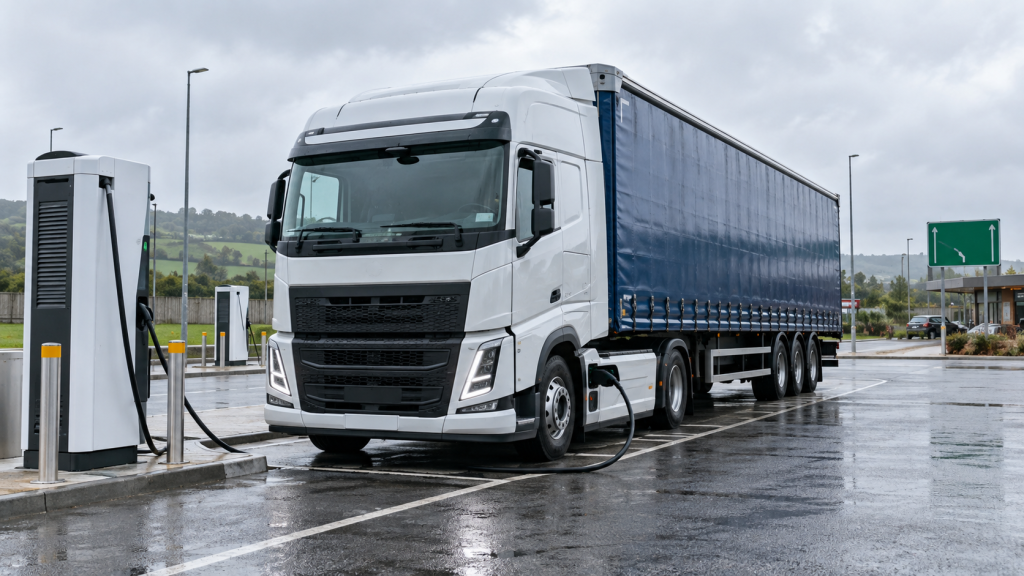
They argue that manufacturers have invested heavily in electric and hydrogen vehicles, but the charging infrastructure, grid capacity and commercial incentives needed by transport operators have failed to keep pace.
Only 2.4 per cent of new heavy-duty trucks registered across Europe are currently zero-emission. In major truck markets including Poland, Spain and Italy, the figure remains below one per cent.
Even Germany and France, Europe’s two largest truck markets, have achieved shares of only 4.3 and 2.4 per cent respectively.
Operators cannot make the figures work
The manufacturers say the central problem is not the availability of zero-emission trucks. Battery-electric and hydrogen-powered vehicles are now offered for urban, regional and some long-distance applications.
Instead, the difficulty is making those vehicles commercially viable for transport operators.
Electric trucks generally remain considerably more expensive to purchase than equivalent diesel vehicles. Operators must also contend with uncertain residual values, high electricity prices, limited public charging and lengthy delays in securing adequate grid connections for depot chargers.
Europe currently has fewer than 2,000 public charging points considered suitable for heavy trucks. ACEA estimates that at least 700 additional truck chargers would have to be installed every month to support the required transition.
Fewer than a dozen suitable hydrogen refuelling stations are operational across Europe, with some of those facing significant operational limitations.
CO₂-based road charging, which could help improve the financial case for cleaner trucks, has been effectively introduced in only four EU member states.
Changes to vehicle weights and dimensions that could compensate operators for the additional weight of zero-emission technology have also yet to be adopted.
Manufacturers face major penalties
Under EU legislation, manufacturers must reduce the CO₂ emissions of their new heavy-duty vehicle fleets by 43 per cent in 2030, 64 per cent in 2035 and 90 per cent by 2040.
Failure to meet those targets could result in penalties of €4,250 for every gram of CO₂ per tonne-kilometre by which a manufacturer exceeds its target, for every newly registered vehicle.
ACEA estimates that missing the 2030 target by only three percentage points could expose manufacturers to approximately €2.2 billion in penalties.
Karin Rådström, president and chief executive of Daimler Truck and chair of ACEA’s Commercial Vehicle Board, said manufacturers remained fully committed to sustainable transport.
“We are fully committed to sustainable transport – the investments have been made, and a wide range of CO₂-free vehicles is available today,” she said.
“But making them commercially viable at scale also depends on the wider ecosystem that is clearly delayed and not yet developing fast enough.”
She said Europe must rapidly improve the conditions supporting zero-emission trucks while delaying the compliance timetable by three years.
Implications for Irish hauliers
The warning is particularly relevant to Ireland, where the high cost of new vehicles, limited heavy-duty charging infrastructure and the nature of long-distance haulage continue to restrict the adoption of battery-electric trucks.
Irish operators cannot be expected to invest at scale unless zero-emission vehicles can compete with diesel trucks over their full working life.
That will require purchase supports, reliable depot and public charging, faster grid connections, suitable electricity tariffs and certainty over road taxes and tolls.
Truck manufacturers insist that postponing the deadline would not mean abandoning Europe’s climate objectives. They argue that imposing billions of euro in penalties will not persuade operators to purchase vehicles they cannot run economically.
Instead, they warn that the fines could divert investment away from the technology, infrastructure and production capacity required to deliver the transition.
The message from Hanover is clear: Europe’s truckmakers say the vehicles are ready, but the infrastructure and economic conditions needed to operate them are not.